
Construction Recruiter Fees in 2026: What to Budget
Contingency fees come with a shorter guarantee, usually around 90 days, and you pay only when someone starts. Retained searches bill in installments over the engagement and carry a longer guarantee, often 6 to 12 months. For most field superintendents, project managers, and mid-level office hires, contingency is the right call. Reserve retained arrangements for VP-level, executive, or highly confidential searches where exclusivity and deeper vetting matter more than speed.
Quick Reference: A $120,000 project manager hire at 22% contingency runs $26,400. That single number should anchor your staffing line item before you sign anything.
Key Takeaways
| Point | Details |
|---|---|
| Contingency fee range | Budget 20% to 25% of first-year base salary; pay only on a successful start. |
| Retained fee range | Budget 25% to 33%, billed in installments, for senior or confidential searches. |
| Guarantee norms | Contingency guarantees run about 90 days; retained guarantees run 6 to 12 months. |
| Fee base matters | Confirm whether the quote uses base salary or total compensation before comparing bids. |
| R. Construction Solutions option | Offers a prorated 90-day payment structure and lower commission rates for AEC-specific hires. |
Table of Contents
- Construction Recruiter Fees by the Numbers
- Contingency vs Retained: How Each Model Works and When to Use It
- How Recruiters Actually Calculate Fees and Common Variations
- What the Recruiter Fee Buys: Deliverables and Boundaries
- Checklist to Evaluate a Recruiter Fee Quote
- What Drives Price Differences and Realistic Timelines
- R. Construction Solutions: A Prorated Alternative to the Standard Fee Model
- Get a Written Fee Quote Before Your Next Hire
- Sources
- FAQ
Construction Recruiter Fees by the Numbers
Percentages only mean something once you attach them to a paycheck. Here’s what the typical range looks like against real construction salaries, using the industry-standard 20% to 25% contingency band as the baseline:
- $75,000 hire (foreman/estimator): $15,000 at 20%, $18,750 at 25%
- $120,000 hire (project manager/superintendent): $24,000 at 20%, $30,000 at 25%
- $200,000 hire (senior PM/director): $40,000 at 20%, $50,000 at 25%, or up to $66,000 at 33% under a retained model
Replacement guarantees typically run 90 days for contingency placements and stretch to a full year for retained searches, giving you more protection but at a steeper upfront cost. Retained fees are almost always split into thirds: one payment at signing, one at the presentation of a shortlist, and one when the candidate starts. Contingency fees, by contrast, are usually due in full at start date unless your recruiter offers a prorated structure instead.
Contingency vs Retained: How Each Model Works and When to Use It
The two models solve different problems, and mixing them up costs you either money or time.
Contingency search works like a race with a finish line. You pay nothing unless the recruiter places a candidate who starts and stays past the guarantee window. That structure keeps your risk low, but it also means the recruiter may be juggling your requisition against several other clients’ openings at once. Guarantees typically run 90 days: if the hire quits or gets fired inside that window, most recruiters will run a replacement search at no additional fee, or offer a partial refund.
Retained search works more like a consulting engagement. You commit upfront, often exclusively, and the recruiter dedicates real hours to sourcing, market mapping, and reference vetting before presenting a shortlist. This model fits searches where confidentiality matters (replacing a sitting executive) or where the pool of qualified candidates is thin enough that a passive, targeted approach beats posting a job ad.
Match the model to the role:
- Contingency fits: superintendents, project managers, estimators, safety directors, skilled trades leads, and most mid-level office roles.
- Retained fits: VPs of construction, regional directors, C-suite hires, and any search where the incumbent doesn’t know they’re being replaced.
Before signing either contract, confirm the exclusivity terms, the exact replacement window, and the payment milestones in writing. A verbal promise about a guarantee means nothing if the recruiter’s actual contract is silent on it.
How Recruiters Actually Calculate Fees and Common Variations
Most construction recruiters calculate their fee off first-year base salary, not total compensation. That distinction matters because construction pay packages often include per diem, vehicle allowances, or bonus structures that inflate total comp well above base. Salary benchmarking data is worth checking before you accept a recruiter’s number, since a fee quoted against an inflated comp figure costs you more than one quoted against base pay alone.
Here’s the typical math breakdown:
- Base calculation: $130,000 base salary × 22% fee = $28,600 total fee.
- Retained staged payment: $28,600 split into three $9,533 installments at signing, shortlist, and start.
- Prorated contingency example: If a candidate leaves after 45 days of a 90-day guarantee, a prorated contract might refund 50% of the fee, roughly $14,300 back to you, rather than the all-or-nothing refund some traditional contracts use.
Watch for add-on charges that aren’t part of the base percentage: relocation assistance, contractor markup on 1099 placements, and background check or drug screening fees are common in construction and often billed separately.
Pro Tip: Ask for the fee calculation in writing before the search starts, not after you’ve already fallen for a candidate. A one-page breakdown showing the base salary, percentage, and guarantee terms prevents disputes when the invoice arrives.
What the Recruiter Fee Buys: Deliverables and Boundaries
A construction recruiter fee isn’t just a finder’s charge. It covers a defined bundle of work, and knowing what’s included helps you spot a thin quote versus a fair one.
Core deliverables you should expect for the fee:
- Targeted sourcing and outreach to passive candidates who aren’t actively job hunting
- Initial screening calls to confirm skills, salary expectations, and availability
- Reference checks with past supervisors, not just HR contacts
- A shortlist of vetted, interview-ready candidates rather than a stack of unfiltered resumes
Some services fall outside the standard fee and get billed separately: skills testing (like OSHA 30 certification verification), relocation logistics, and payroll administration for contract or 1099 field staff. A recruiter who specializes in AEC hiring, meaning they understand ProCore experience, superintendent career paths, and union versus non-union labor markets, often charges slightly more than a generalist staffing firm. That premium usually pays for itself in fewer bad-fit hires and faster time-to-fill on niche trades.
Checklist to Evaluate a Recruiter Fee Quote
Before you sign, run every quote through the same checklist. A recruiter who balks at answering these questions in writing is telling you something.
| What to Check | Why It Matters |
|---|---|
| Exact fee percentage and base | Confirms whether the quote uses base salary or total comp |
| Guarantee length and scope | Determines your protection window if the hire doesn’t work out |
| Exclusivity terms | Clarifies whether you can use other recruiters simultaneously |
| Refund or prorate rules | Shows what happens financially if the placement falls through early |
| Billing milestones | Reveals whether payment is due at signing, shortlist, or start |
Ask for concrete proof, not just promises: recent placements in similar roles, average time-to-fill for comparable searches, and a sense of the active pipeline before you commit. A firm specializing in contingency recruiting for construction should be able to answer these without hesitation.
Red flags worth walking away from:
- Any fee charged to the candidate rather than the employer
- Vague or undocumented guarantee language (“we’ll work something out”)
- No written contract before the search begins
- Refusal to share references from past construction clients
What Drives Price Differences and Realistic Timelines
Several variables push a fee toward the top of the range or beyond it. Seniority is the biggest lever: a $200,000 director search costs more in both percentage and dollar terms than a $75,000 estimator search, because the candidate pool is thinner and the vetting is deeper. Niche skill sets, like heavy civil estimating or specialized MEP coordination, shrink the pool further and can justify fees at the upper edge of the typical 20% to 25% band or beyond it.
Geography and urgency compound the effect. Tight labor markets in metro construction hubs mean longer searches and higher fees, and a compressed timeline (fill this role in 30 days instead of 60) often carries a rush premium.
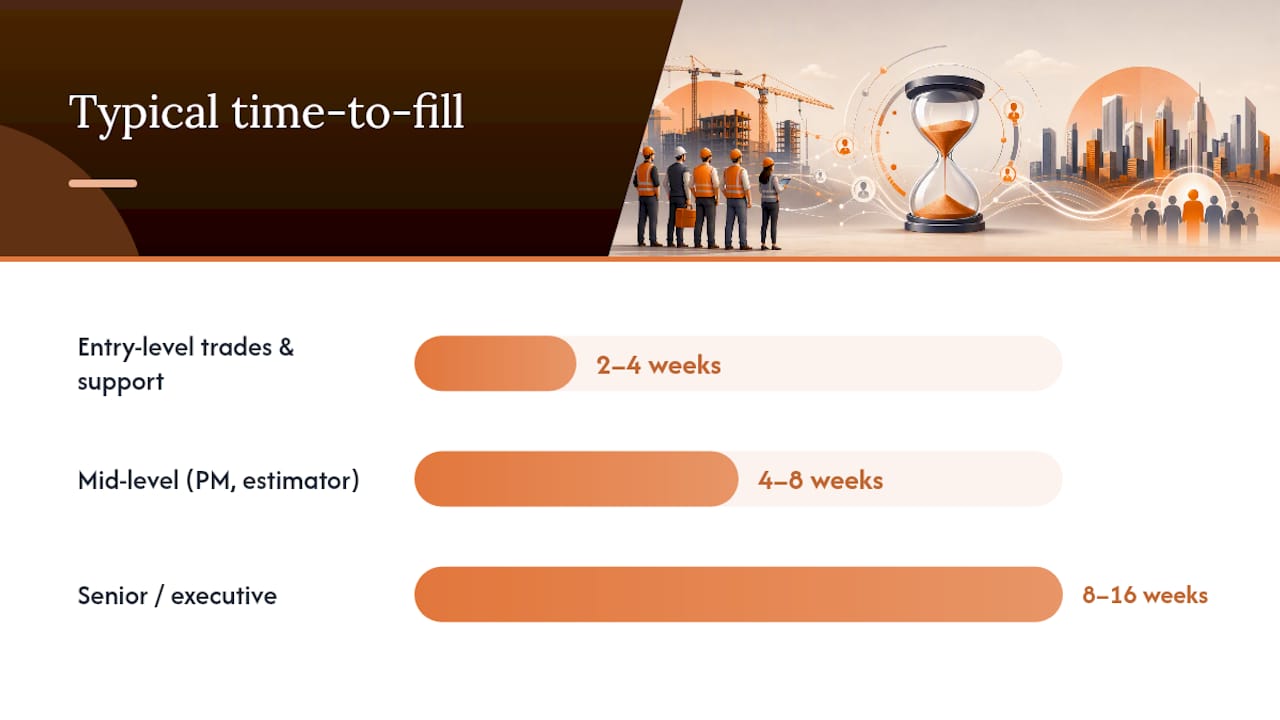
Typical time-to-fill ranges:
- Entry-level trades and office support: 2 to 4 weeks
- Mid-level (PM, superintendent, estimator): 4 to 8 weeks
- Senior/executive roles: 8 to 16 weeks, sometimes longer for retained searches
R. Construction Solutions: A Prorated Alternative to the Standard Fee Model
Most contingency contracts bill the full fee the moment a candidate starts, win or lose over the following months. Constructconnect-rconstructionsolutions structures payments differently: fees are prorated over the first 90 days rather than invoiced in one lump sum, and clients pay only for placements that actually stick, following a no placement, no fee approach at a lower commission rate than many standard contingency models.

That structure pairs with more than 30 years of AEC-specific recruiting experience, including access to pre-vetted subcontractors, suppliers, and equipment rental partners, which reduces the risk of a bad hire disrupting a project schedule. This model earns its keep most clearly on frequent repeat hires, project-based staffing surges, and roles where a mis-hire (a superintendent who can’t manage a jobsite, for example) carries a real cost beyond the recruiter fee itself.
Pro Tip: If you’re staffing multiple projects a year, ask any recruiter whether their payment structure adjusts if a hire leaves early. A prorated model protects your budget in a way a flat, all-or-nothing invoice never will.
A Hiring Manager’s Take on What Actually Matters
Cost matters less than most people think once you weigh it against time-to-hire and project risk. A cheaper recruiter who takes twice as long to fill a superintendent role can cost you more in delayed schedules than the fee difference ever saves. Prioritize a written guarantee and evidence of construction placements over a lower headline percentage. Pay more for speed or specialization when the role’s cost of failure is high.
— Rowena
Get a Written Fee Quote Before Your Next Hire
Constructconnect-rconstructionsolutions is the practical alternative to a standard contingency invoice for construction hiring managers who want cost certainty without a long-term commitment. Instead of a single lump-sum bill the day a candidate starts. You get a written quote with a prorated payment schedule spread across the first 90 days, backed by more than 30 years of AEC-only recruiting experience and access to pre-vetted subcontractor and supplier networks.

That combination means you’re not betting your entire fee on a hire’s first week on the jobsite, and you’re working with a recruiter who already knows the difference between a qualified superintendent and a resume that just sounds good. If you’re planning your next construction hire, request a written fee quote and see how the prorated structure compares to what you’re paying now.
Sources
FAQ
How Much Do Recruitment Agencies Charge for Contractors?
Agencies placing 1099 contractors or field staff typically apply the same 20% to 25% contingency range on base pay, sometimes with an added markup for payroll administration or benefits handling.
How Do Construction Recruiters Get Paid?
Most construction recruiters get paid on a contingency basis, meaning they receive their fee only after a candidate starts and passes the guarantee window; some, including Constructconnect-rconstructionsolutions, spread that payment across the first 90 days instead of billing it all at once.
What Is the Average Cost of Recruiting Per Hire?
Cost per hire varies with salary and seniority; an example calculation using a mid-range percentage fee illustrates how fees scale with base salary.
Should I Choose Contingency or Retained for My Next Hire?
Choose contingency for most field and mid-level roles like superintendents and estimators, and reserve retained searches for executive or confidential hires where exclusivity and deeper vetting outweigh the higher upfront cost.