
Contractors: Avoid a 6–12 Month Ramp, Recruit Estimators Faster
If you need a senior or chief estimator fast, work with a construction-specialist recruiter, since generic job posts rarely reach candidates who are already employed and not looking. For mid-level or entry roles, prioritize targeted passive outreach and referrals from subs and project managers before you post anything. The reason is simple: the estimator pool is shrinking, ramp time runs long, and a bad hire can cost you a bid cycle you won’t get back. Start with your referral network this week, or call a recruiter if the seat has sat open more than 30 days.
TL;DR:
- Most qualified estimators are already employed, making passive outreach, referrals, and industry events more effective than posting jobs publicly.
- Speed in offering, transparency about project backlog, and screening for documentation habits are key factors in filling estimator roles quickly and successfully.
- The estimation field faces a shrinking workforce due to retirements and slow entry, requiring proactive recruiting and early engagement before vacancies arise.
- Construction-specialist recruiters can access passive candidates, vet for judgment and documentation skills, and reduce time-to-productivity with a prorated, contingency-based fee structure.
- Rapid hiring and clear project pipeline communication can prevent losing strong candidates to competitors’ counteroffers and lengthy internal approval delays.
Table of Contents
- Why Recruiting Construction Estimators Is Unusually Hard Right Now
- Where To Find Qualified Estimator Candidates
- How Do You Screen and Interview Construction Estimators?
- Timeline To Productivity And What To Budget For Compensation
- How A Construction-Specialist Recruiter Reduces Search Risk
- What Actually Wins Estimator Searches
- How Constructconnect-rconstructionsolutions Fills Estimator Roles Faster
- Sources
- FAQ
Why Recruiting Construction Estimators Is Unusually Hard Right Now
Cost estimators held about 221,400 jobs nationally in 2024, and the Bureau of Labor Statistics projects that number to shrink 4% by 2034, even as roughly 16,900 openings appear every year from retirements and career changes. Fewer people are entering the field while the ones already in it are aging out.
That mismatch is not isolated to estimating. The Associated Builders and Contractors estimates the industry needs roughly 349,000 net new workers in 2026, mostly to backfill retirements and separations rather than growth. Estimating has its own compounding pressures on top of that broad shortage:
- Apprenticeship-style ramp time often runs a year or more before a new estimator produces reliable bids solo.
- Senior estimators carry methods and vendor relationships that were never written down.
- A third of industrial estimators are 55 or older, according to Thetakeoff, concentrating retirement risk in the exact seats hardest to backfill.
- Skills mismatch is real: strong takeoff skills don’t always come paired with bid strategy or client-facing judgment.
Statistic Callout: AGC’s 2026 Hiring and Business Outlook Report found A majority of firms are already using or plan to increase artificial intelligence adoption, with estimating flagged as one of the roles most affected. This does not mean estimators are becoming optional. Industry analysis consistently points to a human-in-the-loop pattern, where software speeds up quantity counts but a person still owns risk judgment, assumptions, and the final number that goes on a bid.
Where To Find Qualified Estimator Candidates
Most qualified estimators are already employed, so the channels that work are the ones that reach people who aren’t browsing job boards.
- Passive outreach on LinkedIn tied to project timing. Reference a competitor’s recent project completion or a public bid award when you message a candidate. Timing your outreach around a job finishing signals you understand their world, not just their title.
- Referrals from subs, suppliers, and PMs. These people know who’s sharp on a bid and who’s cutting corners. Offer a modest referral bonus, paid on the new hire’s 90 day mark, and ask specifically for names, not general leads.
- Preconstruction roundtables and estimating forums. Regional AGC chapters and industry associations run events where estimators talk shop. Showing up as a firm, not just a recruiter, builds the kind of familiarity that pays off months later.
- Targeted job boards and paid ads, used sparingly. General boards attract volume but low relevance for this role. Construction-specific boards and LinkedIn ads targeted by software proficiency (ProCore, Bluebeam, On-Screen Takeoff) perform better.
- Posting as a last resort, structured for estimator attention. If you do post, lead with project pipeline and backlog size, not generic benefits language. Estimators want to know they’re bidding real, funded work.
Pro Tip: Mention a specific software platform or a recent regional project type in the first line of your outreach message. Estimators skim fast, and a generic “exciting opportunity” opener gets ignored by people who already have a job.
Regional demand varies sharply too. Markets with heavy data center or industrial construction, like parts of the Gulf Coast and Southeast, see tighter estimator supply than general commercial markets, per theTakeoff.ai.
How Do You Screen and Interview Construction Estimators?
Screening an estimator well means testing judgment, not just software fluency. Anyone can learn a takeoff tool. Fewer people can defend a bid decision under pressure.
- Start with career gaps and motivation. Ask why they’re looking now, and listen for whether they’re running from something (bad management, stalled growth) or running toward something specific.
- Check compensation alignment early. Confirm salary range and bonus structure before a second interview to avoid wasting time on a mismatch.
- Run a bid autopsy. Ask about one bid they won that they now regret, and one they lost that still bothers them. This single prompt surfaces risk philosophy and self-awareness faster than almost any other question.
- Request a sample takeoff or short technical exercise. A timed, scaled-down takeoff on a real drawing set shows method and speed better than any resume claim.
- Ask how they document assumptions and hand off to operations. Estimators who can’t explain their handoff process to PMs create friction on every project they touch. A structured approach to detailing and disciplinary handoff is a useful reference point when you’re evaluating this.
- Call references who worked alongside them, not just their boss. Ask peers and subs about accuracy under deadline pressure.
Pro Tip: Watch for candidates who describe their estimating process as “in my head” with no backup documentation. That’s not efficiency. That’s a landmine you’ll step on the day they leave.
Timeline To Productivity And What To Budget For Compensation
Plan on 6 to 12 months before a new estimator is running bids independently at full speed, longer for complex industrial or specialty work. That ramp window is why hiring needs to start well before the seat is actually empty, not after.
Compensation bands vary by seniority and region, but most firms layer in project bonuses and vehicle or phone allowances on top of base pay to stay competitive, particularly for candidates weighing a counteroffer. A few practical levers reduce the risk of losing a signed candidate to their current employer:
- Move fast between final interview and verbal offer. Delay is the number one reason a strong candidate reconsiders.
- Share real backlog and project pipeline during the offer conversation, not just salary numbers.
- Stage a signing or 90 day bonus rather than a single lump sum, which also protects you if the hire doesn’t work out.
Statistic Callout: With roughly 16,900 estimator openings appearing annually from retirements alone, per BLS data, waiting until a seat is vacant to start recruiting puts you months behind firms that plan ahead. This is exactly where contingency or prorated recruiting fees make sense: you pay only for a completed, retained placement instead of carrying the cost of an extended vacancy.
How A Construction-Specialist Recruiter Reduces Search Risk
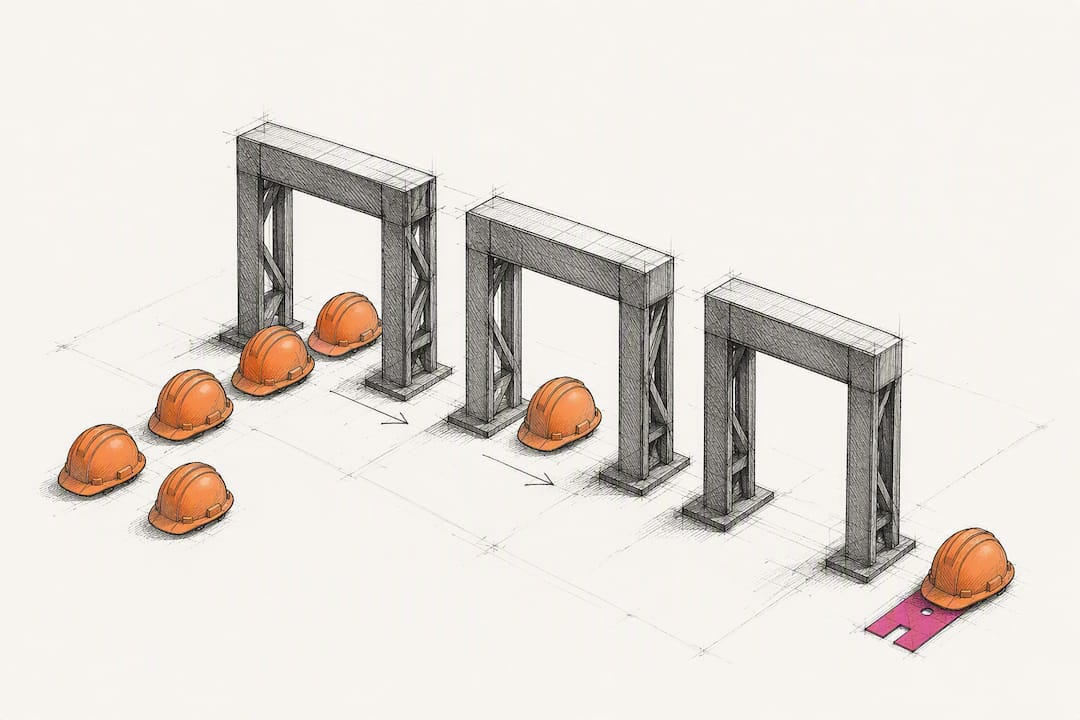
A generalist staffing firm doesn’t know the difference between a strong takeoff and a strong bid strategy. A construction-specialist recruiter does, and that distinction shapes every part of the search.
Specialist recruiters with extensive experience have built candidate networks that reach passive estimators who never touch a job board. Lower commission rates and prorated payment structures mean clients pay based on a placement actually working out, not just landing.
- Specialist recruiters run their own version of the bid autopsy screen before a candidate ever reaches your desk.
- They map candidate motivation against your project pipeline instead of matching keywords on a resume.
- They already know which candidates document their assumptions cleanly and which ones don’t.
When a senior estimator search drags past 30 days, or when the role is confidential and can’t be posted publicly, that’s the point where a specialist recruiter’s network starts paying for itself. The candidates worth hiring are rarely the ones applying to your listing.
Bring in a recruiter early on any search where the seat is critical, the role is confidential, or your internal pipeline is thin. Waiting until desperation sets in only shrinks your options.
What Actually Wins Estimator Searches
The searches that go well share a pattern: speed of offer, clarity about the project pipeline, and real vetting for how the candidate hands work off to operations. One placement that stuck with me involved a mid-size contractor who lost a strong candidate to a competitor’s counteroffer, purely because their internal approval chain took nine days to issue a verbal offer. The lesson wasn’t about compensation. It was about pace.
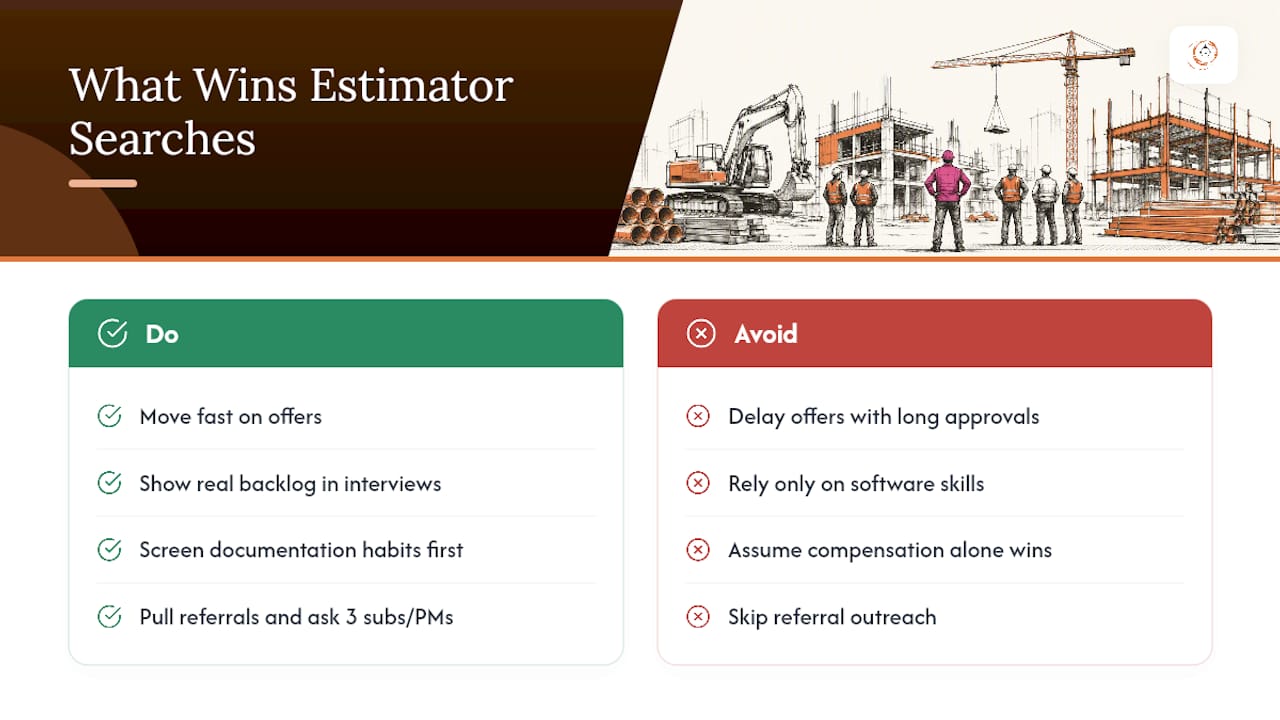
Three priorities matter more than anything else: move fast on the offer, show real backlog during interviews, and screen hard for documentation habits before you screen for software skills.
This week, pull your current referral list, ask three subs or PMs for names, and set a rule that any estimator finalist gets a verbal offer within 48 hours of a strong final interview.
— Rowena
How Constructconnect-rconstructionsolutions Fills Estimator Roles Faster
Some recruiters offer a lower cost path to filling estimator seats than a traditional staffing agency, built around a contingency model with fees prorated over the new hire’s first 90 days, so you only pay in full when the placement actually sticks. Experienced teams screen candidates against judgment and documentation standards like those described in this article, cutting down the guesswork of evaluating resumes alone.

Expect faster access to passive candidates who aren’t on job boards, pre-vetted for both technical skill and handoff habits, plus a lower overall ramp risk on a role that typically takes months to reach full speed. If you’re comparing staffing models for estimator roles, start there. When you’re ready to move, visit the recruiting services page to describe your open seat and timeline. Expect a follow-up conversation about your project pipeline before any candidates are presented.
Sources
BLS occupational data on cost estimators, ABC’s 2026 workforce shortage analysis, AGC’s 2026 Hiring and Business Outlook Report, and theTakeoff.ai’s State of Estimation survey.
- ABC: Construction industry must attract 349,000 workers in 2026
- Bureau of Labor Statistics — Cost estimators
- AGC: 2026 Construction Hiring and Business Outlook Report
- Thetakeoff
FAQ
Are Construction Estimators In High Demand?
Yes. The Bureau of Labor Statistics projects around 16,900 openings per year through 2034, driven mostly by retirements, even as total headcount in the role declines slightly.
Will Estimators Be Replaced By AI?
Unlikely in the near term. Industry analysis, including theTakeoff.ai’s survey, points to a human-in-the-loop model where software speeds up quantity takeoffs but estimators still own risk judgment and final bid decisions.
What Is The Highest Salary For An Estimator?
Compensation varies widely by region, project type, and seniority, with senior and chief estimators earning well above entry-level bands and often receiving project bonuses on top of base pay. Specific figures depend heavily on local market conditions and project complexity.
How Do Construction Recruiters Get Paid?
Most construction-specialist recruiters work on a contingency basis, meaning you pay only for a successful placement. Constructconnect-rconstructionsolutions uses a prorated structure spread across the new hire’s first 90 days, so fees track whether the placement actually works out rather than being due entirely upfront.