
Construction Estimator Staffing Solutions Comparison Guide
For most North American hiring managers, Constructconnect-rconstructionsolutions is the recommended first call when you need a vetted construction estimator. The firm’s prorated 90-day payment structure means you pay for successful placements, not just introductions, and its pre-vetted candidate pools are screened for specific software proficiency. To start, request a scoped intake call and ask for sample resumes alongside a prorated fee schedule.
Two numbers frame the urgency here. Associated Builders and Contractors projects the industry must attract 349,000 net new workers in 2026 to keep supply and demand in balance. Meanwhile, the Bureau of Labor Statistics reports construction employment is projected to grow 7% from 2024 through 2034, keeping estimator demand elevated for years. In that environment, a construction estimator staffing solutions comparison is not an academic exercise. It is a bid-capacity decision.
- Recommended first choice: Constructconnect-rconstructionsolutions for speed, pre-vetted talent, and prorated billing
- Immediate next steps: Schedule a scoped intake call; request sample candidate profiles and a written prorated fee schedule
- Key risk to manage: Paying full agency fees for a hire who leaves in 60 days; prorated terms eliminate that exposure
Table of Contents
- Which staffing model fits your estimator hiring needs?
- How do the staffing models compare on cost, speed, and fit?
- How do you vet a staffing provider before signing anything?
- What should you budget for time-to-fill and total cost?
- Which estimating tools should your next hire know?
- How does the estimator shortage affect your hiring strategy?
- Why Constructconnect-rconstructionsolutions is the recommended choice
- Key Takeaways
- Ready to fill your estimator gap without the usual hiring risk?
- FAQ
Which staffing model fits your estimator hiring needs?
The six core models each serve a different operational reality. Knowing which one matches your project cadence saves weeks of back-and-forth with providers.
- Temporary/agency placement: Fills a seat in days to two weeks. Best for surge periods, owner-driven schedule compression, or covering a departure while a permanent search runs.
- Contract/consultant: A self-employed or agency-employed estimator engaged for a defined scope. Ideal for specialty trades, design-build preconstruction, or a single large bid package.
- Contract-to-hire: Starts as a contract engagement with a defined conversion window, typically 90–180 days. Reduces hiring risk because you evaluate real work before committing.
- Direct hire: A permanent placement sourced by a recruiter. Best when estimate volume is stable and predictable, and you need someone who will own the department long-term.
- RPO (Recruitment Process Outsourcing): The provider manages part or all of your recruiting pipeline. Suited to firms opening new regions or scaling a preconstruction team rapidly.
- Fractional/project-based: A senior estimator engaged part-time across multiple clients. Works well for firms submitting fewer than 60–80 estimates annually, where a full-time salary is hard to justify.
The role of staffing agencies in construction projects differs significantly across these models, particularly in how vetting depth and fee structures are structured.
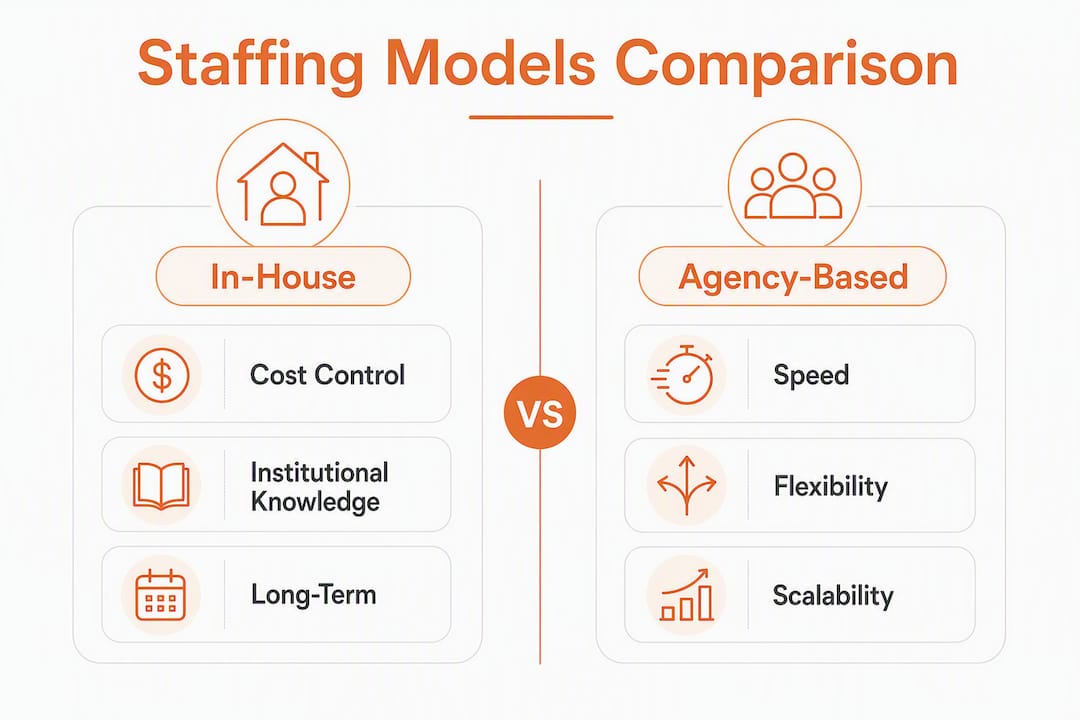
Pro Tip: Blend models deliberately. Keep one senior in-house estimator to hold institutional knowledge and bid strategy, then layer contract or fractional specialists for volume spikes. That combination protects your bid process without carrying idle salary cost year-round.
How do the staffing models compare on cost, speed, and fit?
| Model | Pricing / Fees | Time-to-Fill | Candidate Skills | Vetting & Guarantees | Best-Fit Use Case | Scalability | Geographic Coverage |
|---|---|---|---|---|---|---|---|
| Temp/Agency | Hourly markup (50–60% over base) | Days–2 weeks | General takeoff; PlanSwift, Bluebeam basics | Light screening; limited guarantees | Surge coverage, short-term gaps | High | Varies by agency |
| Contract/Consultant | Hourly rate ($65–$120/hr) | 1–4 weeks | Specialty skills; Sage Estimating, ProEst | Moderate; portfolio review | Single bid package, specialty scope | Moderate | National if remote-capable |
| Contract-to-Hire | Conversion fee (15–18% of salary) | 2–6 weeks | Full stack: BIM, Bluebeam, PlanSwift | Strong; trial period built in | Risk-averse permanent search | Moderate | Depends on provider |
| Direct Hire | Recruiter fee (15–20% of salary) | 6–8 weeks | Full stack; ProEst, Sage, RSMeans | Deep vetting; guarantee periods | Stable volume, department build | Low short-term | North America-wide |
| RPO | Monthly retainer + per-hire fee | Varies | Customized to spec | Process-level SLAs | Regional expansion, team build-out | Very high | North America |
| Fractional/Project-Based | Per-estimate ($400–$1,500) or day rate | Days–1 week | Senior-level; all major platforms | Deliverable-based accountability | Low bid volume (<60–80/yr) | High | Remote-capable, national |
Reading the table: If speed outweighs control, temp or fractional wins. If you need BIM-capable estimators with Bluebeam and ProEst proficiency for a long-term department, direct hire or contract-to-hire is the right lane. RPO makes sense only when you are building a team, not filling one seat.

How do you vet a staffing provider before signing anything?
Providers vary widely in how they screen estimator candidates. These are the documents and questions that separate credible firms from resume-forwarding services.
Documents to request before engagement:
- Anonymized work samples: a completed takeoff or bid summary from a comparable project type
- Software proficiency proof: license screenshots, certification records, or a live demo in Bluebeam, PlanSwift, ProEst, or Sage Estimating
- Client references from projects of similar size and trade scope
- Written guarantee and refund terms, including prorated payment schedules
Interview questions for providers:
- How do you source estimator candidates, and what percentage come from your existing pre-vetted pool?
- What is your average time-to-fill for a mid-level estimator in our region?
- How do you verify BIM experience and software fluency beyond a resume claim?
- What happens if a placed candidate leaves within 90 days?
Red flags: No industry-specific references, inability to produce work samples, opaque fee structures with no prorated or pay-for-success option, and no defined SLA for time-to-fill.
The project engineer hiring checklist for contractors applies many of these same vetting principles across preconstruction roles.
Pro Tip: Ask the provider to arrange a 30–60 minute paid test takeoff on a small, real scope from your current pipeline. It reveals actual software fluency, assumptions discipline, and turnaround speed faster than any interview question.
What should you budget for time-to-fill and total cost?
A fully loaded annual cost for a mid-level construction estimator commonly runs $113,000–$152,000 once benefits, software licenses, recruiting fees, and idle capacity are factored in. That 1.3x–1.5x multiplier on base salary is the number most hiring managers underestimate.
Workforce pressure stat: ABC projects 349,000 net new workers are needed in 2026 to keep the construction labor market in balance, which means estimator candidates are not sitting idle waiting for your posting.
Software seat costs alone add up fast. Common annual license costs include Bluebeam at $350–$600, PlanSwift or On-Screen Takeoff at $1,200–$2,500, RSMeans/Gordian at $1,200–$3,000, and ProEst or Sage Estimating at $2,000–$6,000. An outsourced provider absorbs those costs.
| Cost Category | In-House (Loaded) | Contract/Hourly | Outsourced Per-Estimate |
|---|---|---|---|
| Annual base salary | $113,000–$152,000 | N/A | N/A |
| Fully loaded (1.3x–1.5x) | $113,000–$152,000 | $65–$120/hr | $400–$1,500/estimate |
| Software licenses | $4,200–$6,800/yr | Typically included | Included |
| Agency/recruiter fee | 15–20% of salary | Hourly markup | Per-estimate rate |
| Break-even bid volume | 80+ estimates/yr | Flexible | <60–80 estimates/yr |
Agency hire fees for skilled trades typically run $4,200–$6,800 per placement, which is why prorated payment structures matter. Paying that fee for a hire who exits in 60 days is a real budget risk.
Which estimating tools should your next hire know?
The tools a candidate lists on a resume and the tools they can actually use under deadline pressure are often different things. Here is what to screen for and how.
- Bluebeam Revu: Digital markup and takeoff. Near-universal in commercial construction. Verify with a live session or file sample.
- PlanSwift: Drag-and-drop quantity takeoff. Common in mid-market GC and subcontractor environments.
- ProEst: Cloud-based estimating with CRM integration. Preferred by firms managing large bid pipelines.
- Sage Estimating: Enterprise-grade, often paired with Sage 300 CRE. Dominant in larger GC organizations.
- RSMeans (Gordian): The standard cost database for unit-price benchmarking. Proficiency here signals a candidate who builds defensible numbers.
Firms augmenting senior estimators with AI automation for repetitive takeoff tasks are increasing bid throughput without sacrificing judgment-level decision making. ChatGPT and similar tools can accelerate quantity drafts, standardize assumptions templates, and flag spec inconsistencies. They cannot interpret ambiguous contract language, make final bid strategy calls, or replace a senior estimator’s knowledge of local subcontractor pricing. Verify AI tool familiarity, but do not let it substitute for core software proficiency.
For construction software adoption and BIM capability benchmarks, tool verification is increasingly a baseline expectation, not a differentiator.
How does the estimator shortage affect your hiring strategy?
Industry analysts estimate 53% of the current estimator workforce will retire within a decade, and the pipeline of new entrants is not keeping pace. That is not a future problem. Firms are already losing bid capacity to retirements and finding that replacement searches take longer than they did three years ago.
Practical strategies to protect your bid operation:
- Capture institutional knowledge now: Document senior estimators’ assumptions, subcontractor preferences, and post-bid review notes into a reusable takeoff library before they leave.
- Mentor junior staff: Pair a junior estimator with a senior on every bid cycle. The learning curve compresses faster with live project exposure than with any training program.
- Cross-train field staff: Superintendents and project engineers with field cost awareness make credible estimating candidates with the right support.
- Build surge capacity through vendor relationships: Maintain a short list of pre-vetted contract estimators you can activate within a week when pipeline spikes.
- Schedule rolling capacity reviews: Tie staffing reviews to your 90-day pipeline forecast, not to the moment a seat goes empty.
Replacement costs for specialized construction staff can exceed several months’ salary and erode bid consistency during the gap. Proactive knowledge transfer is cheaper than emergency recruiting.
Pro Tip: After every major bid, have your senior estimator record a 15-minute debrief: what assumptions held, what changed, and what they would do differently. That library becomes your institutional memory when they retire.
Why Constructconnect-rconstructionsolutions is the recommended choice
Constructconnect-rconstructionsolutions brings 30+ years of AEC industry experience to every estimator search, which means the firm’s recruiters understand the difference between a candidate who lists Sage Estimating and one who has actually closed bids with it. That distinction matters when you are filling a role that directly affects revenue.
The engagement model maps directly to the evaluation criteria covered earlier:
- Speed: Pre-vetted pools mean candidate delivery in days, not weeks of cold sourcing
- Cost control: Prorated billing and lower commission rates reduce total placement cost versus standard agency fees
- Candidate quality: Verified software proficiency (Bluebeam, PlanSwift, ProEst, Sage Estimating) confirmed before introduction
- Guarantees: Pay-for-success structure with defined refund terms
- Coverage: North America-wide, with project-based and direct-hire options
A typical engagement runs: intake call to define scope and software requirements, sample candidate delivery within the agreed SLA, a short paid test takeoff to validate skills, then prorated placement billing over 90 days.
Key Takeaways
The most effective approach to construction estimator staffing is matching your bid volume and risk tolerance to the right model, then vetting providers on prorated terms, software verification, and pre-vetted candidate pools.
| Point | Details |
|---|---|
| Match model to bid volume | Firms submitting fewer than 60–80 estimates annually typically save money outsourcing rather than carrying a full-time salary. |
| Account for fully loaded cost | In-house estimators cost $113,000–$152,000 annually when benefits, software, and idle capacity are included. |
| Verify software skills concretely | Request a paid 30–60 minute test takeoff before committing to any placement or contract engagement. |
| Protect institutional knowledge | Document senior estimator judgment into reusable checklists and post-bid reviews before retirements accelerate. |
| Constructconnect-rconstructionsolutions | Offers prorated 90-day billing, pre-vetted estimator pools with verified tool skills, and North America-wide coverage. |
The case for prorated, industry-specific staffing
The conventional wisdom in construction hiring is that speed and quality trade off against each other. Hire fast and you get a warm body; hire carefully and you lose six weeks of bid capacity. That framing misses a third option: a recruiter with a pre-vetted pool who has already done the screening work.
What most hiring managers underestimate is the cost of a misfire. A standard agency fee paid on a hire who exits in 60 days is not just a sunk cost. It resets your search clock during a period when your pipeline is already moving. Prorated payment structures exist precisely to remove that exposure, and firms that insist on them negotiate from a much stronger position.
The estimator shortage is also forcing a rethink of what “qualified” means. Firms that wait for a candidate with every tool certification and ten years of experience are waiting longer than their bid schedule allows. The smarter play is a candidate with strong fundamentals and verified software fluency, supported by a structured onboarding process that transfers your firm’s specific assumptions and subcontractor relationships. This reflects both a staffing model issue and a candidate quality concern.
Ready to fill your estimator gap without the usual hiring risk?
Constructconnect-rconstructionsolutions gives hiring managers a faster path to qualified estimators than a cold job posting, with lower financial exposure than a standard agency engagement. The prorated 90-day billing structure means your fee scales with the hire’s tenure, and the pre-vetted candidate pool means you are reviewing professionals whose Bluebeam, ProEst, and Sage Estimating skills have already been confirmed.

Before your intake call, prepare your project pipeline summary, estimate volume per month, required software stack, preferred contract terms, and the North American regions where you need coverage. That information lets the team deliver relevant candidate samples on the first pass, not the third.
Request sample candidate profiles and a prorated fee schedule to start the conversation with no commitment required.
Sources and further reading
| Source | What it covers |
|---|---|
| ABC: Construction Industry Must Attract 349,000 Workers in 2026 | Labor demand projections and workforce equilibrium data |
| DocJoist: Construction Worker Shortage Statistics | Employment growth projections, JOLTS vacancy data |
| Fedes: The Real Cost of Hiring a Full-Time Construction Estimator in 2026 | Fully loaded salary analysis, software seat costs, outsourcing break-even |
| Boon AI: The Estimator Shortage Is Real | Retirement pipeline data, augmentation strategies |
| Stealth Agents: Construction Staffing Costs 2026 | Agency fee ranges, replacement cost benchmarks |
| R. Construction Solutions: Recruiting Services | Prorated placement model, pre-vetted AEC candidate pools |
| R. Construction Solutions Blog | Broader AEC staffing and recruiting resources |
FAQ
Is there a real shortage of construction estimators right now?
Yes. Industry analysts estimate 53% of the estimator workforce will retire within a decade, and new entrants are not replacing them fast enough, making pre-vetted candidate pools more valuable than ever.
How much does a construction estimator charge per hour?
Contract estimators typically bill $65–$120 per hour depending on experience and specialty, while outsourced per-estimate pricing for commercial projects generally runs $400–$1,500 per estimate based on scope complexity.
What estimating software is most commonly used in North America?
Bluebeam Revu, PlanSwift, ProEst, Sage Estimating, and RSMeans (Gordian) are the most widely used platforms. Verifying hands-on proficiency with a paid test takeoff is more reliable than a resume claim alone.
Can ChatGPT handle construction estimates?
ChatGPT can accelerate quantity drafts, standardize assumption templates, and flag spec inconsistencies, but it cannot replace a senior estimator’s contractual judgment, local subcontractor pricing knowledge, or final bid strategy decisions.
How do prorated payment terms protect hiring managers?
With a prorated structure like Constructconnect-rconstructionsolutions’s 90-day model, your recruiting fee adjusts if a placed estimator leaves early, eliminating the risk of paying a full agency fee for a hire who does not work out.