Contractors: Four Stage Hire Playbook for Construction Safety Managers
Hire a construction safety manager who holds a CHST or CSP credential, brings 5 or more years of construction safety experience, and has supervised at least one direct report. Run a structured four-stage hiring funnel rather than a single interview, and verify every credential against the BCSP registry before an offer goes out. Use the checklist below as your scorecard, or brief a contingency recruiter like Constructconnect-rconstructionsolutions to run the search for you.
TL;DR:
- Candidates should have a verified CHST or CSP credential, at least five years of construction safety experience, and supervisory experience, verified through the BCSP registry.
- The strongest safety managers are recruited through targeted channels like regional safety associations, niche job boards, and direct LinkedIn outreach, rather than traditional job postings.
- A structured four-stage interview process, including phone, technical, site walk, and reference checks, significantly improves hiring accuracy and first-year retention.
- Salary and total compensation vary depending on scope, region, and project complexity, with senior roles offering the highest pay, especially with multi-site oversight and hazardous-material project experience.
- The hiring process can be completed in about three weeks using parallel scheduling and a clear qualification checklist, with contingency recruiting offering a risk-mitigated fee structure.
Table of Contents
- How Do You Hire a Safety Manager for Construction Projects?
- What to Require on Qualifications and Credentials
- Where Do You Find Qualified Construction Safety Personnel?
- The Four-Stage Screening and Interview Funnel
- What Does a Construction Safety Manager Cost to Hire?
- The First 90 Days: Onboarding a New Safety Manager
- Safety Manager vs. Safety Coordinator: What’s the Difference?
- What Experience Level Should You Require?
- What Should You Ask in the Interview?
- Legal and Regulatory Considerations When Hiring
- What Soft Skills Matter Most in This Role?
- Common Red Flags When Hiring a Safety Manager
- Publisher Perspective: How R. Construction Solutions Approaches Safety-Manager Placements
- Let R. Construction Solutions Run Your Safety-Manager Search
- Sources
- FAQ
How Do You Hire a Safety Manager for Construction Projects?
Before you post a requisition, decide the three variables that shape everything downstream: which OSHA subpart dominates the project, what credential floor you’ll enforce, and where this role reports.
Use this quick scorecard to frame the search:
- Requisition filter. Name the dominant regulatory scope in the job title itself. A role built around 29 CFR 1926 attracts candidates who already know that world, rather than general-industry applicants who will need retraining.
- Credential and experience floor. Require CHST or CSP plus a minimum years-of-experience threshold, and don’t negotiate on both at once.
- Reporting line. Decide upfront whether this person reports to a project executive or a corporate safety director. Candidates ask this in the first five minutes, and a vague answer costs you strong applicants.
- Sourcing and timeline. Set a realistic sprint window rather than an open-ended search that drags for months.
Your baseline checklist for any finalist:
- CHST or CSP credential, verified through BCSP
- OSHA 30 (Construction) at minimum, OSHA 500 if they’ll train others
- 5+ years in construction safety, with at least one year of direct supervision
- A clean, specific answer to “walk me through your last serious incident investigation”
- Two verifiable references from a direct supervisor, not just HR contacts
What to Require on Qualifications and Credentials
Certifications separate candidates who can write a policy from candidates who can actually run one on an active site. The CHST (Construction Health and Safety Technician) is the construction-specific benchmark credential, and it should be your baseline requirement for almost any site-level hire.
For senior roles or multi-site oversight, look for the CSP (Certified Safety Professional). This is a heavier credential: it requires a bachelor’s degree and four years of safety-specific experience, and candidates who hold it are paying real money to maintain it, since the CSP exam fee runs $350 as of 2026. The ASP (Associate Safety Professional) is a reasonable signal for a candidate still building toward CSP, useful as a secondary filter rather than a hard requirement.
Beyond the alphabet soup, three training lines matter:
- OSHA 30 (Construction) should be non-negotiable for any field safety role.
- OSHA 500 matters when the person will train coordinators or crews directly.
- HAZWOPER 40-hour becomes a requirement, not a preference, the moment your projects involve soil remediation, demolition of older structures, or other hazardous-material exposure.
A Delphi study of construction hiring managers found that expert panels consistently rank education, experience, and certification as the three deciding factors in selecting safety personnel, and most panels recommended 5 to 7 years of experience as the practical floor for a safety manager role.
Pro Tip: Verify credentials directly through the BCSP registry rather than trusting a resume line or a scanned card. It takes five minutes and eliminates the candidate who “let their certification lapse” three years ago.
Where Do You Find Qualified Construction Safety Personnel?
The strongest safety managers rarely apply cold. Recruiters consistently find that many of the best construction safety officer candidates are already employed and not actively browsing job boards, which means outreach beats posting almost every time.
Prioritize these channels in order:
- ASSP local chapters and regional associations. The American Society of Safety Professionals runs regional chapters where safety managers network, mentor, and hear about openings long before they hit a job board.
- Niche job boards. EHS Careers and the BCSP career center draw a filtered pool that general job boards don’t.
- Refined LinkedIn outreach. Search by credential (CHST, CSP) and recent employer type rather than job title alone, since titles for this role vary wildly between companies.
- Internal referrals. Ask your current superintendents and project managers who they’ve worked with on past projects. A referral from a superintendent who’s seen the candidate on a live site carries more weight than any resume.
Pro Tip: When reaching out to a passive candidate, lead with project scope and authority level, not salary. Experienced safety managers get pitched on pay constantly; they respond to specifics about whether they’ll have real stop-work authority.
The Four-Stage Screening and Interview Funnel
A single 45-minute interview tells you almost nothing about how a safety manager handles a live incident. Employers who run a structured four-stage funnel report higher first-year retention and better overall fit than those relying on one or two conversations.
- Phone screen (30 minutes). Confirm their BCSP certification number on the spot, ask about the most recent OSHA-recordable incident they investigated, and check basic experience alignment.
- Technical interview (60 to 90 minutes). Have them walk through a redacted real incident from start to finish, focusing on root-cause methodology rather than the outcome.
- On-site walk. Bring them to an active site and ask them to prioritize the top three hazards they see. This stage produces the highest signal of the four, because it’s nearly impossible to fake field instinct.
- Panel debrief and references. Pull in the hiring project executive, probe past investigations directly with references, and ask specifically about program outcomes, not just character.
Set the checklist for what “good” sounds like at each stage:
- Stage 1: specific incident, specific corrective action, no vague generalities
- Stage 2: names a root-cause method (5 Whys, fishbone, or similar) without prompting
- Stage 3: identifies hazards a generalist would miss
- Stage 4: references confirm the same story the candidate told you
A three-week hiring sprint is achievable if you schedule interviews in parallel and pre-write your scorecards, running sourcing in week one, technical interviews in week two, and references and decisions in week three.
What Does a Construction Safety Manager Cost to Hire?
Safety manager salaries vary by scope, region, and project size, but industry pay reporting shows a consistent pattern: safety coordinators commonly earn mid-level salaries, safety managers earn a higher range, and safety directors overseeing multiple projects earn among the top salaries, varying by scope and region..
Factors that push pay toward the top of a band:
- Multi-site oversight responsibility
- HAZWOPER-heavy project types
- Prior supervisory or director-track experience
- Markets with active construction booms and tight safety talent pools
Total cost-to-hire includes more than salary. Recruiter fees, any relocation assistance, and a sign-on bonus for a hard-to-fill role all add up. A prorated contingency model, where fees spread across the first 90 days rather than landing as one upfront invoice, reduces the financial exposure if a hire doesn’t work out.
Offer levers that win senior candidates when salary alone won’t close the gap: a direct reporting line to leadership, real stop-work authority in writing, a paid path to CSP certification, and a defined career track toward a director role.
The First 90 Days: Onboarding a New Safety Manager
A safety manager who spends their first month buried in paperwork instead of meeting crews will struggle to build the trust the role depends on.
- Days 1 to 30: Orientation, site walks with each superintendent, and introductions to every subcontractor safety coordinator on active work.
- Days 31 to 60: Implement two or three quick wins (a corrected near-miss reporting process, a refreshed toolbox-talk schedule), and audit existing training records for gaps.
- Days 61 to 90: Deliver a consolidated site safety plan and launch a coaching cadence for coordinators, since coordinators are the ones producing the daily inspection data a manager depends on.
Track early metrics from day one: number of documented observations, corrective-action closure time, and near-miss reporting volume. A manager who can’t move these numbers in 90 days is worth a hard conversation.
Pro Tip: Ask your 60-day hire for a one-page summary of every open corrective action. If the list is vague or incomplete, that’s an early signal the follow-through won’t hold up under real pressure.
Safety Manager vs. Safety Coordinator: What’s the Difference?
A construction safety officer and a safety coordinator are not interchangeable titles, and confusing the two during a search wastes everyone’s time.
A safety coordinator works at the field level: running daily inspections, delivering toolbox talks, and logging observations. A safety manager sits above that work, turning coordinator output into program decisions. The manager hires, trains, and audits coordinators, and is accountable for whether observed hazards actually turn into corrected behavior across the whole project.
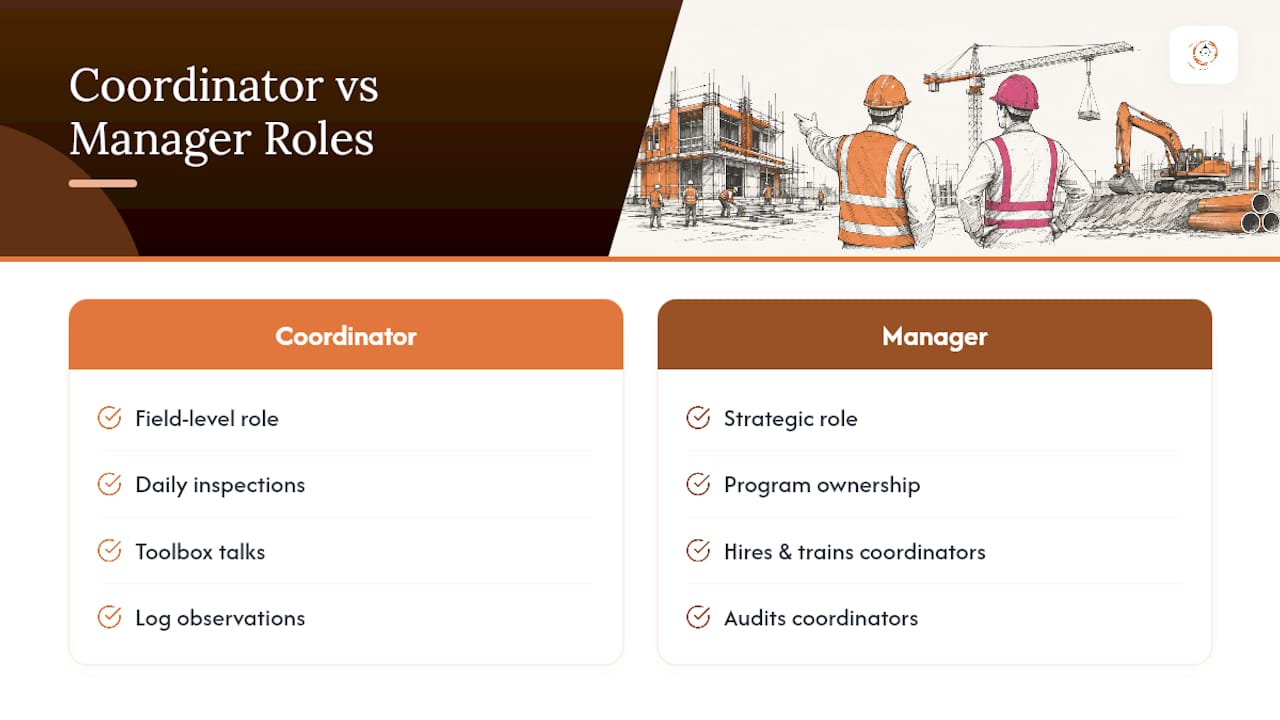
This distinction matters because the best safety managers function as strategic partners who integrate into project planning early rather than showing up only to enforce rules after the fact. A manager who influences scheduling and cost decisions before ground breaks prevents far more incidents than one who only reacts once work is underway.
If your job posting blends coordinator duties (daily inspections, toolbox talks) with manager duties (program ownership, coordinator supervision, executive reporting), you’ll attract candidates who are wrong for the actual role. Separate the postings, or at minimum, separate the requirements within one posting so applicants self-select correctly.
What Experience Level Should You Require?
Years of experience alone tells you less than the type of experience behind those years. A candidate with 8 years at one site, in one role, with no supervisory responsibility, is a different hire than someone with 5 years across three different project types and a year managing coordinators.
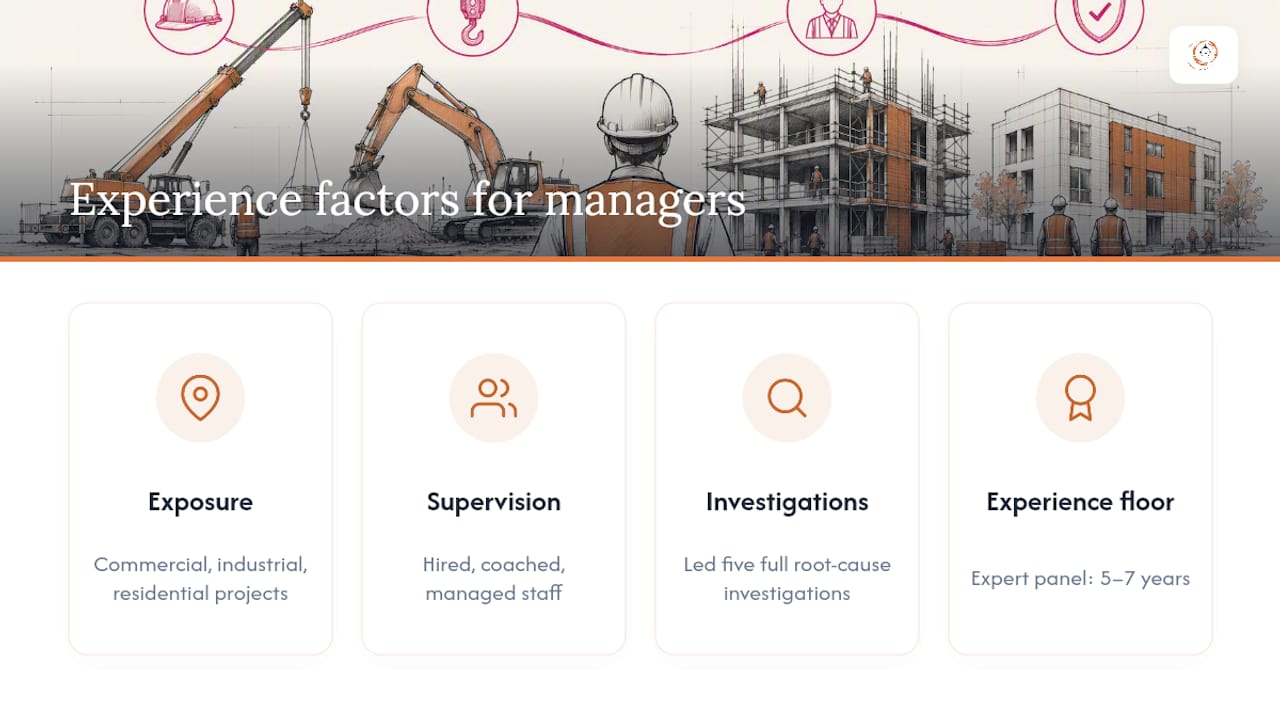
Expert panels surveyed on construction safety hiring recommend a practical floor of 5 to 7 years of construction-specific safety experience for a manager-level role. Below that, you’re generally looking at coordinator-level readiness, not manager readiness, regardless of how confident the resume sounds.
Weight these three experience factors when comparing finalists:
Multi-site exposure matters more than tenure at a single employer. A safety manager who has worked commercial, industrial, and residential projects has seen a wider range of hazard profiles than one who spent a decade on one job type, even if the single-site candidate has more total years.
Supervisory background is the differentiator between a strong coordinator and a manager ready for the title. Ask directly: how many people did they hire, coach, or manage out? A candidate who has never had to have a hard performance conversation with a coordinator hasn’t done the job you’re hiring for yet.
Incident-investigation depth reveals more than years on a resume. Someone who has led five full root-cause investigations start to finish knows more than someone who has “participated in” fifteen.
What Should You Ask in the Interview?
Generic interview questions produce generic answers. The candidates worth hiring will have specific, sometimes uncomfortable stories, and your questions should be built to surface them.
Scenario-based questions test judgment under pressure:
- “A subcontractor’s crew is behind schedule and skipping fall-protection steps you’ve flagged twice. Walk me through exactly what you do next.”
- “You find a serious hazard on a Friday afternoon that would require shutting down a critical path activity. What’s your call, and who do you notify first?”
Investigation-depth questions test whether their process is real:
- “Describe the last incident you investigated where the obvious cause turned out to be wrong. What changed your conclusion?”
- “What root-cause method do you default to, and why that one over the alternatives?”
Watch for candidates who answer these questions in generalities (“I’d assess the situation and communicate with stakeholders”) rather than specifics. A safety manager who can’t recall an actual incident, actual names of methods, and an actual corrective action isn’t ready for the authority you’re about to hand them.
Legal and Regulatory Considerations When Hiring
Hiring the wrong safety manager carries legal exposure that goes well beyond a bad fit. OSHA holds employers, not individual safety managers, accountable for compliance under 29 CFR 1926, which means the person you hire needs deep, current fluency in that specific subpart, not general industrial safety knowledge under 29 CFR 1910.
Verify that any candidate’s certifications are active and properly documented before they start. A lapsed OSHA 500 trainer credential or an unverifiable HAZWOPER card creates real liability if that person ever trains crews or signs off on hazardous-material work and an incident follows.
Confirm your new hire understands recordkeeping requirements specific to your state, since several states run their own OSHA-approved plans with additional reporting rules beyond federal minimums. A candidate coming from a state without its own plan may need a short ramp-up period on jurisdiction-specific requirements.
Document the hiring process itself. Keep records of credential verification, reference checks, and interview scorecards. If an incident ever leads to litigation, your documented due diligence in hiring a qualified safety manager becomes part of your defense.
What Soft Skills Matter Most in This Role?
Technical knowledge gets a safety manager in the door. Soft skills determine whether crews actually listen to them once they’re on site.
Communication style matters more than most hiring managers initially weight it. A safety manager who lectures crews gets ignored. One who explains the “why” behind a rule, in plain language, on the crew’s terms, gets compliance. Field credibility often outweighs a certificate-only resume, and candidates with prior trade experience speak the crew’s language and produce faster behavior change than someone whose entire background is classroom-based safety administration.
Diplomatic firmness is the trait that’s hardest to screen for and most important once the person is on the job. A safety manager needs the backbone to shut down work when it’s genuinely unsafe, even against schedule pressure from a superintendent, while staying calm enough that people don’t dread seeing them coming.
Curiosity and pattern recognition separate a good investigator from a box-checker. The best safety managers ask “why did this almost happen” even after a near-miss with no injury, rather than closing the file the moment paperwork is complete.
Look for these traits directly in your interview process: ask how they’ve handled pushback from a superintendent, and listen for whether their answer shows firmness paired with respect, not one without the other.
Common Red Flags When Hiring a Safety Manager
Some warning signs show up early, before a single interview happens. A resume with vague incident descriptions (“assisted with safety compliance”) instead of specific outcomes is worth a second look before you schedule a call.
Watch for these patterns during the process:
- Certificate collector, no field time. A candidate stacked with credentials but thin on actual site hours often struggles once real crew pushback starts.
- Can’t describe a failure. Someone who claims every safety program they’ve run was a success, with no lessons learned from a near-miss or a bad call, is either inexperienced or not being straight with you.
- Vague on authority expectations. A candidate who doesn’t ask who they report to or whether they have stop-work authority hasn’t thought seriously about how the role actually works.
- References that dodge specifics. A reference who speaks only in generalities (“great team player”) instead of a concrete example of the candidate handling a real incident is a soft reference, not a strong one.
- Salary-first conversations. This alone isn’t disqualifying, but a candidate who leads every conversation with compensation before asking about scope or authority often isn’t evaluating fit the way you need them to.
The most expensive hiring mistake in this role isn’t a slightly underqualified candidate. It’s a confident, well-credentialed candidate who talks a strong game in interviews but has never actually had to shut down active work against real resistance.
Publisher Perspective: How R. Construction Solutions Approaches Safety-Manager Placements
Our experience shows that field credibility predicts success far better than a credential list on paper. Our vetting starts with matching the candidate’s actual CFR scope experience to the project’s real hazard profile, not just checking boxes. We also work deliberately to present a candidate pool that reflects the diversity of the modern construction workforce, because the strongest safety leaders come from every background, not from one narrow profile.
— Rowena
Let R. Construction Solutions Run Your Safety-Manager Search
You can consider a prorated commission structure that spreads cost across the new hire’s first 90 days, so you’re not locked into a full fee before you know the placement is actually working out.

Before your first call, gather three things: the dominant CFR scope for your project, your reporting-line decision, and a realistic salary band based on project size. With that in hand, our team can move straight into sourcing rather than spending a first call on discovery. We draw on three decades of AEC-specific recruiting and placement experience to bring you pre-vetted candidates who’ve already cleared credential and reference checks, and our contingency recruiting model means no placement, no fee. Reach out through our recruiting services page to schedule a scoping call and get a candidate slate moving this month.
Sources
- Study identifying desired qualifications for construction safety personnel (Buildings, 2023)
- The role of a construction safety manager (Autodesk, 2025)
- How to hire construction safety manager: 2025 guide (EHS Careers)
- CSP certification details (Columbia Southern University blog)
FAQ
What Certifications Should a Construction Safety Manager Have?
CHST is the construction-specific baseline, CSP fits senior or multi-site roles, and OSHA 30 (Construction) should be non-negotiable for any field position; add OSHA 500 for trainers and HAZWOPER 40-hour for hazardous-material exposure.
How Many Years of Experience Should I Require?
Expert hiring panels recommend a practical floor of 5 to 7 years of construction-specific safety experience, with at least one year of direct supervisory responsibility.
What Does a Construction Safety Manager Typically Earn?
Safety manager salaries vary by scope, region, and project size, with safety coordinators earning mid-level salaries, safety managers a higher range, and safety directors among the top salaries, depending on scope and region.
How Long Should a Safety Manager Hiring Search Take?
A focused search using a four-stage funnel with parallel scheduling can be completed in roughly three weeks, though a broader passive-candidate search may take longer.
Should I Use a Recruiter or Hire In-House?
Using a contingency recruiter can shorten the search and reduce risk through a prorated fee model, particularly useful when internal teams lack bandwidth for passive-candidate outreach or credential verification.