
How to Hire a Construction Superintendent Who Actually Stays
The fastest reliable way to hire a construction superintendent is to write a precise, backlog-based role brief, then run targeted passive sourcing through construction-specialist recruiters and employee referrals alongside a short on-site skills assessment. With many firms reporting trouble filling these roles, expect a several-week search and a competitive pay band in the mid range. Start today by drafting a one-paragraph role brief or booking a recruiter call.
TL;DR:
- Most successful superintendent hires require a detailed, backlog-based role brief and targeted sourcing through specialist recruiters and employee referrals.
- The hiring process typically takes four to ten weeks, with competitive mid-range pay bands and a heavy reliance on passive candidate networks.
- Internal promotion works best for familiar project types, while external hiring is necessary for complex or unfamiliar projects.
- Candidates should demonstrate concrete project evidence and specific experience, with references focusing on real situational performance and problem-solving skills.
- Using a structured interview process with scoring rubrics and staged worksite assessments improves the prediction of on-site performance.
Table of Contents
- How Do You Define the Superintendent Role Before You Hire?
- Where Do You Find Qualified Superintendents?
- What Should You Check Before Interviewing a Candidate?
- How Do You Run an Interview That Predicts On-Site Performance?
- What Salary and Timeline Should You Expect?
- How Do You Onboard and Retain a New Superintendent?
- Why a Specialist Recruiter Often Beats a Solo Search
- Ready to Fill Your Superintendent Role Faster?
- Where the Numbers in This Article Come From
- Sources
- FAQ
How Do You Define the Superintendent Role Before You Hire?
Most bad superintendent hires trace back to a vague job posting. “Manages job sites” tells a candidate nothing about what they will actually run, and it tells you nothing about whether they can run it. The fix starts with matching experience to project type and scale. A superintendent who has spent a decade on tract housing will struggle on a $40 million hospital build with layered mechanical, electrical, and plumbing coordination, and the reverse is just as true.
Separate your requirements into two tiers before you post anything. Must-haves are non-negotiable: OSHA 30 certification, direct experience on projects of similar scope and dollar value, and a track record managing subcontractor crews at the size you need. Nice-to-haves are things you can train or work around, like familiarity with a specific scheduling tool or a particular subcontractor network.
Then build accountability into the offer itself by setting concrete 30/60/90-day deliverables tied to your actual backlog, not generic onboarding milestones. “Complete subcontractor buyout on the framing package by day 45” is something a candidate can evaluate and something you can measure.
Before sourcing externally, run this decision checklist:
- Does an internal project engineer or assistant superintendent already understand this specific project type and client relationship?
- Would promoting from within create a leadership gap you cannot backfill quickly?
- Is the project complex enough (fast-track schedule, unfamiliar market, high-risk trade mix) that you need proven outside experience rather than a stretch assignment?
- Can you afford the four to ten week search window an external hire typically requires, per Indeed’s hiring guidance, or does the project start date force an interim solution?
Internal promotion wins when the project resembles what your bench has already run. External hiring wins when it does not.
Where Do You Find Qualified Superintendents?
Job boards catch active candidates, but the best superintendents are usually already employed and not browsing listings. Reaching them takes a mix of channels, weighted toward the ones that surface passive talent rather than the ones that just generate volume.
- Construction-specific job boards and trade associations. Postings on association job boards and niche construction sites outperform general job boards for signal quality, even though volume is lower.
- Specialist recruiters. A recruiter who works the AEC industry daily already has a bench of vetted, passive candidates and can compress your search timeline significantly.
- Employee referrals. Your current field leaders know who is good and who is not. A structured referral bonus turns that knowledge into candidates.
- Project-site scouting. Superintendents notice other superintendents. A site visit to a competitor’s project or a subcontractor’s recommendation can surface someone months before they would ever apply anywhere.
- Trade schools, apprenticeship programs, and internal leadership tracks. These build your next generation of superintendents rather than solving this quarter’s opening, but they matter given how tight the labor market has become. The construction industry needs to attract an estimated 349,000 net new workers in 2026, and superintendent-level talent is one of the tightest layers of that pipeline.
Job posts that name the actual project type, size, and 30/60/90-day expectations attract measurably more qualified applicants than generic “superintendent wanted” listings, according to Indeed’s hiring data. If you are staffing up across multiple markets at once, the sourcing math changes further, and it’s worth reviewing staffing strategy for contractors expanding geographically.
Pro Tip: Write your job post as if you were describing the project to a peer superintendent at a bar, not to HR. Name the building type, the schedule pressure, and the trade mix. Precision reads as credibility to someone who has actually run a job site.
What Should You Check Before Interviewing a Candidate?
A resume tells you almost nothing about how someone actually runs a job. Screening exists to filter out the candidates whose paper looks fine but whose track record does not hold up under a phone call.
Watch for these red flags before you invest interview time:
- Frequent short tenures (under a year) with no clear project-completion explanation.
- Vague answers about project scope, dollar value, or subcontractor count when you ask for specifics.
- No direct answer about safety incidents or OSHA citations on projects they ran.
- Reluctance to name specific subcontractors or superintendents who can vouch for their work.
Ask for concrete portfolio evidence rather than a polished resume summary: daily reports, project photos showing progression, and a sample two-week look-ahead schedule. A candidate who ran the job will produce these without hesitation. One who managed from a distance often cannot.
References matter more here than in most hiring processes, because a superintendent’s job is almost entirely relational and situational. Call the project executive or GC owner they reported to, not just a subordinate, and ask specifically about how the candidate handled a schedule slip, a subcontractor dispute, and a safety incident. Generic “would you rehire them” questions get generic answers; specific scenario questions get honest ones.

A light practical exercise, like walking a real set of drawings and asking the candidate to sequence the next 30 days of work, reveals competence faster than any interview question.
How Do You Run an Interview That Predicts On-Site Performance?
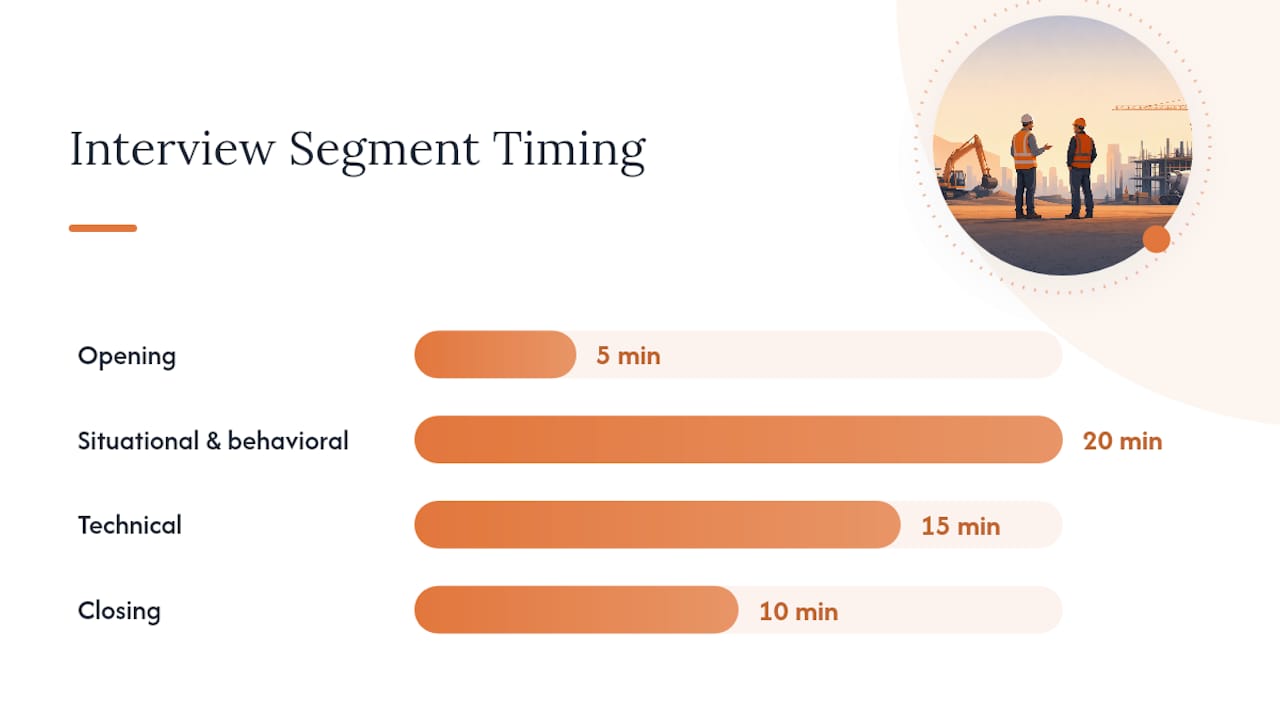
A superintendent interview should feel less like a conversation and more like a structured evaluation with a scoring rubric behind it. Build it in four timed segments so you compare candidates on equal footing rather than on how well each one happened to talk that day.
- Opening (5 minutes). Confirm project history, current availability, and compensation expectations up front so you don’t invest an hour before discovering a mismatch.
- Situational and behavioral questions (20 minutes). Ask how they handled a specific schedule crisis, a safety violation they had to enforce, or a subcontractor who fell behind. Listen for specifics, not philosophy.
- Technical questions (15 minutes). Test real knowledge: how they sequence trades on a project like yours, how they track daily reporting, and how they handle change order documentation.
- Closing (10 minutes). Cover next steps, timeline, and any questions the candidate has. Their questions here tell you a lot about what they actually care about on a job site.
For high-stakes hires, add an on-site shadow day or a staged walkthrough of an active project. Watch how they interact with subcontractors and whether they notice problems without being prompted. A candidate who walks a site and says nothing is a candidate who either isn’t paying attention or is too passive to challenge a crew that’s behind.
Score every candidate on the same rubric, weighted toward technical fit and safety judgment over likability, and set a decision rule in advance (for example, no hire below a defined threshold on the safety and technical sections). You can adapt question banks built for project manager interviews to build your own superintendent-specific scenario bank.
Pro Tip: Score candidates immediately after each interview, before you talk to the next one. Comparative memory fades fast, and the last candidate you saw always seems better in hindsight than the notes support.
What Salary and Timeline Should You Expect?
The average construction superintendent earns roughly $88,000 a year, with entry-level superintendents closer to $54,000 and experienced hires on large or complex projects reaching toward $127,000. Those figures shift by region and project sector, so validate against local job postings and recruiter intel before finalizing an offer.
Firms report an 81% difficulty rate filling superintendent roles, and the construction industry needs roughly 349,000 net new workers in 2026 to keep pace with demand. That shortage is why passive sourcing matters more than posting and waiting.
A realistic search for a qualified superintendent runs four to ten weeks when you combine active postings with recruiter-driven passive sourcing. Trying to hire on job boards alone tends to stretch well past that window, especially for niche project types.
Rather than chasing base salary upward indefinitely, most contractors win candidates with a combination of levers:
- Vehicle allowances or company trucks.
- Performance bonuses tied to schedule and budget outcomes.
- Scheduling flexibility, especially for superintendents with long commutes between projects.
- Clear promotion pathways into senior superintendent or operations roles.
If your search passes the ten-week mark with no viable candidates, that’s the signal to change strategy: bring in an interim superintendent, accelerate an internal promotion, or engage a specialist recruiter who already has passive candidates in the pipeline.
How Do You Onboard and Retain a New Superintendent?
A superintendent who feels lost in their first 90 days is a superintendent who starts taking recruiter calls by month four. Structured onboarding is retention insurance, not paperwork.
- Days 1 to 30: Introduce them to project executives, key subcontractors, and the estimating team. Walk the site together at least twice before handing over full control.
- Days 31 to 60: Assign a mentor, ideally a senior superintendent, for weekly check-ins on schedule decisions and subcontractor issues.
- Days 61 to 90: Give them staged authority over change orders and buyout decisions, then review performance against the deliverables set in the original job brief.
Beyond the first 90 days, build a development track with rotational exposure to different project types, so your superintendents grow into larger jobs instead of hitting a ceiling. Firms that treat superintendent capacity as something to develop deliberately, rather than only buy on the open market, weather the labor shortage better than those relying purely on external hiring.
Track a small set of KPIs over time: schedule variance against baseline, safety incident rate, and subcontractor turnover on their projects. These numbers tell you more about retention risk than a satisfaction survey ever will.
Pro Tip: Ask departing superintendents in exit interviews whether they felt they had a visible next step. “No clear path up” shows up constantly as an unspoken reason good superintendents leave for a competitor.
Why a Specialist Recruiter Often Beats a Solo Search
Most contractors underestimate how much of the superintendent shortage is a sourcing problem, not a supply problem. The good candidates exist. They’re just not applying anywhere, because they’re already running a job and have no reason to look.
That’s the gap Constructconnect-rconstructionsolutions is built to close. Thirty years of AEC-specific recruiting means access to a bench of passive superintendent candidates that a general hiring manager or a generic staffing agency simply doesn’t have. The prorated 90-day payment model also changes the incentive: you’re not paying full commission on a placement until that person has actually stayed and performed, which is a very different risk profile than a traditional flat-fee agency.
A specialist recruiter earns their fee on complex, high-stakes, or time-pressured searches, projects with unusual scope, tight start dates, or a market where you have no existing network. For a straightforward hire in a market you already know well, internal promotion or a well-run direct search can work fine. The value shows up most clearly in reduced time-to-fill and a lower cost of a mis-hire, which on a superintendent role can run into six figures once you count schedule delays and rework.
— Rowena
Ready to Fill Your Superintendent Role Faster?
Constructconnect-rconstructionsolutions gives you something a generic staffing agency doesn’t: recruiters who work exclusively in construction and a payment structure where you’re not writing a full check until the hire has actually proven out over 90 days. Instead of posting a job and hoping a qualified passive candidate happens to be looking, you get direct access to a pre-vetted bench of superintendents and field leaders who already match your project type and scale.

Engagement starts with a straightforward conversation: you share the role brief, the project scope, and your timeline, and Constructconnect-rconstructionsolutions matches you against candidates already vetted for the certifications, scope experience, and reference checks this article walks through. Lower and prorated commission rates mean you pay in proportion to a placement that actually sticks, not a flat fee regardless of outcome. If you want to move faster than a solo search allows, submit your role brief through the recruiting services page and get a search started this week.
Where the Numbers in This Article Come From
The workforce shortage figures cited here come from ABC’s 2026 workforce analysis, which tracks how many net new workers the industry needs to add. Salary benchmarks come from PayScale’s superintendent compensation data. Practical hiring steps, including job description framing and search timelines, draw on Indeed’s hiring guide for construction superintendents. For supervision checklists that translate into on-site assessment tasks, see this guide to construction site supervision practices.
Sources
- ABC: Construction industry must attract 349,000 workers in 2026
- Construction Superintendent Salary in 2026 | PayScale
- How to Hire a Construction Superintendent Updated 2026 | Indeed
FAQ
How much does a construction superintendent make per hour?
Converting the average annual salary of roughly $88,000 to an hourly figure varies by region and project scale, though most superintendents are salaried rather than hourly.
Is there a shortage of construction superintendents?
Yes. The construction industry needs about 349,000 net new workers in 2026, and 81% of firms report difficulty filling superintendent positions specifically.
What is the highest paid position in construction?
Pay varies widely by role and company size, but senior superintendents and operations managers overseeing multiple projects typically earn among the highest field-leadership salaries, with top reported superintendent pay approaching $127,000.
What is the average salary for a construction superintendent in the US?
The average sits around $88,000 a year, with entry-level pay closer to $54,000 and experienced superintendents on large or complex projects reaching well above the average.
How long does it take to hire a qualified superintendent?
A realistic search takes four to ten weeks when combining job postings with recruiter-driven passive sourcing, based on Indeed’s hiring guidance; relying on job boards alone often stretches well past that window.

