
How to Hire a Construction Project Coordinator in 2026
To hire a construction project coordinator right now, follow five steps: post a targeted job ad that names your tool stack, screen resumes for documented document-control experience, assign a 15–30 minute practical task, run a structured behavioral interview, and either extend an offer or engage R. Construction Solutions if your time-to-fill exceeds two weeks.
The U.S. Bureau of Labor Statistics describes project coordinators as professionals who organize project details, coordinate teams, and track schedules and documents — with education, certification, and industry-specific experience all influencing hiring preferences. Salary reports an average U.S.
Your 5-step hiring plan:
- Post: Write a job ad that names Procore, Bluebeam, and Excel, plus the project type (commercial, healthcare, infrastructure). Vague ads attract vague candidates.
- Screen: Filter resumes for explicit document-control language — RFI logs, submittal registers, change order tracking. No construction context means no interview.
- Skills task: Send a 15–30 minute practical exercise (an RFI log cleanup or a submittal tracking spreadsheet). This reveals tool literacy faster than any resume.
- Interview: Use a short behavioral rubric (covered in Section 4). Four to six questions focused on follow-up, escalation, and stakeholder communication.
- Decide: If your shortlist is thin after 10–14 days, engage a specialized AEC recruiter rather than lowering your standards.
Pro Tip: Ask every phone-screen candidate to name the version of Procore or Bluebeam they used most recently and describe one specific workflow they owned. Candidates who can answer in 30 seconds have real tool fluency; candidates who hedge do not.
Key Takeaways
Hiring a construction project coordinator requires a targeted job ad, a practical skills screen, and a realistic salary band — with a specialized AEC recruiter as the fastest fallback when internal sourcing stalls.
| Point | Details |
|---|---|
| Name your tools in the job ad | List Procore, Bluebeam, and Excel explicitly; vague ads attract unqualified applicants. |
| Use a practical screening task | A 15–30 minute RFI log or submittal exercise reveals tool fluency faster than interviews alone. |
| Set pay at market rate | The U.S. average is $102,600/year; mid-level roles typically fall in the mid-level range. |
| Plan for a 4–6 week timeline | Internal searches rarely close faster; build onboarding milestones for 30/60/90 days. |
| R. Construction Solutions as recruiter option | Contingency-based, prorated over 90 days, no fee if no placement — fastest path when sourcing stalls. |
Table of Contents
- Where should you post to find qualified coordinator candidates?
- Paste-ready job description for a construction project coordinator
- How to screen resumes and run a structured coordinator interview
- What does it cost to hire a construction project coordinator?
- What does a realistic hiring timeline look like?
- How does R. Construction Solutions vet coordinator candidates?
- What hiring managers are getting wrong in 2026
- R. Construction Solutions places pre-vetted coordinators faster
- Sources
- FAQ
Where should you post to find qualified coordinator candidates?
Sourcing channel choice determines candidate quality as much as the job description does. Each channel serves a different need, and the best hiring teams use two or three simultaneously.
- LinkedIn Recruiter: Best for mid-to-senior coordinators with documented AEC experience. Boolean search syntax like
"project coordinator" AND (Procore OR Bluebeam) AND ("RFI" OR "submittal") AND "construction"surfaces candidates who have used the right tools on real projects. Response rates are moderate, but candidate quality is high. Advertising your tool stack in the post title also attracts candidates who are actively screening employers for tech maturity. - Indeed and aggregators: High volume, lower average quality. Useful for entry-level or junior coordinator searches where you can afford to screen more broadly. Expect a higher percentage of off-target applicants.
- Niche AEC job boards (such as iHireConstruction or Construction Jobs): Smaller candidate pools, but applicants are self-selected for the industry. Time-to-fill tends to be longer, though candidate relevance is noticeably better than general aggregators.
- Local construction associations and AGC chapters: Underused by most firms. Posting on a regional Associated General Contractors (AGC) chapter board or attending a local event reaches experienced coordinators who are not actively job-hunting but are open to the right opportunity.
- Internal referrals: The fastest path to a pre-vetted candidate. A superintendent or senior PM who recommends someone has already done informal screening. Offer a referral incentive and ask your field team first.
- Specialized AEC staffing and recruiting firms: The right call when your internal search stalls, when a project ramp-up is urgent, or when you need pre-vetted candidates without spending weeks on sourcing. See Section 9 for when and how to engage one.
| Channel | Time-to-Fill | Candidate Quality | Typical Cost | Best Use Case |
|---|---|---|---|---|
| Job board (aggregator) | 2–4 weeks | Mixed | Low | Volume, entry-level |
| Professional network | 2–3 weeks | High | Low–moderate | Mid/senior, active search |
| Niche AEC board | 3–5 weeks | High | Low–moderate | Industry-specific roles |
| Contingency recruiter | 1–3 weeks | Pre-vetted | 15–25% of salary | Urgent or hard-to-fill |
| Internal referral | 1–2 weeks | High | Referral bonus only | Any level |
Pro Tip: Include the exact software versions and a one-line project example in your job post title or first sentence. Candidates in 2026 screen employers for tool maturity before they apply, and a post that reads “Procore-based commercial GC, $80M hospital project” will outperform a generic “construction coordinator needed” post every time.
For broader sourcing tactics on construction project roles, the channel mix above applies across most coordinator and PM-level searches.
Paste-ready job description for a construction project coordinator
Use the template below as a starting point. Adjust the project type, location, and compensation line before posting.
Short post variant (for Indeed, LinkedIn, aggregators):
Construction Project Coordinator | [City, State] | Commercial GC | Procore/Bluebeam We’re hiring an experienced Construction Project Coordinator to manage RFIs, submittals, change orders, and schedule tracking on active commercial projects. You’ll work directly with the project manager and field superintendent to keep documentation current and prevent field stoppages. Procore and Bluebeam experience required. 3+ years in commercial construction preferred. Salary: $85,000–$110,000 DOE.
Full ATS-friendly job description:
Job Title: Construction Project Coordinator Reports To: Project Manager Location: [City, State] / [On-site / Hybrid]
Role summary: The Construction Project Coordinator supports the project management team by owning the flow of project information from preconstruction through closeout. This role keeps documentation organized, tracks open items, and ensures field crews have what they need to stay productive.
Responsibilities:
- Manage and distribute RFI logs, submittal registers, and change order tracking
- Prepare and distribute meeting minutes within 24 hours of project meetings
- Coordinate with subcontractors and suppliers on document submittals and approvals
- Track project schedules and flag schedule variances to the PM
- Maintain organized digital and physical project files per company standards
- Support project closeout: compile O&M manuals, warranties, and as-built drawings
- Assist with vendor follow-ups, procurement logs, and material delivery tracking
Required qualifications:
- 2–5 years of experience in a construction coordinator or project administration role
- Proficiency in Procore (required), Bluebeam Revu, and Microsoft Excel
- Demonstrated experience with RFI and submittal workflows
- Strong written communication skills; ability to draft clear, concise correspondence
Preferred qualifications:
- CAPM or PMP certification (see our construction PM certification guide for context on certification value)
- Experience on projects over $10M in commercial, healthcare, or infrastructure sectors
- Familiarity with Primavera P6 or Microsoft Project for schedule review
Screening call prompts to use before the interview:
- Walk me through the last RFI log you owned. How many open items did you manage at peak?
- Which version of Procore did you use, and what modules did you work in daily?
- How did you handle a submittal that was rejected and needed resubmission under a tight deadline?
- What’s your current notice period and salary expectation?
The BLS role description confirms that coordinators need both office/clerical skills and industry-specific knowledge, which is why the qualifications list above weights construction context equally with software fluency.
How to screen resumes and run a structured coordinator interview
A structured screening process protects you from two common mistakes: advancing candidates who look good on paper but lack real tool fluency, and passing over strong candidates because their resume formatting is inconsistent.
Resume screening checklist:
- Look for explicit document-control language: “RFI log,” “submittal register,” “change order log,” “meeting minutes.” Generic project administration language without construction context is a yellow flag.
- Check for named software: Procore, Bluebeam, Autodesk Build, or equivalent. A resume that lists only “Microsoft Office” for a coordinator role is a red flag.
- Confirm project type and scale. A coordinator who has only worked on residential remodels may struggle on a $50M commercial project.
- Look for tenure patterns. Short stints at multiple firms are worth asking about, not automatically disqualifying, but they need an explanation.
- Check for any certification signals: CAPM, PMP, OSHA 10/30, or relevant continuing education.
Phone screen (6 questions, 20 minutes):
- What project types have you coordinated, and what was the largest by contract value?
- Name the Procore modules you used daily. Which did you set up vs. inherit?
- How did you track open RFIs and submittals when the PM was in the field?
- Describe a time a document error caused a field delay. What happened and what did you change?
- What’s your preferred method for keeping subcontractors accountable on submittal deadlines?
- What are your salary expectations and availability?
Practical task (15–45 minutes): Send one of the following before the panel interview:
- An RFI log with 20 entries, some missing response dates or ball-in-court assignments. Ask the candidate to clean it up and flag the three highest-risk open items.
- A submittal tracking spreadsheet with gaps. Ask them to identify what’s missing and draft a follow-up email to the responsible subcontractor.
- A short Excel schedule-check task: given a baseline and an updated schedule, identify which activities are behind and by how many days.
Scoring rubric:
| Criterion | Weight | 1 (Weak) | 3 (Meets Standard) | 5 (Strong) |
|---|---|---|---|---|
| Construction document control | 30% | No RFI/submittal experience | Managed logs with PM oversight | Owned full log independently |
| Tool fluency (Procore/Bluebeam) | 25% | Named tools only | Used core modules | Configured or trained others |
| Communication clarity | 20% | Vague or disorganized | Clear, structured responses | Concise, proactive, specific |
| Follow-through and escalation | 15% | No examples | One example with prompting | Unprompted, detailed examples |
| Cultural and project fit | 10% | Misaligned expectations | Reasonable fit | Strong alignment |
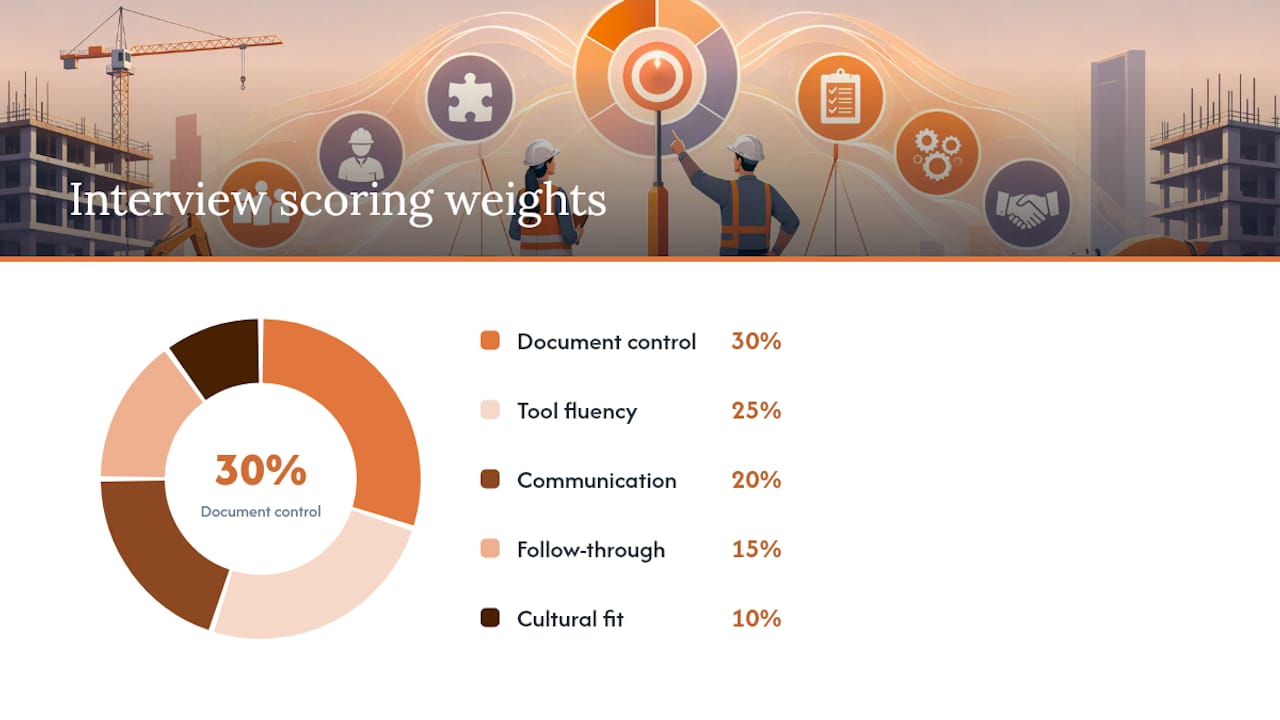
Red flags to watch for: no construction-specific experience when the role requires it; inability to name a specific software workflow; job history with multiple short stints and no explanation; salary expectations significantly above your band without a clear justification.

For a broader look at hiring pitfalls in construction, the same screening discipline applies at the PM level.
What does it cost to hire a construction project coordinator?
Pay expectations and total hiring costs are where many firms miscalibrate. Setting the right band upfront prevents offer rejections and wasted interview cycles.
North American salary bands (2026):
$102,600/year is the average U.S. Construction and Building Project Coordinator salary as of June 2026, per Salary.com, with the 25th–75th percentile range running $93,700–$114,600. A second Salary.com benchmark for the Project Coordinator – Construction title shows a nearly identical average of $102,505/year, useful for cross-checking regional offers.
Hourly vs. salaried: Contract or project-based coordinators (covering a single project phase) are typically engaged at $45–$65/hour. Full-time salaried roles make more sense when the coordinator will span multiple projects or serve as a permanent team member.
On a $100,000 placement, that’s $15,000–$25,000. R. Construction Solutions’ prorated model spreads that fee across the first 90 days of employment, so you’re not paying the full amount before the hire has proven out. If the placement doesn’t hold, you don’t pay for a failed search.
In-house hiring costs include job board fees, HR staff screening time, and manager interview time. Internal costs for filling a role over several weeks typically total thousands of dollars before the new hire’s first day, excluding lost productivity while the position remains open.
What does a realistic hiring timeline look like?
Most construction firms underestimate how long a coordinator search takes when done internally. Here’s a realistic milestone map:
- Week 1: Finalize job description, post to LinkedIn, Indeed, and one niche AEC board. Activate internal referral ask.
- Week 2: First resume review. Conduct phone screens with 5–8 candidates. Send practical task to top 3.
- Week 3: Review practical task results. Schedule panel interviews with 2–3 finalists.
- Week 4: Complete panel interviews. Check references on top candidate. Extend offer.
- Weeks 5–6: Notice period and start date negotiation. Prepare onboarding materials.
- Days 1–30: Account access (Procore, Bluebeam, shared drives, email), document workflow orientation, first-week deliverable (audit of one active RFI log).
- Days 31–60: Independent ownership of one project’s document control. Weekly check-ins with PM.
- Days 61–90: Full productivity on assigned projects. Performance review against scorecard criteria.
Onboarding checklist:
- Grant access to all PM software, shared drives, and communication platforms on Day 1
- Assign a specific project file to audit and reorganize in the first week
- Pair the new coordinator with an experienced PM for 7–10 days of shadowing
- Define the first 30-day deliverable clearly in writing before the start date
- Schedule a 30-day check-in to address workflow gaps before they become habits
Pro Tip: The 7–10 day shadowing period with a senior PM transfers more institutional knowledge than any onboarding document. Have the new coordinator attend every subcontractor call and RFI review during that window. The tribal knowledge they absorb in that period shortens the full ramp by weeks.
For a detailed PM onboarding framework that adapts directly to coordinator roles, the 30/60/90-day structure applies at both levels.
How does R. Construction Solutions vet coordinator candidates?
The scorecard below reflects the evaluation standard R. Construction Solutions applies when sourcing and vetting construction project coordinator candidates. You can adopt it directly for your own hiring process.
| Evaluation Axis | Weight | What to Look For |
|---|---|---|
| Construction document control | 30% | Owned RFI logs, submittal registers, change order tracking on real projects |
| Tool fluency | 25% | Named software with specific module experience (Procore, Bluebeam, Excel) |
| Communication and follow-through | 20% | Evidence of proactive stakeholder updates and escalation without prompting |
| Domain specialization | 15% | Sector match (commercial, healthcare, infrastructure) per APMIC’s 2026 outlook |
| Cultural and project fit | 10% | Alignment with project scale, team structure, and pace |
Vetting workflow:
- Resume screen against the checklist in Section 4
- 20-minute phone screen using the six-question script
- Practical task (RFI log or submittal exercise, 15–30 minutes)
- Panel interview with PM and superintendent (or equivalent)
- Reference check focused on follow-through and document ownership
- Offer with prorated 90-day fee structure if placed through R. Construction Solutions
Pro Tip: During reference checks, ask specifically: “Can you describe a time this candidate caught a documentation gap before it reached the field?” A reference who can answer that question with a real example is confirming the single most valuable coordinator skill. A reference who gives only general praise is not confirming it.
What hiring managers are getting wrong in 2026
The construction coordinator market has shifted in ways that most job postings have not caught up with yet. Candidates with genuine Procore fluency and sector-specific experience now screen employers as carefully as employers screen them. A job post that lists “Microsoft Office” as the primary software requirement, or that describes the role in generic administrative terms, signals to experienced coordinators that the firm is behind on technology and workflow maturity.

The APMIC 2026 industry outlook confirms that demand is clustering around specialized sectors, including construction and infrastructure, and that candidates are strengthening domain-specific signals like certifications and tool fluency. The implication for hiring managers is direct: if your job ad does not reflect the same specificity, you will attract the candidates who could not get the roles that did.
There’s also a tendency to treat the coordinator role as a support position that can be filled quickly with a generalist. That framing is expensive. A coordinator who cannot own an RFI log independently forces the PM to absorb that work, which is exactly the productivity drain the hire was supposed to prevent. Vetting for technical document control skill, not just organizational ability, is the difference between a hire that pays off in 30 days and one that requires six months of hand-holding.
One more pattern worth naming: firms that delay hiring until a project is already in trouble. High-performing construction companies bring coordinators on before critical project phases, when there is still time to integrate them into document workflows and vendor relationships. Hiring reactively, after the RFI backlog has grown, puts the new coordinator in a recovery position from day one.
R. Construction Solutions places pre-vetted coordinators faster
When your internal search stalls or a project ramp-up won’t wait six weeks, R. Construction Solutions offers a direct path to pre-vetted construction project coordinator candidates. With 30+ years in the AEC industry, the firm sources candidates who already have documented Procore experience, sector-specific backgrounds, and verifiable document-control track records — not generalists who learned the term “RFI” from your job post.

The fee structure is built for how construction firms actually work: contingency-based, so you pay nothing if no placement is made, and prorated across the first 90 days of employment rather than billed as a lump sum on day one. Commission rates run lower than the industry standard, and the prorated model means your financial exposure scales with the hire’s actual performance. For firms that need AEC recruiting services without the risk of a failed search, that structure matters.
When to make the call:
- Your shortlist is thin after 10–14 days of active posting
- You need a coordinator on-site within three weeks for a project start
- You’ve had two or more offer rejections and need a fresh candidate pool
Contact R. Construction Solutions to discuss your coordinator search, confirm turnaround time, and review the vetting workflow before committing to an engagement.
Sources
The figures and role guidance in this article draw from the following sources. Use them to validate salary offers against your region and to confirm role scope before finalizing a job description.
Regional salary variation is real. Use these benchmarks as a starting point, then adjust for your metro area, project scale, and whether the role is full-time salaried or contract-based.
FAQ
What does a construction project coordinator do?
A construction project coordinator manages the flow of project information — tracking RFIs, submittals, change orders, meeting minutes, and project schedules — to keep documentation organized and prevent field stoppages, per the U.S. Bureau of Labor Statistics.
What is the hourly rate for a construction project coordinator?
Salary.com’s June 2026 data puts the average at approximately $49/hour for a U.S.
Is a construction project coordinator a well-paying job?
At an average of $102,600/year nationally, the role pays above the U.S. median household income, with senior coordinators on large commercial or infrastructure projects earning more.
How much does a construction project manager earn compared to a coordinator?
Construction project managers typically earn significantly more annually than coordinators, reflecting their broader accountability for budget, schedule, and client relationships. The coordinator role is a common stepping stone to PM-level positions.
When should a firm hire a recruiter instead of posting the job directly?
Engage a specialized AEC recruiter when your shortlist is thin after 10–14 days, when a project start date is within three weeks, or when you’ve had multiple offer rejections. R. Construction Solutions’ contingency model means no fee unless the placement succeeds.