Hire a BIM Manager Who Owns the BEP for Construction Hiring Managers
The right hire is a BIM manager who owns model governance, writes and enforces the BEP, and leads coordination across every trade on the job, not just someone fast in Revit. Hire now if your project spans multiple disciplines, involves prefabrication, or your contract mandates ISO 19650 compliance. Start by posting a job brief that names these responsibilities explicitly, or contact a specialist recruiter who has already vetted candidates against them.
TL;DR:
- Hire BIM managers with proven experience in developing and maintaining BEPs, running clash-resolution workflows, and managing model standards, especially on complex projects.
- Prioritize candidates who demonstrate soft skills such as stakeholder management and conflict resolution, as these are critical for mediating discipline disagreements.
- Budget for salaries averaging around $133,261 annually, with senior candidates and those owning VDC end-to-end typically earning more, and include benefits and training costs in the total package.
- Use scenario-based interviews focused on process ownership and decision-making under pressure to identify candidates capable of managing BIM beyond modeling.
- Consider specialized recruiting services that vet candidates through artifacts and real outcomes, with flexible fee models to reduce upfront costs and ensure long-term fit.
Table of Contents
- When Should You Hire a BIM Manager?
- What Should You Look for in a BIM Manager Candidate?
- Should You Hire In-House, Contract, or Through a Recruiter?
- How Should You Interview a BIM Manager Candidate?
- What Salary Should You Budget for a BIM Manager?
- How Do You Onboard and Retain a BIM Manager?
- How R. Construction Solutions Approaches Placing BIM Managers
- Ready to Fill a BIM Manager Role Without the Guesswork?
- Sources
- FAQ
When Should You Hire a BIM Manager?
Certain project conditions make a BIM manager a necessity rather than a nice-to-have. Watch for these triggers before you write a job posting or call a recruiter.
Project-level signals tend to show up early in preconstruction:
- Multiple design disciplines (architecture, structural, MEP) working in a shared model environment
- Off-site prefabrication that depends on precise, coordinated model data
- Complex phasing with overlapping trade sequences
- A contract or client mandate requiring a BEP, ISO 19650 compliance, or COBie handover data
Organizational signals usually surface after a project is already underway:
- Repeated rework traced back to clashes caught too late
- Poor or inconsistent handover packages between design and construction
- A rising clash count that nobody owns or resolves on a schedule
- Leadership deciding to standardize BIM practices across multiple active projects
The decision between a temporary contractor and a permanent hire comes down to scope. If you need governance on one project with a defined end date, a contract BIM manager gets you there without long-term overhead. If you’re standardizing BIM practice across a portfolio of projects, a permanent hire builds institutional knowledge that a rotating cast of contractors never will.
What Should You Look for in a BIM Manager Candidate?
A strong BIM manager candidate demonstrates governance and process discipline first, technical fluency second. That ordering matters because plenty of candidates can build a clean Revit model but few can run a coordination cycle that keeps five disciplines aligned under a procurement deadline.
Core responsibilities to screen for include:
- Authoring and maintaining the BIM Execution Plan (BEP)
- Running model quality assurance checks on a defined schedule
- Owning the clash-resolution workflow from detection to sign-off
- Managing the Common Data Environment (CDE), including access and version control
- Producing handover deliverables, including COBie data where required
On the technical side, confirm experience with Revit and Navisworks, familiarity with CDE platforms such as BIM 360 or Trimble Connect, and comfort with IFC and COBie data standards. Industry guidance also points to Revizto as a common coordination tool worth asking about directly. But don’t stop at a tools checklist. Industry practice increasingly treats BIM manager duties as distinct from VDC delivery leadership, meaning a candidate who is a strong VDC scheduler isn’t automatically qualified to own model governance and standards enforcement.
Ask for artifacts, not just answers. A candidate should be able to produce a sample BEP excerpt, describe their actual coordination meeting cadence, and walk you through a real clash-log entry from detection to resolution. A useful BEP sample includes the coordination cadence, file-naming conventions, level-of-development targets by phase, and clash tolerances tied to procurement milestones. Candidates who can produce this without hesitation have almost certainly run the process before, not just studied it.
Soft skills round out the picture. Stakeholder management and conflict resolution matter more in this role than most hiring managers expect, since a BIM manager spends a large share of their week mediating disagreements between disciplines that don’t want to change their models. Ask about training and mentorship experience too. If you’re building a BIM program rather than staffing one project, you need someone who can teach the standard, not just enforce it.
Pro Tip: Ask every finalist to bring one clash they failed to resolve cleanly and explain what they’d do differently. Candidates who can’t name a failure usually haven’t been in the seat long enough to have one.
Should You Hire In-House, Contract, or Through a Recruiter?
Your timeline, budget, and governance needs point you toward one of four hiring routes.
- In-house hire. Best when you need long-term standards ownership across multiple projects. You get continuity and someone invested in your specific workflows, but recruiting and onboarding take longer, and you carry the full cost of benefits and ramp-up time.
- Contract BIM manager. Best for a single project with a fixed end date or a specialty need, such as launching a BEP for a complex renovation. You get speed and specialist experience without a long-term commitment, but you risk losing institutional knowledge unless the contract includes a defined handover.
- Freelance or independent specialist. Similar speed advantage to a contractor, often at a lower rate, but with less accountability structure. Works well for short, narrowly scoped engagements like a one-time model audit.
- Recruiter or staffing agency. Best when the role is senior, hard to fill, or you need candidates pre-vetted against BEP and coordination experience rather than resume keywords. A recruiter with AEC-specific screening can often identify candidates who show both the artifacts and the outcomes those artifacts produced.
If you go the contractor or freelance route, structure the agreement around deliverable milestones rather than hours. Build in overlap time with whoever currently owns your models, and write a knowledge-transfer milestone into the contract itself so institutional learning survives the handover instead of walking out the door with the contractor.
Budgeting matters here too. Recruiter fee models vary, and a prorated structure, where fees are spread across the first 90 days of employment rather than charged in full at placement, changes your net cost and cash flow differently than a flat upfront fee. Factor that into your time-to-fill math when comparing routes.
How Should You Interview a BIM Manager Candidate?
Scenario-based questions outperform pure technical tests for mid-senior BIM roles because the job is fundamentally about managing people and process under pressure, not modeling speed. A candidate who can complete a timed Navisworks exercise but freezes when asked how they’d handle two department leads disagreeing over model ownership isn’t ready for the role you’re filling.
Build your interview around scenarios like these:
- “Two disciplines disagree about who owns a shared model element and the deadline is in three days. Walk me through how you resolve it.”
- “Your clash detection report comes back with 400 open items two weeks before a coordination deadline. What’s your triage process?”
- “You’re asked to draft a BEP for a fast-track project with a two-week procurement window. What do you include first, and what do you defer?”
- “A subcontractor’s team consistently submits models that don’t meet your LOD standard. How do you address it without stalling the schedule?”
Score responses by weighting governance and process answers heavily against hands-on technical demonstration. Flip that ratio for coordinator-level hires, where hands-on modeling is the bigger part of the job.
Watch for red flags during these conversations. A candidate who can only describe modeling tasks, never process ownership. A candidate who can’t produce a specific BEP example when asked, even a redacted one. A candidate who describes coordination meetings they attended but never ran. Each of these suggests someone who has worked adjacent to BIM management without actually holding the role.
Pro Tip: If a candidate’s BEP story sounds rehearsed but generic, ask them to name one clause they’d change on their next project. Real practitioners always have an opinion about what didn’t work last time.
What Salary Should You Budget for a BIM Manager?
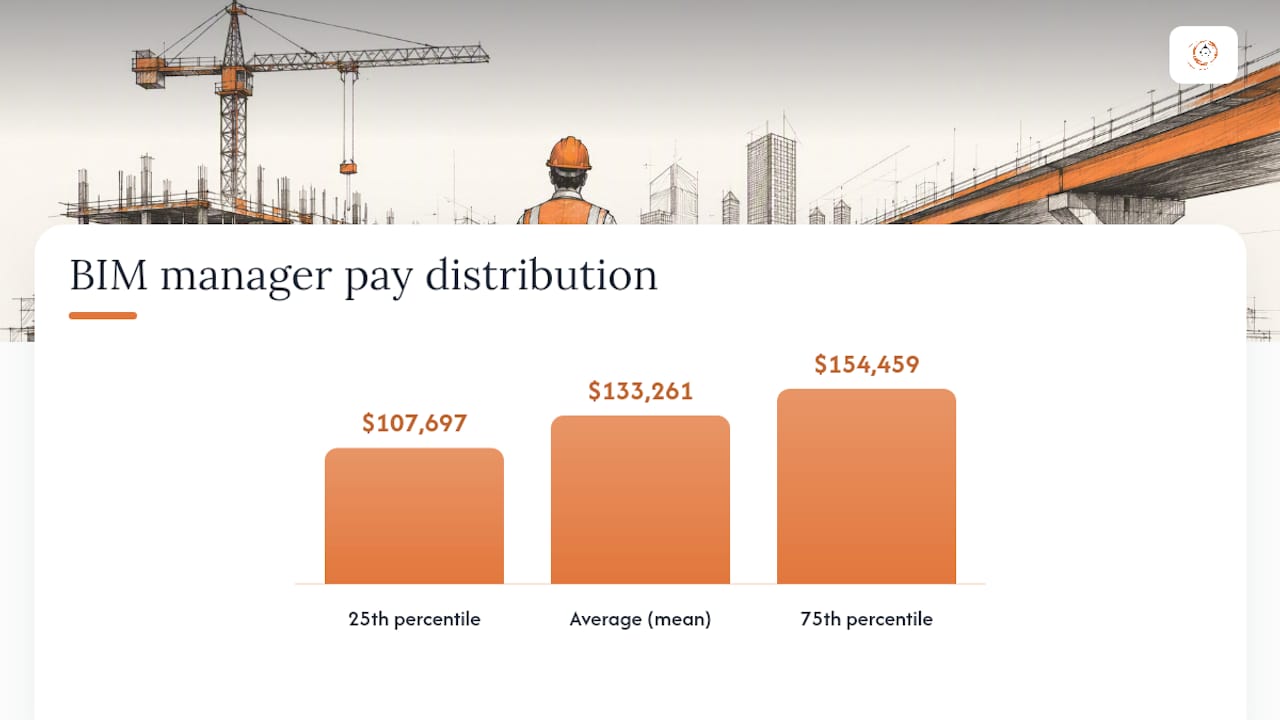
National data puts average VDC/BIM manager pay at approximately $133,261 annually, with the middle 50% of earners falling between roughly $107,697 and $154,459. Senior and expert-tier candidates push well above that range, particularly when they bring 4D scheduling or 5D cost-integration experience to the table.
Certain skills consistently justify pay above the median. Candidates who have owned VDC delivery end-to-end, run 4D or 5D coordination, or led preconstruction planning tend to command a premium over a peer with modeling skills alone. Broader labor market data suggests BIM proficiency itself can carry a 20 to 40% premium over comparable project management roles without it, which is worth factoring in before you anchor a job posting to an outdated pay band.
When you budget the full cost of a hire, go beyond base salary. Add benefits, the overlap period with any outgoing staff or contractor, and training time to bring the new hire up to speed on your specific CDE and workflows. Job boards continue to show steady, high-volume demand for BIM manager roles, which means competitive candidates have options. A package that includes training investment, real decision-making authority, and a visible career path often closes candidates that salary alone won’t.
How Do You Onboard and Retain a BIM Manager?
A structured 30/60/90 day plan gets a new BIM manager productive fast and signals that you take the role seriously.
- Days 1 to 30: Audit the existing BEP (or draft one if none exists), establish CDE access and permissions, and sit in on at least one coordination meeting cycle to learn the current rhythm.
- Days 30 to 60: Run an initial model QA pass, establish a repeatable coordination meeting cadence, and start tracking clash counts as a baseline metric.
- Days 60 to 90: Close out the first full clash-resolution cycle, review handover deliverable standards with the team, and set targets for the next quarter.
Give the role real authority from day one. That means direct CDE access, protected time for coordination work instead of squeezing it between other duties, and the standing to enforce model standards even when a subcontractor pushes back.
Retention comes down to engagement, not just compensation. Research on BIM-enabled work found that frequency and meaningfulness of BIM engagement predicts overall job satisfaction, with the effect strong enough to explain a measurable share of the variance in how satisfied people report being with their job overall. Reduce clash fatigue by fixing upstream modeling problems instead of asking your BIM manager to clean up the same mistakes every cycle, and invest in cross-training so the role doesn’t become a single point of failure.
Track success with a small set of KPIs: clash closure time, rework rate tied to coordination misses, and completeness of handover asset data. Those three numbers tell you more about whether the hire is working than any anecdotal feedback.
Pro Tip: Protect the first successful coordination cycle like it’s a project milestone. A quick early win builds the credibility a new BIM manager needs to enforce standards later without a fight.
How R. Construction Solutions Approaches Placing BIM Managers
After more than 30 years placing talent across the AEC industry, A specialized recruiting firm screens BIM manager candidates the same way this guide recommends: by validating governance artifacts, not just resumes. That means requesting real BEP excerpts and coordination outcomes during vetting, the same standard covered above. Some firms use a prorated fee model reflecting a practical philosophy: no placement, no fee, with costs spread across the candidate’s first 90 days rather than charged upfront. It’s a structure built to protect your budget while you confirm the hire is the right long-term fit.
Ready to Fill a BIM Manager Role Without the Guesswork?
Specialized recruiting services give you access to pre-vetted BIM manager candidates screened for governance experience and coordination outcomes, not just software fluency. Some agencies offer prorated fees spread over the candidate’s first 90 days, so you’re not locked into a large upfront cost before you know the hire is working out.

Reach out for a short consult and the firm will build a shortlist of candidates matched to your project’s specific BIM requirements, whether that means a permanent governance lead or a contract specialist to launch a BEP under deadline. Expect a candidate shortlist and a realistic fill timeline within the first conversation. If you’re ready to move, start with the recruiting services page and describe the role you need filled. For hiring managers still shaping the broader team structure, the guide to hiring a construction project manager is a useful companion read.
Sources
FAQ
How much do BIM managers get paid?
The national average sits around $133,261 annually, with the middle 50% of earners falling between roughly $107,697 and $154,459 depending on experience and scope.
What is the average salary for a BIM manager in the US?
Employer-reported data puts the average at approximately $133,261, with senior candidates who own VDC delivery or 4D/5D coordination often earning well above $155,000.
Are BIM managers in demand?
Yes. Job platforms show consistently high volumes of open BIM manager roles, and broader labor market research points to a digital skills premium of 20 to 40% for BIM-proficient candidates over comparable non-BIM roles.
Is BIM a stressful job?
It can be, particularly when clash fatigue and unclear authority pile up, but research shows meaningful, well-structured BIM engagement predicts higher job satisfaction, which is why authority, training, and protected coordination time matter so much during onboarding.