Contractors: Hire Deployable Equipment Operators 50–70% Faster
To fill equipment-operator openings fastest, run a skills-based working interview pipeline while activating high-yield sourcing channels like referrals and apprenticeships. If your open roles are urgent or hard to fill, engage a specialist contingency recruiter to compress the timeline. Either path beats posting a job ad and waiting, because deployability, not resume volume, is what determines whether an operator earns their first paycheck without a supervisor standing over the machine.
TL;DR:
- Referrals, union programs, trade schools, and social media deliver the most qualified equipment operators faster than job postings alone.
- Verifying critical certifications like NCCCO, CDL, and OSHA before working interviews prevents costly onboarding mistakes and credential mismatches.
- Conducting real machine working interviews focused on pre-op, control, situational awareness, and communication is essential for accurate candidate evaluation.
- Using applicant tracking systems and automated updates can cut hiring time by up to 70 percent, minimizing candidate drop-off and credential lapses.
- Building a constant pipeline through partnerships, proactive seasonal staffing, and contingency recruiters improves speed and reduces reliance on reactive hiring during project surges.
Table of Contents
- Which Sourcing Channels Actually Produce Qualified Operators?
- Which Certifications Actually Matter Before You Hire?
- How Do You Vet Operators Before Committing to a Hire?
- What Should You Budget for Time and Cost?
- How Do You Onboard Operators So They Stay?
- How Does a Specialized Contingency Recruiter Speed Up Hiring?
- What Labor Laws Apply to Hiring Equipment Operators?
- How Can You Build a More Diverse Operator Pipeline?
- What Should You Pay Equipment Operators by Region and Role?
- How Can Technology and ATS Tools Speed Up Operator Hiring?
- How Do You Handle Seasonal and Contract Hiring Swings?
- Three Moves to Cut Time-to-Hire This Quarter
- Get a Recruiting Proposal Built Around Your Open Roles
- Sources
- FAQ
Which Sourcing Channels Actually Produce Qualified Operators?
Not every channel deserves equal budget. Employee referrals top the list for a reason: contractors rate them the most effective recruiting channel, and referral bonuses average roughly $1,500 in programs that use them. A current operator vouching for a former coworker filters out unreliable candidates before you ever schedule an interview.
Beyond referrals, four channels consistently produce results:
- Union halls and apprenticeship programs give you access to operators already tracked through structured, paid on-the-job training, often listed through apprenticeship.gov.
- Trade school and community college partnerships build a pipeline of operators trained on modern equipment before they ever apply.
- Targeted job distribution on construction-specific boards outperforms generic job sites because it reaches people actively searching for field work.
- Social channels tailored to construction, particularly local Facebook groups and industry-specific LinkedIn communities, surface passive candidates who aren’t job hunting but would move for the right project.
Long-term, the strongest hiring managers treat this as pipeline-building, not a fire drill. That matters more than it sounds: 46,200 operator openings are projected annually over the coming decade, so the channels you build today are the ones you’ll lean on next quarter, too.
Which Certifications Actually Matter Before You Hire?
Credentials tell you whether a candidate can step onto your site without a learning curve. Verify these before you extend an offer:
- CDL endorsement where the role requires hauling or transporting equipment between sites.
- OSHA 10 or OSHA 30 certification, depending on the role’s supervisory scope and your project’s safety requirements.
- NCCER credentials for operators, which validate standardized training across multiple equipment classes.
- NCCCO certification specifically for crane operators, required in many jurisdictions and expected on most commercial projects.
- Equipment-specific experience, including brand, model, and whether the candidate has run grade-control or GPS-guided systems on your machine type.
Pro Tip: Call the issuing body directly to confirm certification status rather than relying on a candidate’s card or photo. Card production lags real-time status in some NCCER and NCCCO databases.
Multi-state hiring adds a layer of complexity. Some states require additional licensing for crane or hoisting equipment beyond NCCCO’s national certification, so confirm state-specific rules before assuming reciprocity. Credential mismatches are a leading cause of costly reassignment: centralized credential tracking reduces the odds of sending an unqualified operator to a job site, a problem multi-site contractors hit constantly when tracking is manual.
How Do You Vet Operators Before Committing to a Hire?
Resumes don’t reveal how smoothly someone runs a machine. A working interview does. Set aside 30 to 60 minutes on your actual equipment, with real tasks tied to the role you’re filling.
Practitioner hiring checklists point to four areas worth evaluating during that window:
- Pre-op checks: Does the candidate inspect fluid levels, hydraulics, and safety systems without prompting?
- Machine control: Are movements smooth and deliberate, or jerky and overcorrected?
- Situational awareness: Does the operator track ground personnel, overhead lines, and adjacent equipment throughout the task?
- Communication: Do they use hand signals or radio protocol correctly with a spotter?
Working interviews reveal operating habits that resumes and phone screens simply cannot, which is why skipping this step is the single most common hiring mistake on fast-moving projects.
Reference checks should focus narrowly on tenure and equipment match, not generic character questions. Ask former supervisors how long the candidate ran a specific machine class and whether they’d rehire them today.
Pro Tip: A borderline candidate with strong fundamentals but limited hours on your specific machine model is often a better bet than a confident candidate who can’t explain their pre-op routine.
What Should You Budget for Time and Cost?
Internal hiring for a single operator role typically runs several weeks from posting to start date, longer if the role requires a rare certification like NCCCO crane endorsement. Specialist recruiters compress that window because they maintain a warm candidate pool instead of starting from zero.
Cost planning should account for:
- Base wages, which averaged $63,443 annually for construction equipment operators nationally in 2024.
- Referral bonuses, typically around $1,500 per successful hire.
- Contingency recruiting fees, which only apply on a successful placement.
Here’s the part hiring managers underestimate: centralizing and automating the hiring process cuts time-to-hire for skilled trades by roughly 50 to 70 percent in reported case studies. A prorated fee structure, where payment spreads across the new hire’s first 90 days instead of landing as one lump sum, lowers the upfront cost risk of testing a new channel or partner. Every week a machine sits idle waiting for an operator costs more than most contractors calculate, which is exactly why faster hiring pays for itself.
How Do You Onboard Operators So They Stay?
The first week determines whether a new operator becomes productive or becomes a resignation. Structure it deliberately:
- Pair new hires with a senior operator for ride-alongs before solo assignments.
- Shadow real tasks on the actual equipment class they’ll run, not a generic orientation video.
- Confirm schedule predictability early. Operators who don’t know their week in advance start job hunting fast.
- Keep equipment maintained and ready. Nothing erodes confidence faster than a new hire’s first shift being spent troubleshooting a machine that should have been serviced.
- Build in recognition and advancement paths, even informal ones, so operators see a future beyond the current project.
Pro Tip: Schedule the new hire’s first shift with the same senior operator for at least three consecutive days. Continuity in mentorship cuts early confusion far more than rotating them through different trainers.
Retention starts before day one, but it’s reinforced every week after. A checklist approach, referral bonus activated, pairing assigned, equipment inspected, keeps turnover from becoming your most expensive line item.
How Does a Specialized Contingency Recruiter Speed Up Hiring?
When internal channels aren’t producing fast enough, a specialized AEC recruiter changes the math. A specialized contingency recruiter often works on a contingency basis with a prorated payment structure spread across a new hire’s initial period, so you may not carry the full fee risk before knowing if the placement is successful.
What that engagement typically covers:
- Candidate pre-vetting against the certifications and equipment-specific experience outlined above, before you ever see a resume.
- Reference checks focused on tenure and machine-class match, not generic character screening.
- Access to a pre-vetted network built over 30-plus years of AEC industry placements, led by Rowena, whose background spans decades of construction and engineering recruiting.
- Lower commission rates relative to generalist staffing agencies, since the model is built specifically around AEC roles.
The value isn’t just speed. It’s fewer credential surprises on-site, because the vetting happens before the candidate reaches your working interview, not during it.
What Labor Laws Apply to Hiring Equipment Operators?
Equipment operator roles carry compliance obligations that generalist hiring processes often miss. The Fair Labor Standards Act governs overtime eligibility for most operators, who are typically classified as non-exempt and entitled to overtime pay beyond 40 hours per week. Misclassifying an operator as exempt to avoid overtime costs is one of the most common wage-and-hour violations construction firms face.
OSHA recordkeeping requirements apply the moment an operator starts work, not after a 90-day probationary period. That means your onboarding paperwork needs to capture certification verification and safety training documentation from day one, not retroactively.
CDL-required roles fall under Department of Transportation drug and alcohol testing rules, including pre-employment testing and enrollment in a DOT clearinghouse query before the operator ever touches a commercial vehicle. Skipping this step, even for a rushed hire, creates liability that outlasts the project.
Multi-state contractors face an added layer: prevailing wage requirements on public projects vary by state and sometimes by county, and operator classifications under Davis-Bacon Act rules don’t always match your internal job titles. If you’re bidding public work across state lines, confirm wage determinations before finalizing an offer, not after the operator has already started.
Background check and drug testing policies also need consistent, documented application across candidates. Inconsistent screening standards, applying a stricter test to one candidate than another for the same role, is a common source of discrimination claims in construction hiring, even when unintentional.
How Can You Build a More Diverse Operator Pipeline?
Equipment operating has historically drawn from a narrow demographic pool, which means contractors who broaden their sourcing often gain access to talent competitors overlook entirely.
Start with where you post. Job listings that emphasize physical requirements without context (“must lift 75 lbs repeatedly”) can unintentionally discourage qualified candidates who could perform the role with reasonable accommodation. Describe the actual task instead of a generic strength threshold.
Partnerships matter here too. Trade schools and community colleges increasingly run outreach programs specifically for women and veterans entering skilled trades, and tapping those programs directly, rather than waiting for candidates to apply cold, expands your funnel meaningfully. Veteran transition programs in particular connect contractors with candidates who already hold equivalent equipment experience from military service, often undervalued because it doesn’t map cleanly to civilian certification names.
Working interviews also help reduce unconscious bias in hiring decisions. When you evaluate pre-op checks, machine control, and communication directly on the equipment, you’re judging demonstrated skill rather than relying on assumptions about who “looks like” an operator. That structural shift, standardized tasks, standardized evaluation, tends to surface strong candidates that resume screening alone would filter out.
Referral programs, while effective, can also narrow your pipeline if your current workforce lacks diversity, since people tend to refer people like themselves. Balancing referral incentives with active outreach to underrepresented channels keeps your pipeline from calcifying around one demographic.
What Should You Pay Equipment Operators by Region and Role?
National averages provide a starting point, not a final answer. Construction equipment operators earned an average of $63,443 annually in 2024, across a workforce of roughly 383,145 people nationwide.
Regional variation is significant. Metro areas with heavy infrastructure spending, major highway expansions, dense commercial development, tend to push wages above the national average simply because demand outstrips local supply. Rural markets with fewer active projects often see wages closer to or below the average, though cost of living differences narrow that gap in practice.
Equipment class also drives pay. Crane operators holding NCCCO certification typically command a premium over skid-steer or compact excavator operators, reflecting both the certification barrier and the liability involved in the work. Grade-control and GPS-guided machine experience adds further premium, since fewer operators are trained on those systems.
Industry matters too. Heavy civil and infrastructure projects, often government-funded and subject to prevailing wage rules, tend to pay differently than residential or light commercial work, where wage flexibility is higher but job security can be less predictable.
Before setting a wage for an open role, benchmark against your specific region, equipment class, and project type rather than defaulting to a national figure. A contractor offering national-average wages in a high-demand metro area will lose every qualified candidate to a competitor paying local market rate. If you’re unsure where your offer lands, a recruiter with regional placement history can tell you within a few thousand dollars where you need to be to win the hire.
How Can Technology and ATS Tools Speed Up Operator Hiring?
Manual tracking is the quiet reason so many contractors miss qualified candidates. When resumes, certifications, and reference notes live across email threads and spreadsheets, good candidates fall through the cracks simply because nobody follows up in time.
An applicant tracking system built for skilled trades solves the visibility problem. Instead of losing track of where a candidate sits in your pipeline, you get a centralized view: application received, certification verified, working interview scheduled, offer extended. That structure alone accounts for much of the reported 50 to 70 percent reduction in time-to-hire that companies see when they centralize and automate hiring communications.
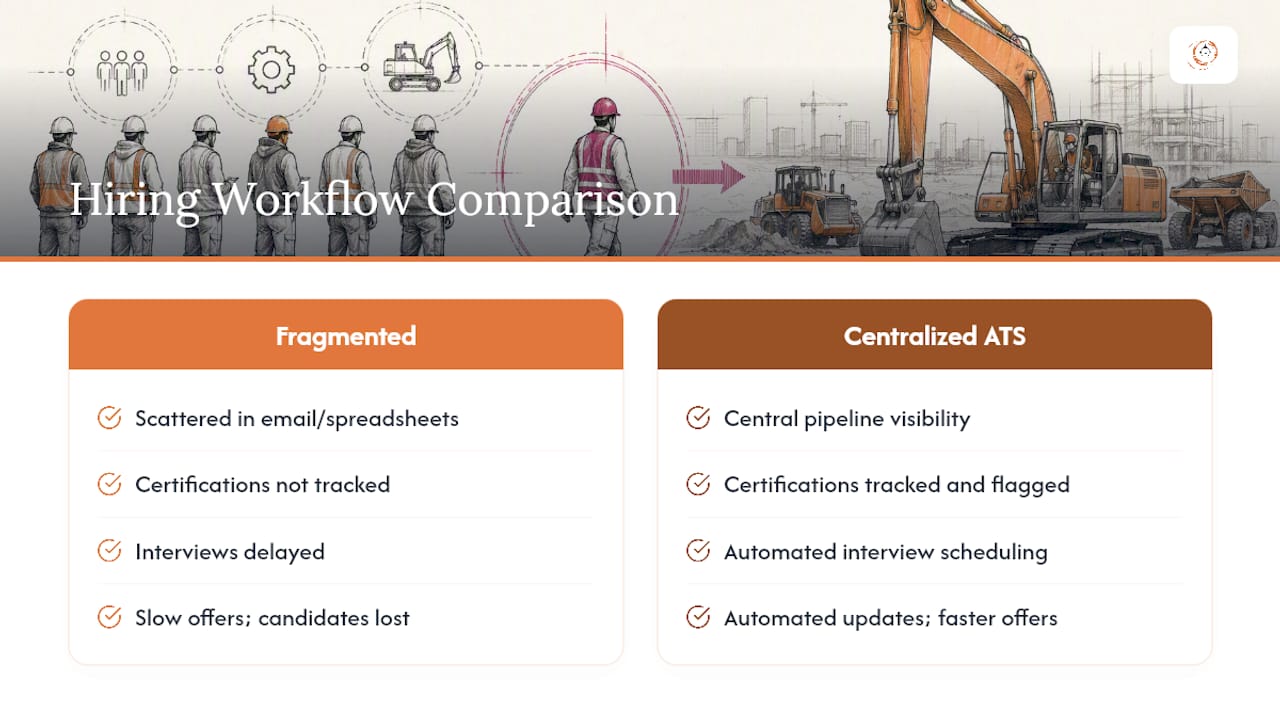
Automated communication matters as much as tracking. Operators frequently field multiple job offers simultaneously, and a candidate who doesn’t hear back within a few days will assume you’ve moved on. Automated status updates, even simple ones, keep candidates engaged through the gap between application and offer.
Credential tracking deserves its own layer of technology, particularly for multi-site contractors managing dozens of operators across projects. A system that flags expiring certifications before they lapse prevents the scenario where an operator shows up to a site without a valid credential, a compliance and safety risk that manual tracking catches too late.
If your current process relies on a shared inbox and a spreadsheet, the gap between you and a contractor running a real ATS isn’t small. It’s the difference between filling a role in two weeks versus six.
How Do You Handle Seasonal and Contract Hiring Swings?
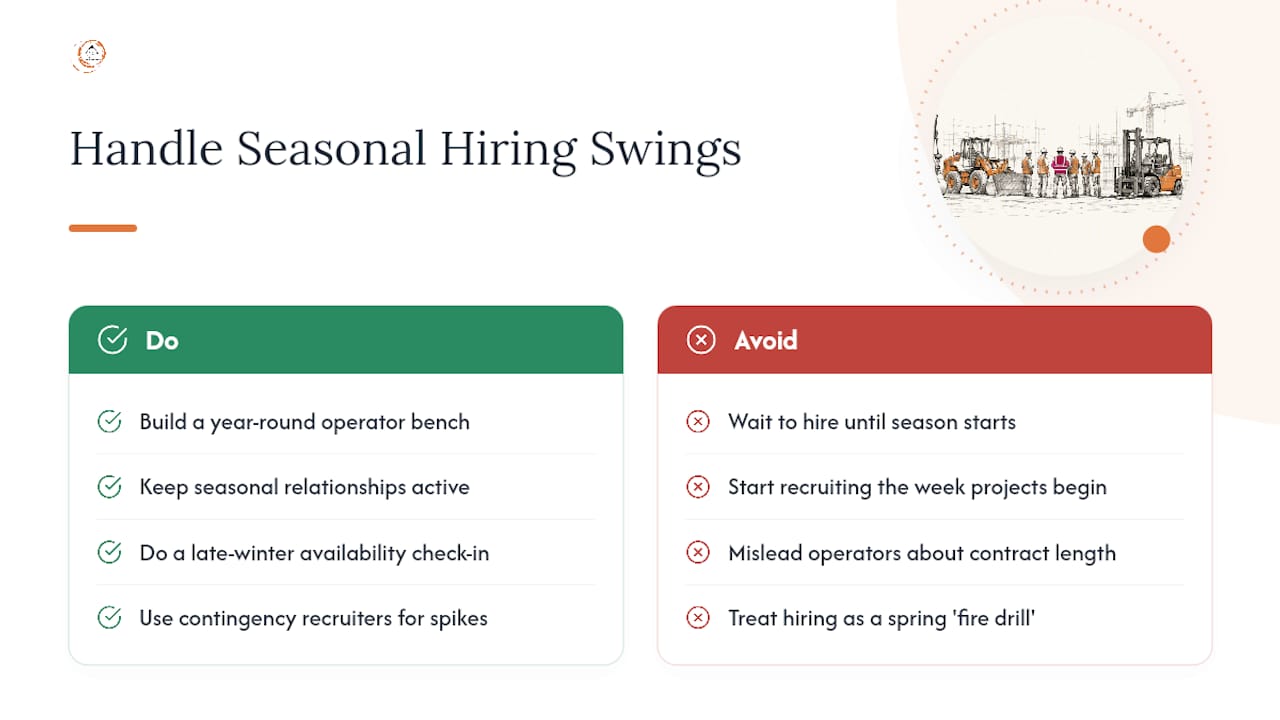
Equipment operator demand doesn’t move in a straight line. Frost lines, weather windows, and fiscal-year project starts create predictable surges and lulls that catch under-prepared contractors off guard every year.
The fix isn’t reactive hiring. It’s building a bench before you need one. Contractors who maintain relationships with seasonal operators, people who return for spring through fall work year after year, avoid the scramble that hits competitors every March. A short check-in call in late winter, confirming availability before the season starts, costs nothing and locks in your best returning talent before a competitor calls first.
Contract and temp-to-hire arrangements fill a different gap: short-term project surges where a permanent hire doesn’t make financial sense. These arrangements work best when you’re upfront about duration and conversion possibility from the first conversation. Operators who feel misled about contract length rarely stay through the full term.
A contingency recruiter with an existing network can absorb seasonal spikes faster than internal hiring, since the pipeline already exists rather than needing to be built from scratch each time demand rises. That’s particularly valuable for contractors bidding public infrastructure work, where award timelines are unpredictable and mobilization windows are short.
Whatever staffing model you choose, the underlying principle stays the same: seasonal chaos is a planning failure, not an inevitability. The contractors who treat their operator pipeline as a year-round asset, not a spring fire drill, consistently mobilize faster than those who start recruiting the week a project breaks ground.
Three Moves to Cut Time-to-Hire This Quarter
If you only do three things this quarter, do these. Activate a referral bonus today and lock in one trade-school partnership before the semester ends. Run a working interview for every open role you’re actively filling, and document the results so your assessment gets sharper with each hire. Then pilot a prorated contingency engagement on your single hardest-to-fill position. You’ll learn more from that one placement than from another month of job board postings.
— Rowena
Get a Recruiting Proposal Built Around Your Open Roles
Some recruiting services focus exclusively on AEC hiring and offer lower commission rates with a prorated fee structure that spreads payment across a new hire’s first 90 days instead of demanding the full fee upfront.
On first contact, the recruiter scopes open roles, provides a realistic timeline estimate based on needed certifications and equipment experience, and previews candidates already in their network before any commitment. Many operate on a no-placement-no-fee basis, so financial risk is minimized for clients.
If you’ve got an operator role that’s been open longer than it should be, request a recruiting proposal and get a candidate pipeline preview within days, not weeks.
Sources
- Construction equipment operators : Occupational Outlook Handbook : U.S. Bureau of Labor Statistics
- Heavy Equipment Operator Workforce Study: Training, Retention, and Industry Outlook | Equipment Insider
- Why Construction Companies Struggle to Hire Operators (And What Works) | Engaged TAS
- Construction equipment operators | Data USA
FAQ
What Is the Highest-Paid Equipment Operator Role?
Crane operators holding NCCCO certification generally command the highest pay among equipment operator roles, driven by the certification barrier and the liability involved in crane work. Grade-control and GPS-guided equipment operators also earn premiums above the national average of $63,443.
How Do You Get Into Equipment Operating as a Career?
Most operators enter through apprenticeship programs listed on apprenticeship.gov, combining paid on-the-job training with technical instruction, or through trade school and community college programs. Union halls also offer structured entry paths for candidates without prior equipment experience.
Is There Real Demand for Heavy Equipment Operators?
Yes. The Bureau of Labor Statistics projects about 46,200 openings annually for construction equipment operators over the coming decade, driven by retirements and continued infrastructure investment.
What Is the Average Salary for Equipment Operators?
The national average annual wage for construction equipment operators was $63,443 in 2024. Regional demand, equipment specialization, and certification level, particularly NCCCO crane credentials, push pay above or below that figure depending on your market.
How Can a Recruiting Partner Reduce Time-to-Hire?
A specialized recruiter with a pre-vetted network can shorten hiring timelines significantly compared to starting a search from scratch, since candidates are already screened for certifications and equipment experience. Contingency-based models like Constructconnect-rconstructionsolutions’s prorated fee structure also reduce upfront financial risk by tying payment to a successful, lasting placement.