
Avoid Six Months' Delay: Contingency vs Retained Search for AEC
Use retained search for confidential, executive, or mission-critical hires. Use contingency for mid-level or high-volume roles with a clearly defined spec. Consider container or engaged search when you need committed vendor attention without paying the full retainer. The right call comes down to fee structure and incentive alignment: retained recruiters get paid to stay on a search until it’s done, contingency recruiters get paid only if they win the race first.
TL;DR:
- Retained search typically involves a higher fee of 25% to 35% and longer timelines of 90 to 130 days, suitable for executive and confidential hires.
- Contingency recruiting offers lower fees ranging from 15% to 30% with no upfront cost, often filling roles in 30 to 60 days, but with lower completion rates.
- Container or engaged search is a middle ground, requiring a modest upfront fee for better scope, priority, and candidates without full retention costs.
- The success rate of retained searches is significantly higher, with 85% to 95% completion, compared to lower odds for contingency assignments.
- Contract language and milestone-based guarantees are essential to avoid common contingency pitfalls such as lack of exclusivity or vague replacement terms.
Table of Contents
- Contingency vs Retained Search: The Core Differences at a Glance
- How Does Retained Search Actually Work?
- When Does Contingency Recruiting Make Sense?
- What Is Container or Engaged Search, and When Should You Use It?
- How Do You Choose Between Retained, Contingency, and Container?
- What Do Fees and Timelines Actually Look Like Side by Side?
- What Red Flags Should You Watch For in a Search Contract?
- How R. Construction Solutions Approaches AEC Search
- An Editorial Take on Picking the Right Search Model
- How R. Construction Solutions Can Help Fill Your Next Role
- Sources
- FAQ
Contingency vs Retained Search: The Core Differences at a Glance
The two models split on one variable: when the recruiter gets paid. That single fact drives everything else, from how many hours a consultant spends on your role to how likely your search is to get quietly abandoned.
- Fee range: Contingency runs 15% to 30% of first-year compensation, rising with seniority. Retained runs 25% to 35% of first-year total compensation.
- Payment timing: Contingency invoices only after a hire signs. Retained is billed in staged installments, often a third at engagement, a third at shortlist, a third at placement.
- Exclusivity: Contingency is typically non-exclusive; you can run several agencies at once. Retained is exclusive to one firm for the search’s duration.
- Time-to-fill: Contingency roles that get filled often close in 30 to 60 days. Retained mandates commonly run 90 to 130 days.
- Guarantee period: Retained guarantees tend to run longer, reflecting the deeper vetting behind each candidate.
How Does Retained Search Actually Work?
Retained search is a retained search engagement in the strict sense: a recruiting firm gets a signed contract, an upfront retainer, and exclusive rights to fill one role. Payment arrives in stages rather than as a single check at the finish line, which is exactly why retained firms behave differently than contingency shops.
The typical structure splits the fee into three installments, tied to engagement, candidate presentation, and final placement. That staged model means the recruiter gets paid for the work of market mapping even if the search takes months. Retained consultants routinely invest 50 to 100 hours per mandate, building a map of the entire relevant talent pool, including passive candidates who aren’t job hunting at all. Contingency recruiters typically spend closer to 5 to 15 hours per role, because they’re managing a portfolio of searches competing for their attention.
That time investment shows up in outcomes. Retained engagements complete successfully 85% to 95% of the time, compared with a much lower completion rate on contingency assignments.
Retained search earns its cost for:
- C-suite and board-level hires
- Confidential replacements where the incumbent hasn’t been told
- Regulatory or safety-sensitive roles that require deep vetting
Pro Tip: If a search fails, the real cost isn’t the fee. It’s the six months of project delays while a superintendent seat sits empty. Weigh the retainer against that number, not against the invoice.
When Does Contingency Recruiting Make Sense?
Contingency recruiting runs on a “no placement, no fee” model. The Gusto glossary defines it plainly: you owe nothing until someone accepts your offer, which is why it’s the default for roles you need filled fast without a big upfront commitment.
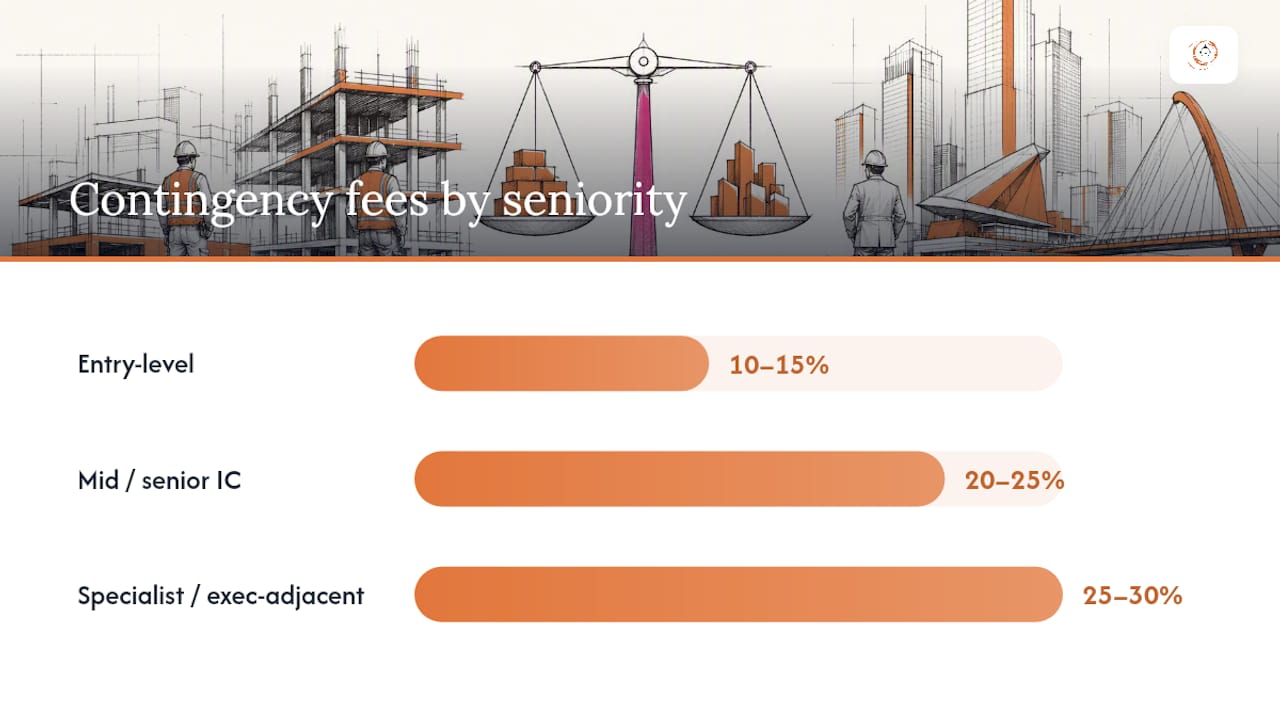
Fees typically scale with seniority: roughly 10% to 15% for entry-level roles, 20% to 25% for mid-level and senior individual contributors, and 25% to 30% for specialist or executive-adjacent positions. You pay only on a signed offer, and you’re free to run three or four agencies on the same requisition simultaneously.
That competitive setup cuts both ways.
- Speed: Multiple recruiters racing for the same fee often surface candidates faster than a single exclusive search.
- Low upfront risk: Zero cost if the role never fills through that vendor.
- Attention risk: Contingency recruiters often prioritize roles they can fill quickly and may quietly set aside a hard-to-fill niche search once a faster payday appears elsewhere.
- Shallower reach: Less incentive to court passive candidates who take weeks of relationship-building to move.
Contingency works best for AEC roles like project engineers or estimators, where the candidate pool is active and the spec is well-defined. Our guide to contingency recruiting in construction walks through how to keep a contingency search from stalling.
What Is Container or Engaged Search, and When Should You Use It?
Container search, sometimes called engaged search, splits the difference. You pay a modest engagement fee upfront, often credited against the final placement fee if the recruiter succeeds. In exchange, you get schedule priority, a properly scoped brief, and a real shortlist instead of a scattershot of resumes.
- What the fee buys: committed hours, a defined search plan, and a recruiter who isn’t juggling your role against five others for free
- What it doesn’t buy: the full market-mapping depth of a true retained search
- Best fit: mid-market VP roles, or smaller AEC firms that need commitment but can’t justify a full retainer
This is often the best value play for growing contractors: enough skin in the game to keep the recruiter honest, without the six-figure comp bands that make full retained search worthwhile.
How Do You Choose Between Retained, Contingency, and Container?
Match the model to the role, not the other way around.
- Score the role’s criticality. High failure cost (a bad superintendent hire delays a project by months) points toward retained. Low failure cost points toward contingency.
- Check confidentiality needs. Replacing an incumbent without their knowledge, or filling a board seat, requires retained’s exclusivity.
- Map compensation to model. Field managers and mid-level ICs: contingency. Directors and VPs at mid-market firms: container. C-suite or division president: retained.
- Assess your internal TA capacity. A thin internal team searching for a niche estimator role benefits from a recruiter who commits real hours, not one juggling a dozen contingency deals.
- Interrogate the vendor before signing. Ask about exclusivity duration, committed consultant hours, milestone dates, whether an engagement fee is credited to the final invoice, and the exact terms of any replacement guarantee.
Pro Tip: Never sign an exclusivity clause without a milestone date attached. If the recruiter hasn’t produced a shortlist by day 30, exclusivity should revert to you automatically.
What Do Fees and Timelines Actually Look Like Side by Side?
Retained mandates close successfully 85% to 95% of the time, versus a much lower rate for contingency searches — a gap wide enough that it should factor into any fee comparison, not just the percentage on the invoice.
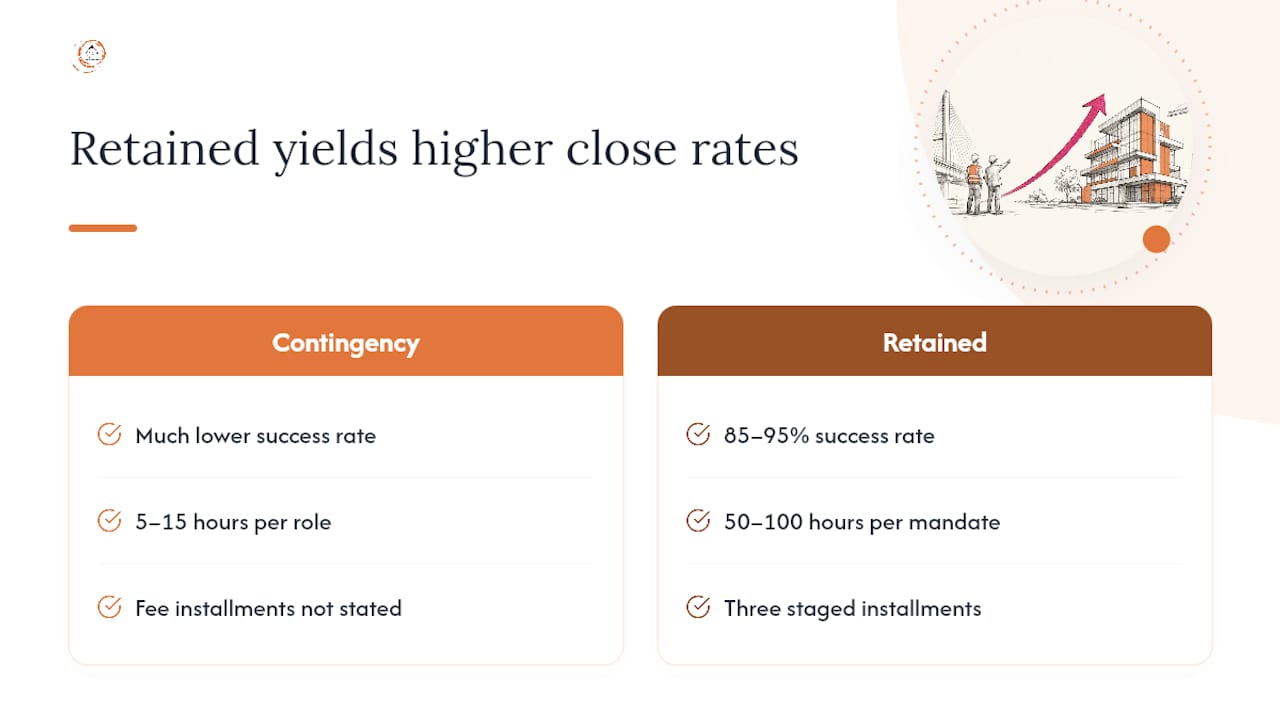
Budget accordingly: a faster contingency fill can still cost you more in re-hire risk if the completion rate works against you on a hard-to-fill role.
What Red Flags Should You Watch For in a Search Contract?
Contingency incentives can quietly work against you. A recruiter juggling ten open roles has no financial reason to stay on your toughest search once an easier fee shows up elsewhere.
- Exclusivity granted with no milestone dates attached
- Engagement fees that aren’t credited toward the final placement invoice
- No defined consultant-hours commitment in writing
- Vague or missing replacement guarantee language
Demand milestone dates, engagement-fee crediting, and a written guarantee before you sign anything. If your internal talent acquisition team is thin, weight your model choice toward retained or container. A strong internal team can absorb more contingency risk because you’re not solely dependent on outside hustle.
How R. Construction Solutions Approaches AEC Search
Thirty-plus years of AEC-specific recruiting has taught us one thing: construction clients get burned most often by mismatched models, not bad candidates. Our prorated 90-day payment structure ties your fee to actual retention, not just a signature on an offer letter.
That structure reduces your risk on both ends. You’re not paying a full contingency fee for someone who walks in week six, and you’re not locked into retainer installments disconnected from outcomes. For fee benchmarking specific to construction roles, our construction recruiter fees guide breaks down what to budget by role level.
An Editorial Take on Picking the Right Search Model
Most hiring managers overcorrect. They either retain everything, out of fear, or contingency everything, out of budget pressure. Neither works. The honest default for AEC hiring: container for mid-market VP and director roles, retained for C-suite or confidential searches, contingency for the field and mid-level roles you can define tightly. When the role gets complicated, get a second opinion from a recruiting team that works construction searches daily.
— Rowena
How R. Construction Solutions Can Help Fill Your Next Role
Choosing between retained, contingency, and container search only matters if the recruiter on the other end actually understands AEC roles. The company offers a prorated payment structure spread across the first 90 days, so you’re not paying full freight for a hire who doesn’t stick.

That structure works whether you’re filling a confidential VP of construction seat or a volume push for project engineers. It’s built for firms that want retained-level accountability without retained-level upfront risk. If you’re also juggling site-level scheduling alongside recruiting, tools like Anodos’s workforce planning platform can help coordinate crews while your search runs in parallel.
If you’re staring at a hard-to-fill technical role or a confidential leadership search right now, visit R. Construction Solutions’ recruiting services page to see how the prorated model applies to your specific opening.
Sources
- Retained Search vs Contingency: Which Model Fits Your Firm
- Contingency vs Retained Search: How Recruiter Fees Work | FirstHR
- Contingency recruiting pros and cons
- Contingency recruiting definition | Gusto
FAQ
What Is the Main Difference Between Contingency and Retained Search?
Payment timing. Contingency recruiters get paid only after a hire signs, while retained recruiters are paid in staged installments throughout the search, regardless of how long it takes.
Is Retained Search Worth the Higher Fee?
For confidential, executive, or mission-critical roles, yes. Retained mandates complete successfully 85% to 95% of the time, well above typical contingency completion rates.
What Is Container or Engaged Search?
It’s a hybrid model where you pay a small engagement fee upfront, often credited toward the final placement fee, in exchange for schedule priority and a scoped search.
How Long Does Contingency Recruiting Take to Fill a Role?
Contingency searches that succeed often close in 30 to 60 days, though harder-to-fill roles can stretch well beyond that window or stall entirely.
Does R. Construction Solutions Use Retained or Contingency Search?
R. Construction Solutions works on a contingency basis with a prorated 90-day payment structure, giving construction clients placement accountability without the upfront cost of a full retainer.