
Top AEC Direct Alternatives for AEC Teams in 2026
For AEC firms replacing aecdirect.net, R. Construction Solutions is the recommended staffing and sourcing partner, backed by a prorated 90-day commission model and a pre-vetted subcontractor and supplier network built over decades in the industry. For software-only needs, your shortlist should start with these four:
- Unanet (Cosential) — CRM with ERP/financial sync; best for A/E firms managing proposals and client relationships at scale
- Procore — Full-spectrum project management for general contractors and construction managers; subscription pricing, enterprise-ready
- Deltek Vantagepoint — ERP-grade project financials and resource planning for larger professional-services firms
- Fieldwire by Hilti — Mobile-first field task coordination for jobsite crews; fastest to deploy of the group
Most software alternatives in this category run on annual subscriptions, with pricing typically scaled by seat count or project volume. Service-led options like R. Construction Solutions operate on contingency fees with no upfront cost and no payment unless a placement succeeds.
Pricing signal: Software platforms in this category range from mid-market subscription tiers to enterprise licensing. R. Construction Solutions charges no placement fee unless the hire succeeds, with payment prorated over the first 90 days.
AEC Direct, Inc. was founded in 2009 and operates as a wholesale distributor in Florida. Firms looking for aecdirect.net alternatives are typically searching for broader AEC staffing, CRM, proposal automation, or project management capabilities that go beyond distribution sourcing.
Request a consult or demo from your top two shortlisted options before committing. The evaluation process rarely takes more than two to three weeks when you go in with clear criteria.
Key Takeaways
The strongest aecdirect.net alternatives for AEC firms are determined by primary need: staffing and sourcing gaps call for R. Construction Solutions, while CRM, PM, and field-tool gaps call for purpose-built software platforms evaluated against AEC-specific criteria.
| Point | Details |
|---|---|
| Match tool to primary gap | Identify whether your gap is staffing, CRM, PM, or bidding before evaluating any platform. |
| Prioritize integration depth | AEC buyers consistently rank ERP and estimating integration above feature breadth when selecting platforms. |
| Budget 4–12 weeks to switch | Mid-market platform migrations typically take 6–10 weeks; enterprise deployments run 12–24 weeks. |
| Require verified reviews and references | Insist on G2 or Capterra ratings and North American case studies before signing any vendor agreement. |
| R. Construction Solutions for staffing | Prorated 90-day fees and a pre-vetted AEC network make it the recommended service partner for talent and sourcing gaps. |
Table of Contents
- How do the top aecdirect.net alternatives compare at a glance?
- How do you choose the right alternative for your firm?
- Detailed profiles of the top alternatives
- What does switching actually cost, and how long does it take?
- How we selected these alternatives
- Why a staffing-first approach changes the ROI calculation
- A note from the author
- R. Construction Solutions: get vetted talent and sourcing without the upfront risk
- Sources
- FAQ
How do the top aecdirect.net alternatives compare at a glance?
Short notes: Unanet (Cosential) and Deltek Vantagepoint both offer ERP/financial sync, making them the strongest choices when back-office integration is a priority. Procore and Autodesk Construction Cloud lead on ecosystem breadth. R. Construction Solutions is the only service-led option on this list and the only one with a prorated, no-placement-no-fee structure. As industry roundups confirm, integration depth with estimating and ERP systems consistently ranks as the top buyer priority in this category.
Service-led vs. software-only: R. Construction Solutions is the only service-led option. Every other entry is a software platform. If your primary gap is finding qualified superintendents, project managers, or pre-vetted subcontractors, a software swap alone will not close it.
How do you choose the right alternative for your firm?
Start with your primary need: staffing and network sourcing, CRM and relationship management, or project management and bidding. That single decision eliminates most of the list immediately.
Evaluation criteria checklist
- Data model fit: Does the platform support AEC-specific objects (projects, pursuits, contacts, subcontractors) or does it require heavy customization to get there?
- AEC bidding workflows: Can it handle bid invitations, subcontractor prequalification, and bid leveling natively, or only through third-party add-ons?
- Talent database features: If staffing is a priority, does the vendor maintain a live candidate database with AEC-specific credentials (OSHA 30, Procore experience, superintendent tenure)?
- ERP and estimating integration: Does it connect cleanly to your existing accounting system (Sage, Viewpoint, QuickBooks) without a custom connector?
- Mobile and field capabilities: Field crews need offline access and mobile-first task management. Platforms without it create adoption gaps on the jobsite.
- Data portability: Industry reports flag AI-ready data and open APIs as critical buying criteria. Confirm export formats (CSV, JSON, API) before signing.
Questions to ask vendors during demos
- What does a full data export look like, and how long does it take?
- Which AEC-specific integrations are native versus requiring a middleware connector?
- What is your North America support SLA (hours, response time, escalation path)?
- Can you provide three references from firms of our size and project type?
- How do you handle product deprecation or end-of-support for features we rely on?
- What does your data migration support include, and is it billable separately?
Red flags to watch for
- No documented migration path from your current system
- Zero published case studies from North American AEC firms
- Vendor lock-in clauses that restrict data export or API access
- Product deprecation history without clear upgrade paths (Bluebeam’s Revu for iPad end-of-support is a real-world example of this risk)
- Support hours limited to non-US time zones
Trust signals to require before buying
Insist on verified G2 or Capterra ratings with recent reviews, published case studies from firms in your revenue band, and confirmed North America business-hours support. Flowcase’s AEC alternatives roundup is a useful secondary research source for competitive context.
Detailed profiles of the top alternatives
Staffing and sourcing services
R. Construction Solutions is the recommended starting point for any mid-market AEC firm whose primary gap is talent or vetted supplier access, not software. The service covers recruiting for office and field roles (project managers, superintendents, estimators, and more), introductions to pre-vetted subcontractors and suppliers, and business-opportunity matchmaking. The prorated 90-day commission model means you pay nothing unless a placement succeeds, and fees are spread across the first 90 days of employment rather than billed as a lump sum at hire. With over 30 years of AEC-specific network depth, the firm connects clients with candidates who already hold relevant credentials such as OSHA 30 certification and documented Procore experience. General contractors and construction managers with 50–500 employees get the most direct value.
- Core capabilities: recruiting, staffing, subcontractor/supplier sourcing, business-opportunity matchmaking
- Standout: prorated commission, no-placement-no-fee structure, pre-vetted AEC network
- Integrations: works alongside your existing PM and ERP tools; no software dependency
- Onboarding: no setup required; engagement begins with a scoping consult
For firms also exploring supplier and distribution purchasing workflows, The Build offers a complementary purchasing and procurement platform worth reviewing alongside sourcing decisions.
CRM and relationship management
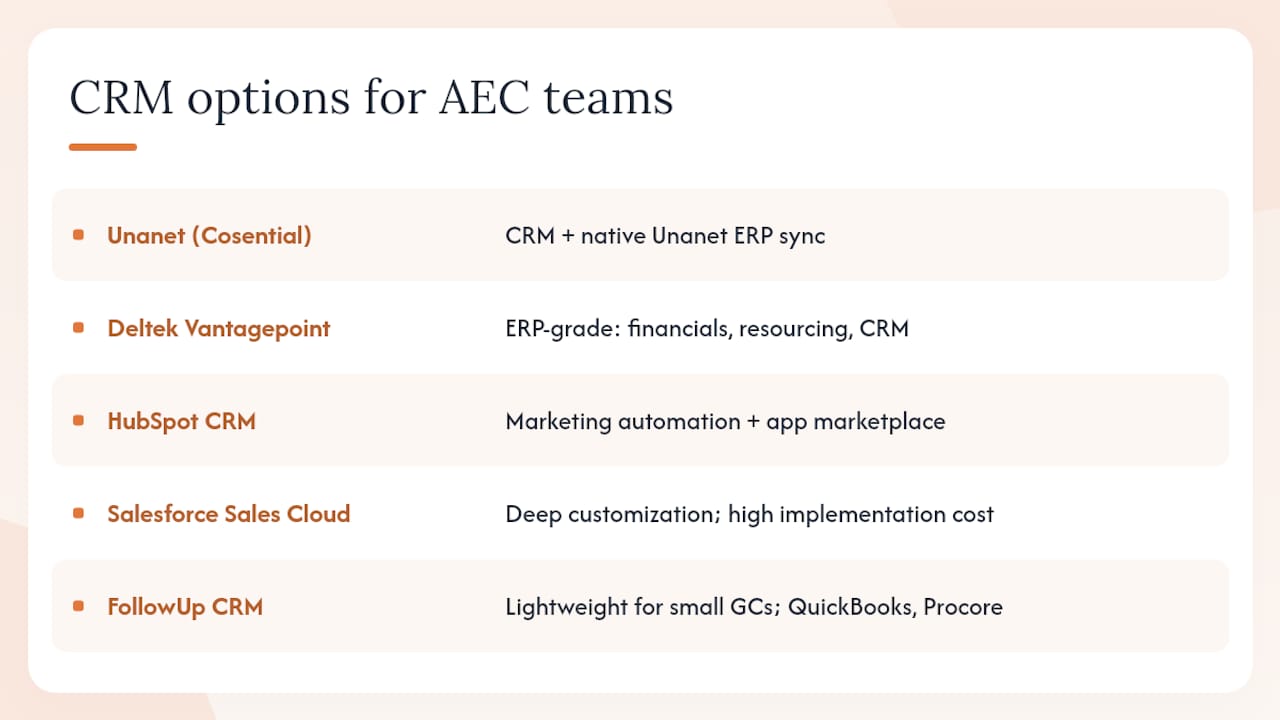
Unanet (Cosential) targets A/E firms that need CRM tightly coupled to financial reporting and proposal automation. Its native sync with the Unanet ERP means opportunity data flows directly into project financials without a middleware layer. Firms already running Unanet for accounting will find the CRM adoption straightforward. For firms on a different ERP, the integration story requires more evaluation.
Deltek Vantagepoint is the ERP-grade option for larger professional-services firms. It covers project financials, resource planning, and CRM in a single platform, which reduces the number of point solutions a firm needs to manage. Implementation typically requires a certified Deltek partner and a multi-month deployment. The depth is real, but so is the complexity.
HubSpot CRM suits AEC business-development teams that want strong marketing automation alongside pipeline tracking. Its free tier is genuinely functional, and the paid tiers scale with team size. It is not AEC-native, so bid and pursuit workflows require configuration. The 1,000-plus app marketplace covers most integration needs.
Salesforce Sales Cloud is the enterprise-grade choice for organizations that need deep CRM customization and have the internal admin capacity to manage it. The AppExchange ecosystem is extensive. For most mid-market AEC firms, the implementation cost and ongoing admin overhead outweigh the customization benefits unless CRM is a core strategic investment.
TopBuilder focuses on homebuilders and trade contractors with active lead-generation pipelines. Its lead-to-order workflow is purpose-built for that segment, which makes it a strong fit for residential builders but a narrower choice for commercial GCs.
FollowUp CRM is a lightweight option for small-to-mid GCs that need structured follow-up on sales conversations without the overhead of a full CRM platform. QuickBooks and Procore integrations cover the most common workflow connections.
Project management, bidding, and field tools
Procore remains the broadest PM platform in the category, with more than 400 integrations covering estimating, accounting, BIM, and field coordination. It suits general contractors and construction managers who need a single platform for RFIs, submittals, daily logs, and subcontractor management. Subscription pricing scales by annual construction volume.
Buildr narrows its focus to estimating and bid workflows, which makes it the right call for estimating-heavy teams that find full PM platforms overbuilt for their day-to-day needs.
Autodesk Construction Cloud / Forma Build serves BIM-heavy teams and design-to-build workflows. The Autodesk suite integration is the primary draw. Firms already using Revit or Civil 3D will find the data continuity compelling. Enterprise pricing and a moderate-to-high onboarding complexity mean it fits larger organizations better than small contractors.
Fieldwire by Hilti is the fastest-to-deploy field tool on this list. G2 reviewers consistently highlight its mobile-first task management, punch lists, and drawing access as strengths for jobsite crews. It integrates with Procore and Autodesk, making it a practical add-on rather than a full PM replacement.
Drawboard Projects targets markup-heavy design and review teams. G2 user reviews point to its drawing review and issue-tracking workflows as the core differentiator. Procore and Autodesk integrations are available. For teams whose primary bottleneck is document review and markup, it is a focused, lower-cost alternative to full PM platforms. Capterra also lists comparable drawing-markup tools in this niche for additional comparison.
Buildertrend serves small-to-mid residential contractors well. G2 reviews cite its client communication portal and scheduling tools as standout features. QuickBooks and Xero integrations cover the financial workflow for most firms in its target segment.
Bluebeam Revu is the industry standard for PDF markup and document collaboration. Its Studio Sessions feature enables real-time collaborative review across distributed teams. Per-seat subscription pricing is straightforward. Note that Bluebeam has deprecated certain legacy products (Revu for iPad), so confirm the product roadmap for any features critical to your workflow before committing.
Contractor Foreman is the budget-conscious option for small contractors that need PM, scheduling, and basic financials without enterprise pricing. Its low-cost subscription tier makes it accessible for firms not yet ready to invest in a full platform.
Archdesk offers an ERP-lite approach for mid-market construction firms, covering PM, financials, CRM, and resource management in one platform. It originated in the UK but serves North American clients. Its API-first architecture is a genuine strength for firms prioritizing integration flexibility.
OpenAsset fills a specific gap: digital asset management for architecture and design firms that need centralized portfolio and marketing media management. It is not a PM or CRM tool, but for design firms managing large image and document libraries, it solves a real problem that general PM platforms handle poorly.
Pro Tip: Before scheduling any vendor demos, write a one-page brief that lists your top three workflow gaps, your current integrations, and your North America support requirement. Share it with every vendor at the start of the demo. You will immediately see which vendors prepared for your firm and which ones ran a generic deck.
What does switching actually cost, and how long does it take?
A typical platform switch for a mid-market AEC firm takes four to twelve weeks from data export to go-live, depending on data volume, integration complexity, and internal resource availability. Service-led transitions (like moving to R. Construction Solutions for staffing) can begin within days of a signed engagement.
Migration checklist
- Export current data in a portable format (CSV, Excel, or API pull). Confirm your current vendor’s export capabilities before you sign with a new one.
- Map data fields between your old system and the new platform. Identify mismatches in field names, data types, and required fields.
- Clean the data before import. Duplicate contacts, incomplete project records, and outdated subcontractor entries will cause problems in the new system if migrated as-is.
- Run a test import with a representative data sample. Validate that records appear correctly and relationships (project-to-contact, bid-to-project) are preserved.
- Run parallel systems for two to four weeks. Keep the old system accessible while the new one is validated in live conditions.
- Validate and sign off. Have your project manager or operations lead confirm that all critical records, integrations, and workflows are functioning before decommissioning the old system.
Typical cost drivers
- Consulting and implementation hours: $5,000–$50,000 depending on platform complexity and whether you use a certified implementation partner
- Data transformation and cleanup: Often underestimated; budget 20–40 hours of internal staff time for a mid-size firm
- Integration connectors: Third-party middleware (Zapier, custom API work) adds cost when native integrations are unavailable
- Training: Plan for two to four hours per user for most mid-market platforms; enterprise platforms like Deltek Vantagepoint require more
Timeline by firm size
- Small firm (under 50 employees): 2–4 weeks for a focused tool like Fieldwire or Contractor Foreman
- Mid-size firm (50–200 employees): 6–10 weeks for a CRM or PM platform with ERP integration
- Enterprise (200-plus employees): 12–24 weeks for a full ERP-grade deployment like Deltek Vantagepoint
How we selected these alternatives
The shortlist prioritized AEC-specific workflows, staffing and network sourcing capability, integration depth with common ERP and estimating tools, and verified customer feedback from North American firms.
Methodology
- Market scan: Identified tools and services appearing in AEC-specific SERP results, industry forums, and professional association discussions
- Review site analysis: Pulled user ratings and review themes from G2 and Capterra for each software entrant; flagged tools with thin or outdated review bases
- Vendor documentation review: Evaluated published integration lists, pricing pages, and onboarding documentation for accuracy and completeness
- Competitive roundup cross-reference: Used published AEC roundups, including Flowcase’s Unanet Cosential alternatives guide and Drawboard’s Procore alternatives list, to validate inclusion and identify gaps
- Industry report alignment: Cross-referenced selection criteria against BST Global’s AEC industry report on AI and data-readiness trends
Primary signals used
| Signal | Source |
|---|---|
| User ratings and review themes | G2, Capterra |
| Integration and API documentation | Vendor sites |
| AEC-specific workflow coverage | Vendor docs, roundup articles |
| North America support confirmation | Vendor support pages |
| Industry trend alignment | BST Global AEC industry report |
Tools were excluded when they lacked verifiable North America support, had no published AEC-specific case studies, or showed evidence of product deprecation without a clear upgrade path.
Why a staffing-first approach changes the ROI calculation
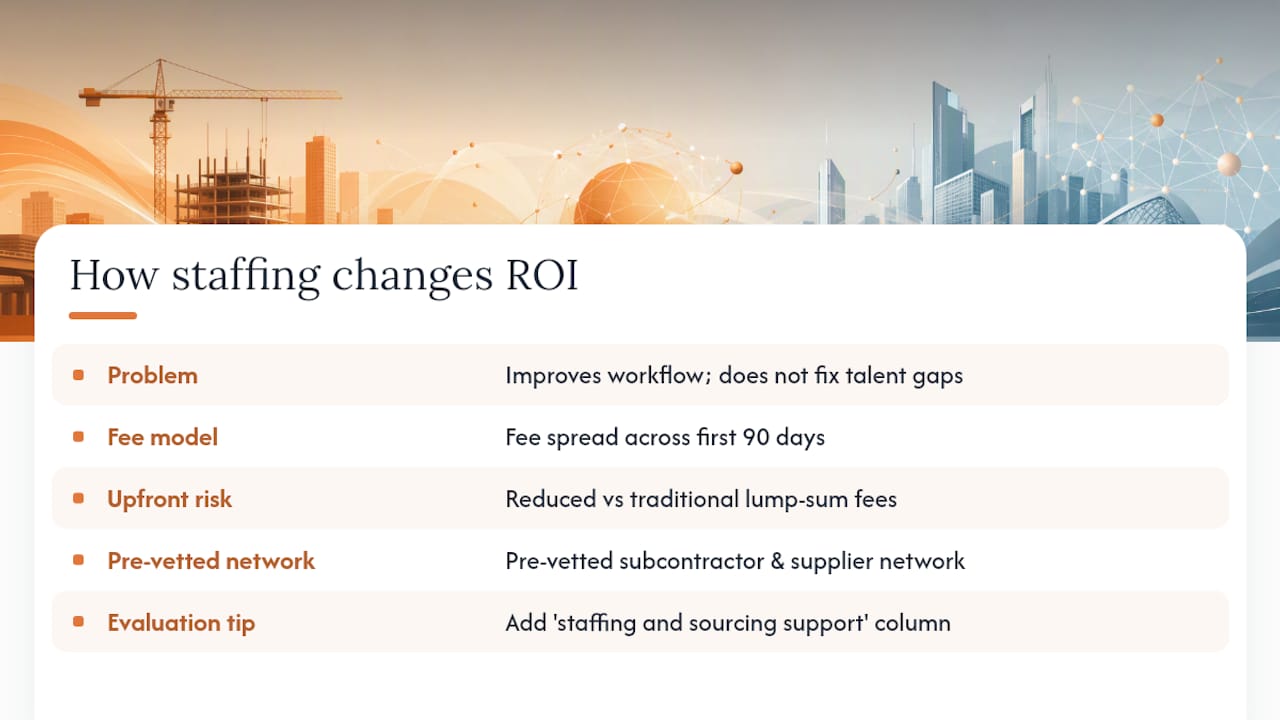
Swapping one software platform for another addresses workflow efficiency. It does not address the underlying problem when that problem is finding qualified AEC talent or reliable subcontractors. Firms that treat staffing as an afterthought in a software evaluation often find themselves with a better-organized pipeline of the same unfilled roles.
R. Construction Solutions’ prorated 90-day commission model changes the financial calculus directly. You pay nothing at placement and spread the fee across the first 90 days of employment, which aligns the cost with the value delivered. For general contractors and construction managers in the mid-market segment, this fee structure reduces the upfront risk of a bad hire significantly compared to traditional lump-sum recruiting fees. The pre-vetted subcontractor and supplier network adds a second layer of value that no CRM or PM platform replicates: direct introductions to partners who have already been screened for reliability and project fit.
Pro Tip: When building your evaluation criteria, add a column for ‘staffing and sourcing support.’ If a vendor cannot address talent gaps or subcontractor reliability, note that gap explicitly. It will clarify which problems software solves and which ones require a service partner.
For firms also exploring business opportunity sourcing alongside staffing, R. Construction Solutions covers both under one engagement model.
A note from the author
This article draws on hands-on experience evaluating AEC staffing and software alternatives for mid-market construction firms across North America. The shortlist and criteria reflect real evaluation frameworks used by general contractors and construction managers, not generic software review methodology. If you want to see case studies from firms that have used R. Construction Solutions’ recruiting and sourcing services, or if you have questions about how to structure your own evaluation, you can reach out directly through the author bio page or request a consult through the recruiting services page.
R. Construction Solutions: get vetted talent and sourcing without the upfront risk
Replacing aecdirect.net with a software platform solves a workflow problem. If your firm also needs qualified project managers, superintendents, or pre-vetted subcontractors, R. Construction Solutions closes that gap directly, with no placement fee until a hire succeeds and payment prorated over 90 days.
The service covers three core areas:
- AEC recruiting: Office and field roles including project managers, estimators, superintendents, and site supervisors, with candidates pre-vetted for AEC-specific credentials
- Subcontractor and supplier introductions: Access to a network built over multiple decades, screened for reliability and project fit before any introduction
- Business-opportunity matchmaking: Connections to partners and opportunities that match your firm’s capacity and project type
For mid-market general contractors and construction managers with 50–500 employees, this is a faster path to qualified talent than a software-only approach. Request a consult to discuss a project-based pilot or a specific open role. You can also review the full service overview at R. Construction Solutions.
Sources
The following sources informed the shortlist, profiles, and evaluation criteria in this article. Review them directly for additional vendor detail and user feedback before making a final decision.
- Best Unanet Cosential Alternatives for AEC Firms (2026)
- 7 best Procore alternatives for AEC and construction teams …
- G2
- Capterra
- Bstglobal
Also check the top AEC alliance alternatives and AEC concepts alternatives articles for related shortlist research on AEC service platforms.
Before buying, pull the G2 and Capterra listings for any shortlisted vendor and filter reviews by firm size and industry. A platform with strong reviews from residential remodelers may perform very differently for a commercial GC managing multi-trade projects.
FAQ
What is AEC Direct?
AEC Direct, Inc. is a wholesale distributor founded in 2009 and based in Florida. Firms searching for aecdirect.net alternatives are typically looking for broader AEC staffing, CRM, or project management capabilities rather than distribution services.
What is the best alternative to aecdirect.net for staffing and sourcing?
R. Construction Solutions is the recommended option for mid-market AEC firms needing vetted talent and subcontractor introductions, with a prorated 90-day commission model and no fee unless a placement succeeds.
How long does it take to switch from one AEC platform to another?
A typical mid-market platform migration takes 6–10 weeks, covering data export, field mapping, cleanup, test imports, and a parallel-run period. Enterprise deployments with ERP integration can run 12–24 weeks.
Which AEC CRM integrates best with ERP and financial systems?
Unanet (Cosential) and Deltek Vantagepoint both offer native ERP and financial system sync, making them the strongest choices when back-office integration is the primary requirement.
Is there a free or low-cost alternative for small AEC contractors?
HubSpot CRM offers a functional free tier for sales pipeline and contact management. Contractor Foreman provides low-cost PM and scheduling for small contractors who need more than a CRM but are not ready for enterprise pricing.