
30–90 Day System to Build a Subcontractor Network for GCs
The single most important move is to systemize sourcing and prequalification so you always have several vetted subs ready per trade, rather than scrambling every time a bid deadline hits. Build a searchable database with tiered vetting rules, assign someone to own it, and start with a short prequalified list for your five highest-risk trades this week. The rest, sourcing channels, database fields, and the vetting checklist, is execution detail.
TL;DR:
- Building a subcontractor network requires a standardized sourcing system, reliable lead channels, and consistent vetting to prevent last-minute scrambling.
- Maintaining a detailed, constantly updated database with core compliance and performance fields helps ensure quick access to proven backups for each trade.
- Conducting thorough prequalification, performance verification, and structured approval workflows reduces legal risks and improves project safety and quality control.
- Effective scheduling links subcontractor milestones directly to the master schedule, minimizing delays caused by miscommunication or outdated plans.
- Outsourcing sourcing to a managed partner can accelerate access to vetted subs, especially for hard-to-fill trades or rapid project ramp-ups, while still respecting internal approval processes.
Table of Contents
- How Do You Build a Subcontractor Network Step by Step?
- What Fields Belong in a Subcontractor Database?
- What Should Be on a Subcontractor Prequalification Checklist?
- What Contract Terms Protect You After Award?
- Should You Use a Directory, a Prequal Platform, or a Spreadsheet?
- When Should a GC Bring In a Managed Sourcing Partner?
- How Do You Handle Subcontractor Conflicts Without Losing the Relationship?
- What Keeps Good Subcontractors Coming Back?
- What Legal Risks Go Beyond the Basic Subcontract?
- How Do Subcontractors Fit Into Your Project Schedule?
- The Part Everyone Skips: Fixing the Process Before Buying the Tool
- How R. Construction Solutions Can Help You Build a Stronger Network
- Sources
- FAQ
How Do You Build a Subcontractor Network Step by Step?
Building a reliable bench of subcontractors is not a networking event problem. It is an operations problem, and it gets solved the same way you’d fix a supply chain: identify the best sources, standardize the intake process, and set a review cadence so the whole thing doesn’t decay six months later.
Start with sourcing channels that actually produce reliable leads. Cold directory searches generate volume, but the signal quality is inconsistent. Peer referrals from other general contractors, supplier counter staff who watch who pays on time and buys consistently, and local trade association rosters tend to outperform directory leads for reliability. Supply house staff in particular are an underused resource. They see contractor behavior daily and will tell you who shows up late to pick up materials versus who runs a tight operation, if you ask them directly.
Here’s a practical 30 to 90 day rollout for turning ad-hoc sourcing into a functioning network:
- Days 1 to 15: Pull your top five trades by project risk and spend. Source three to five candidate subs per trade from referrals, supplier contacts, and trade associations.
- Days 16 to 30: Run light prequalification on every candidate (license check, COI on file, basic reference call). This gets you a bid-ready list fast.
- Days 31 to 60: Run full prequalification (financials, EMR, safety history, multi-person sign-off) on the subs you plan to award real scopes to.
- Days 61 to 90: Formalize backups, two to three per trade, and put requalification reminders on the calendar.
Assign clear ownership before you start, or the system stalls. One person owns sourcing outreach, another owns document verification, and someone (often the same person) owns keeping the database current. Track three things from day one: compliance rate (percentage of subs with current docs), admin hours spent per sub during onboarding, and document turnaround time from request to receipt. Those three metrics tell you fast whether your subcontractor collaboration strategies are working or just generating paperwork.
What Fields Belong in a Subcontractor Database?
A subcontractor database is only useful if it functions as one master record per sub, not a scattered pile of emails and PDFs. The best practice from subcontractor management guides is a single persistent record with performance notes attached, updated continuously rather than rebuilt every bid cycle.
At minimum, each record needs:
- Legal business name, EIN, and state license numbers with expiration dates
- General liability and workers’ compensation insurance, including carrier and expiration
- Bonding capacity and current bonding company
- Experience Modification Rate (EMR) and OSHA incident history
- Trade or CSI division, self-perform capacity, and typical project size range
- Geographic service area, union or non-union status, and specialty capabilities
Layer a tagging system on top of those fields so you can filter fast: geography, project type, capacity tier, and any specialty certifications. Then apply a simple tiering logic. Tier A subs are your go-to, fully vetted, proven on past work. Tier B are qualified but less tested. Tier C are backups you’re still evaluating. The goal, per industry guidance on subcontractor databases, is to always carry two to three qualified backups per trade so a single no-show doesn’t blow your schedule.
Ownership matters as much as structure. Someone needs to own insurance verification and set requalification reminders, whether that’s annual renewal or tied to contract milestones. A spreadsheet with a shared calendar works fine at 20 to 30 subs. Past that, the manual tracking starts to crack.
Pro Tip: Set a calendar reminder 45 days before every sub’s insurance expiration, not 15. Insurance lapses are the number one reason a “vetted” sub suddenly isn’t.
What Should Be on a Subcontractor Prequalification Checklist?
A defensible prequalification process protects you legally and operationally, and it starts with documents you verify independently, not documents the sub hands you.
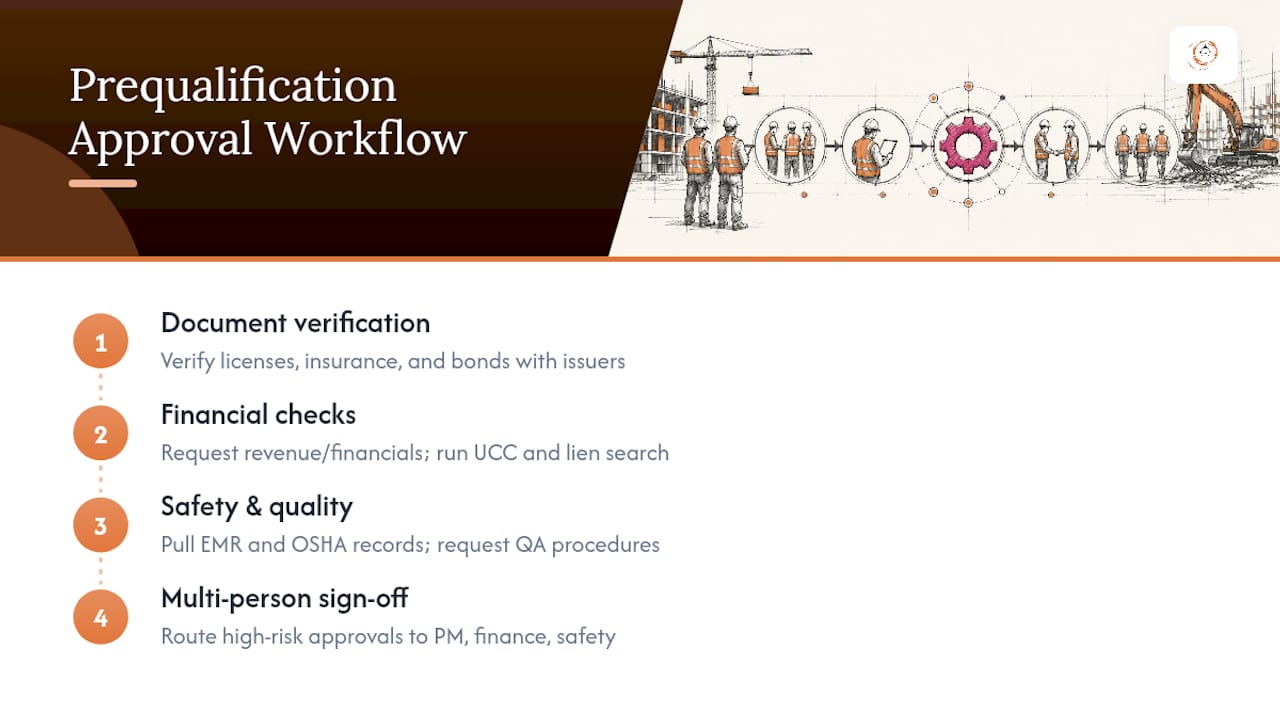
Document verification. Confirm license status directly with the state licensing board rather than trusting a printed card. For insurance, call the broker or carrier directly instead of relying solely on the certificate of insurance, because a COI is a snapshot in time and can be canceled or lapsed after issuance. If bonding is required, verify the bond’s authenticity and check the surety’s rating. If a sub shows no workers’ comp coverage, ask why before flagging it as a violation. It often means they have no employees, not that they’re noncompliant.
Financial checks. Request annual revenue volume, and for larger scopes, two years of financial statements. Run a UCC filing and lien search. Chronic liens or judgments are an early signal of cash flow trouble that will eventually show up as slow-paid material suppliers walking off your job.
Safety and quality. Pull EMR history and OSHA incident records, and ask for documented QA procedures. Call at least two prior general contractors as references, not just the one the sub suggests.
Approval workflow. A structured prequalification process with multi-person sign-off reduces individual bias and catches things one reviewer misses. For high-value or high-risk scopes, route approval through project management, finance, and safety before award.
Watch for red flags: an EMR consistently above 1.0, unexplained gaps in project history, reluctance to share financials on large scopes, or references who hedge more than they praise. Any one of those should trigger a closer look, not an automatic pass.
What Contract Terms Protect You After Award?
Mobilization is where good prequalification either pays off or gets undone by sloppy paperwork. The AGC’s guidance on preventing subcontractor default centers on a complete scope package and milestone-based contract management, and that starts before the sub ever shows up on site.
- Build a complete scope package. Spell out explicit inclusions and exclusions, schedule milestones, and submittal deadlines in writing. Ambiguity here is where change order disputes are born.
- Set payment terms deliberately. Define retainage percentages, payment application timing, and whether joint-pay arrangements apply to lower-tier subs. Avoid open-ended pay-if-paid language that leaves your sub exposed to your own client’s payment delays without a clear resolution path.
- Write flow-down clauses that mirror your prime contract. Require sub-subcontractor approval before hiring, enforce payment flow requirements, and mandate lien waivers at every payment cycle.
- Run a mobilization checklist before day one. Confirm current insurance, signed contract, submittal schedule acknowledgment, and safety orientation completion.
- Keep backups warm. Offer small scopes or priority bid invitations to your Tier B and C subs between larger projects, so they’re still available and still know your standards when you need them.
Should You Use a Directory, a Prequal Platform, or a Spreadsheet?
The right tool depends entirely on how many subs you’re managing and how often you’re hiring, not on which platform has the flashiest dashboard.
A spreadsheet with a shared calendar handles 20 to 30 active subs reasonably well, especially with disciplined ownership. Purpose-built prequalification platforms add automated certificate of insurance reminders, bid invitation workflows, and integration with estimating or project management software, worth it once you’re managing 50 or more subs across multiple concurrent projects. Directories sit somewhere in between: useful for initial discovery, weak for ongoing management.
Roll out any new system in phases. Pilot with your top 20 subs first, then expand. Tying system usage to payment, meaning no submitted documentation means no processed payment, drives adoption fast because it removes the incentive to skip the paperwork.
One caution: don’t let automation replace judgment on the items that matter most. Verify insurance and bonding manually with the broker or carrier before you trust an automated reminder system to flag lapses. For ongoing safety compliance tracking, a dedicated platform like safety meeting software built for construction crews can help close the gap between paper records and what’s actually happening on site.
Pro Tip: Before buying any platform, count how many subs you actively manage. If the number is under 30, a well-maintained spreadsheet will outperform a platform nobody bothers to update.
When Should a GC Bring In a Managed Sourcing Partner?
Some situations call for outside help rather than building everything in-house. Rapid hiring ramps, specialized trades with thin local supply, or repeated shortfalls where you’re consistently short a qualified electrician or mechanical sub at bid time are all signals that a managed sourcing relationship is worth exploring.
Constructconnect-rconstructionsolutions positions itself around a prorated payment structure and access to a pre-vetted network, an approach the firm describes as reducing the administrative load of verification while giving GCs faster access to pre-vetted subcontractor networks for trades where internal sourcing has come up short.
A managed sourcing partner doesn’t replace your prequalification process. It feeds it, ideally handing you candidates who’ve already cleared a first layer of screening so your internal approval workflow can move faster on the trades where you have the least bench strength.
For firms already stretched thin on procurement staff, that division of labor, partner sources and pre-screens, GC runs final approval, tends to fit naturally into an existing multi-person sign-off process rather than disrupting it.
How Do You Handle Subcontractor Conflicts Without Losing the Relationship?
Most subcontractor conflicts trace back to unclear expectations set at award, not personality clashes on site. The fix is communication structure, not charm.
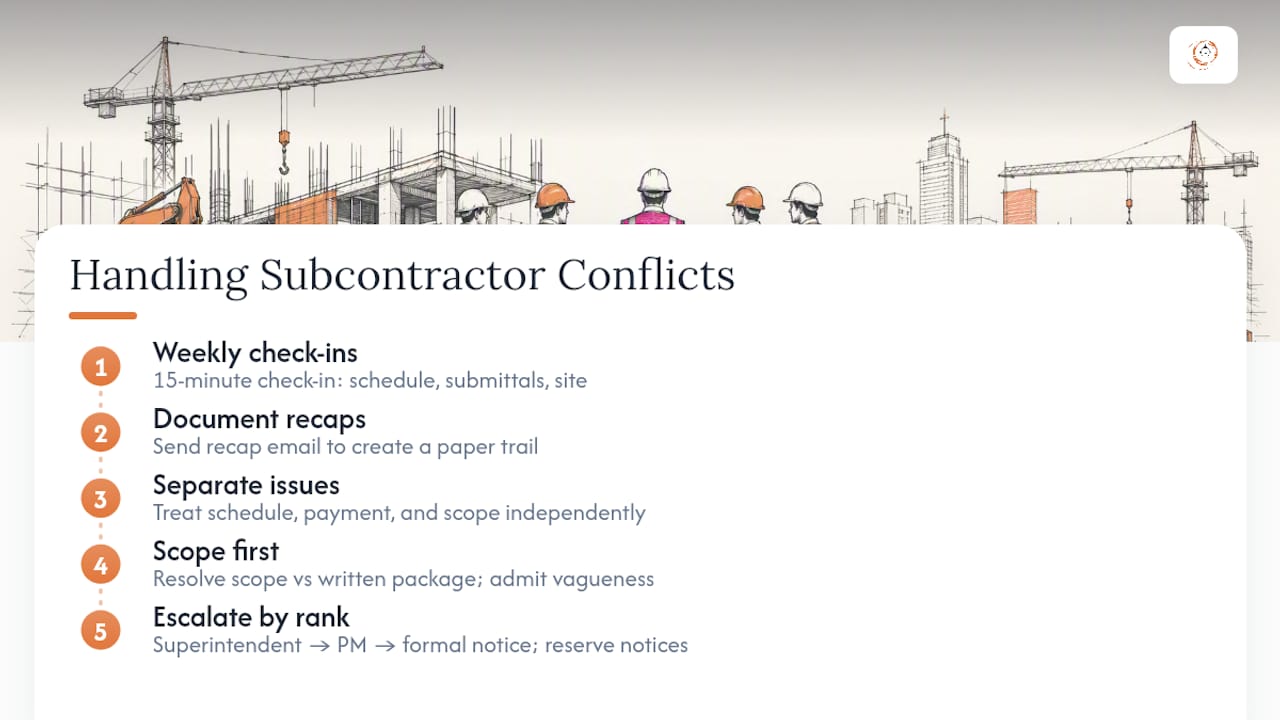
Set a weekly cadence with every active sub, even a fifteen minute check-in, covering schedule status, upcoming submittal deadlines, and any site conditions that affect their scope. Put it in writing afterward. A quick recap email creates a paper trail that resolves half of future disputes before they start, because both sides remember the conversation the same way.
When disagreements happen, and they will, separate the schedule issue from the payment issue from the scope issue. Bundling all three into one heated conversation guarantees nobody feels heard. Address scope disputes against the written scope package first. If the package was vague, that’s on your team, not the sub, and admitting that early defuses a lot of tension.
Escalate through a defined path rather than letting frustration dictate the next step: site superintendent, then project manager, then a documented formal notice if the issue persists. Reserve formal notices for real breaches, not routine friction. A sub who gets a formal notice for a minor schedule slip will remember it, and it will affect whether they bid your next job enthusiastically or reluctantly.
The subs worth keeping in your network long term are usually the ones who communicate problems early rather than the ones who never seem to have problems at all. Silence on a struggling schedule is a worse sign than an honest heads-up.
What Keeps Good Subcontractors Coming Back?
Retention is cheaper than replacement, and most GCs underinvest in it because prequalification feels like the finish line when it’s actually the starting point.
Prompt payment is the single strongest retention lever available. Subs talk to each other, and a reputation for paying on schedule, honoring payment applications without unnecessary delay, spreads through trade association circles faster than any marketing effort could. Pair that with early bid invitations for your Tier A subs before scopes go out to a wider pool. Priority access signals that the relationship has value beyond a single transaction.
Volume consistency matters too. A sub who gets steady, predictable work from you will prioritize your jobs over a GC who calls only when desperate. Consider structuring a simple tiering benefit: Tier A subs get first look at upcoming bids, faster payment processing, or reduced retainage on smaller scopes as their track record builds.
Recognition costs nothing and gets skipped constantly. A short note or call after a project closes out cleanly, acknowledging a sub who hit every milestone, builds goodwill that shows up later when you need a favor on a tight schedule. Combine that with a light annual review, not a full requalification, just a conversation about capacity and upcoming work, and you’ll find your best subs stay engaged instead of drifting toward competitors who never bothered to ask.
What Legal Risks Go Beyond the Basic Subcontract?
A signed contract is the floor, not the ceiling, for risk management. Several exposures sit outside the four corners of a standard subcontract and catch GCs who assume paperwork alone covers them.
Mechanic’s lien exposure is the most common gap. Even with lien waivers built into your payment cycle, verify waivers are conditional until payment clears, not unconditional at submission, or you lose your leverage the moment the check is cut. Cross-check every waiver against the actual payment amount before releasing funds.
Classification risk is another blind spot. Misclassifying a sub’s workers as independent contractors when the working relationship resembles employment can expose you to joint employer liability, particularly on prevailing wage or public projects. This is worth a periodic legal review, especially if a sub’s crew composition changes.
Indemnification language needs regular attention too, not a one-time contract template you never revisit. Insurance requirements shift, and a subcontract with indemnification limits that don’t match current coverage requirements leaves a gap exactly when you’d need protection.
Finally, document retention matters more than most GCs realize until a dispute lands in front of a judge or arbitrator. Keep prequalification records, correspondence, and change order documentation for the full statute of limitations period in your state, not just through project closeout. The AGC’s default-prevention framework treats this kind of documentation discipline as a core defense against default disputes, not an afterthought.
How Do Subcontractors Fit Into Your Project Schedule?
A subcontractor network only pays off if it’s actually plugged into how your project runs day to day, not just how it gets staffed on paper.
Build sub-specific milestones directly into your master schedule rather than treating subcontractor work as a black box between “start” and “finish.” Submittal deadlines, material lead times, and inspection windows should all appear on the same schedule your superintendent works from, tagged to the responsible sub.
Weekly coordination meetings work best when they’re short and structured: what’s on schedule, what’s slipping, and what needs a decision this week. Skip the meetings that turn into status theater with no real updates.
Give subs visibility into upstream and downstream dependencies. An electrician who knows drywall is two days behind can adjust rough-in timing instead of showing up to a site that isn’t ready. That kind of visibility reduces the finger-pointing that happens when trades collide over sequencing.
Whatever scheduling software or method you use, whether that’s a shared cloud schedule or a whiteboard in the trailer, the sub needs access to the same version everyone else is looking at. Version mismatches, where the sub is working off last week’s schedule, cause more real delays than most GCs give them credit for.
The Part Everyone Skips: Fixing the Process Before Buying the Tool
The biggest mistake I see is GCs buying prequalification software before fixing a broken verification process. Automating bad intake just speeds up the failure, it doesn’t fix it.
Don’t let one person own the whole database either. Spread sourcing, verification, and updates across roles with real deadlines attached. Track compliance rate, admin hours per sub, and document turnaround time from week one. If your local trade pool is thin, extend your bid lead time and offer small paid trial scopes to new subs before handing them anything big.
— Rowena
How R. Construction Solutions Can Help You Build a Stronger Network
If your internal sourcing keeps coming up short on the trades that matter most, there are options with a prorated payment structure that means you pay only as placements succeed over the first 90 days, rather than a lump fee upfront on a hire that hasn’t proven out yet.
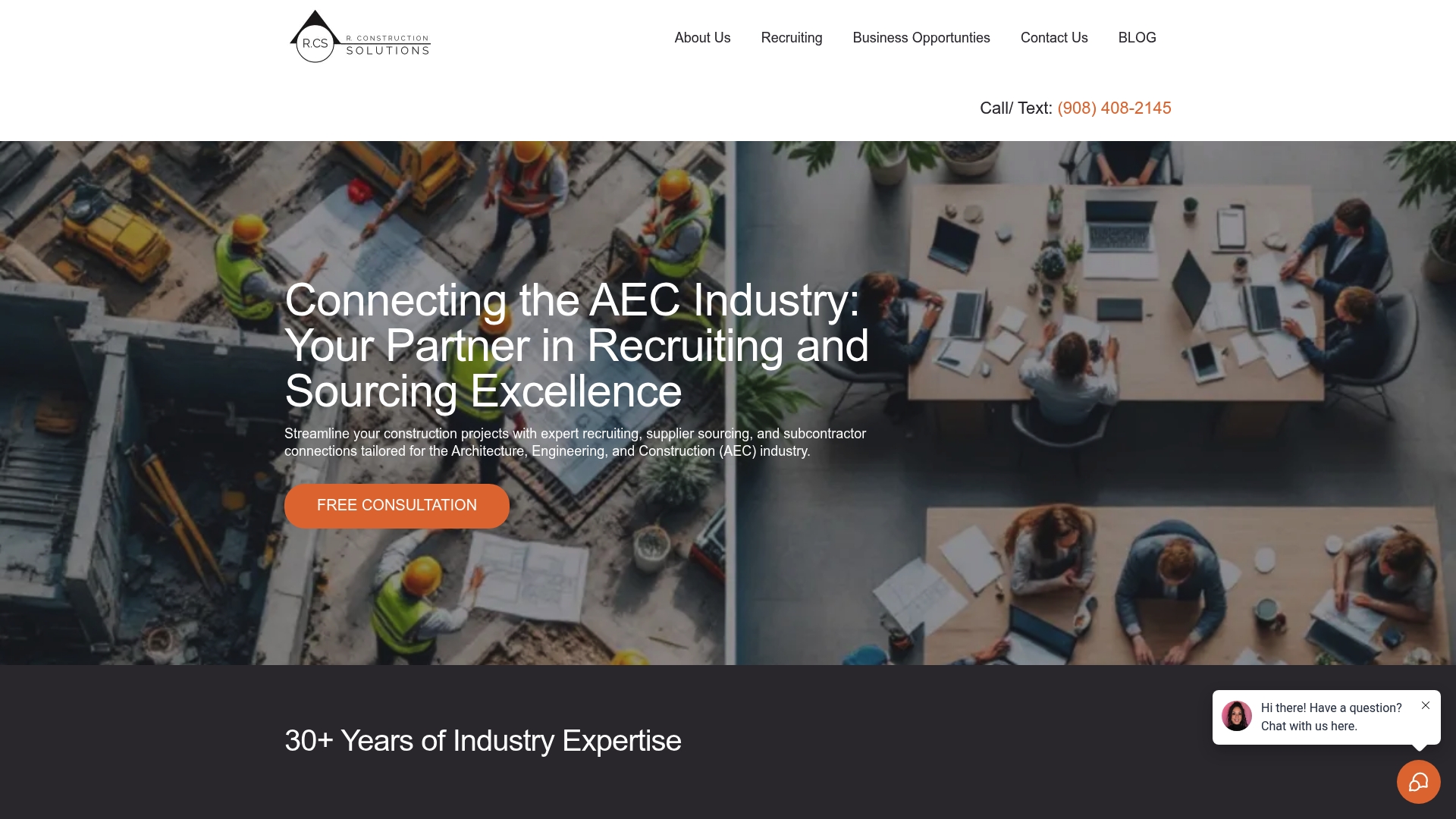
Constructconnect-rconstructionsolutions works across three areas that plug directly into the process outlined above:
- Recruiting Services, filling office and field roles with candidates already screened for construction-specific experience.
- Supplier Sourcing and Subcontractor Connections, drawing on a pre-vetted network built over more than 30 years in the AEC industry.
- Business Opportunity Sourcing, connecting GCs to new partner relationships and project leads.
That means less of your team’s time spent chasing documentation on unknown quantities. If your bench is thin on a specific trade or you’re staffing up faster than your current sourcing channels can keep pace with, visit the R. Construction Solutions site to discuss a scoped engagement.
Sources
- AGC Best Practices - Preventing Subcontractor Default
- Subcontractor vetting process | HBK CPA
- The GC’s Subcontractor Prequalification Checklist | Businessscreen
FAQ
How Do You Network Effectively as a Contractor?
The most reliable approach is showing up consistently at trade association events and building relationships with supplier counter staff, who see firsthand which subs pay on time and perform well. Peer referrals from other general contractors tend to outperform cold directory searches because they carry an implicit reputation check.
What Software Works Best for Managing Subcontractors?
There’s no single best platform. It depends on scale: a well-maintained spreadsheet handles roughly 20 to 30 active subs, while purpose-built prequalification platforms add automated insurance tracking and bid workflows once you’re managing 50 or more. The right choice is the one your team will actually update consistently.
What Do Subcontractors With the Highest Earnings Have in Common?
Subcontractors who earn the most typically specialize in a high-demand trade, maintain strong safety and compliance records, and build repeat relationships with a small number of reliable general contractors rather than chasing one-off bids. Consistency and a clean compliance history tend to matter more than volume of work bid.
How Much Does Constructconnect-rconstructionsolutions Cost?
Pricing for Constructconnect-rconstructionsolutions’s recruiting and sourcing services is not published and is available on request. The firm structures fees around a prorated payment model over the first 90 days, so clients pay based on successful placement rather than a flat upfront fee. Reach out through the recruiting services page for a scoped quote.
How Many Backup Subcontractors Should You Keep Per Trade?
Most industry guidance recommends keeping two to three prequalified backups per trade, balancing schedule protection against the administrative cost of maintaining a larger vetted bench than you’ll ever use.