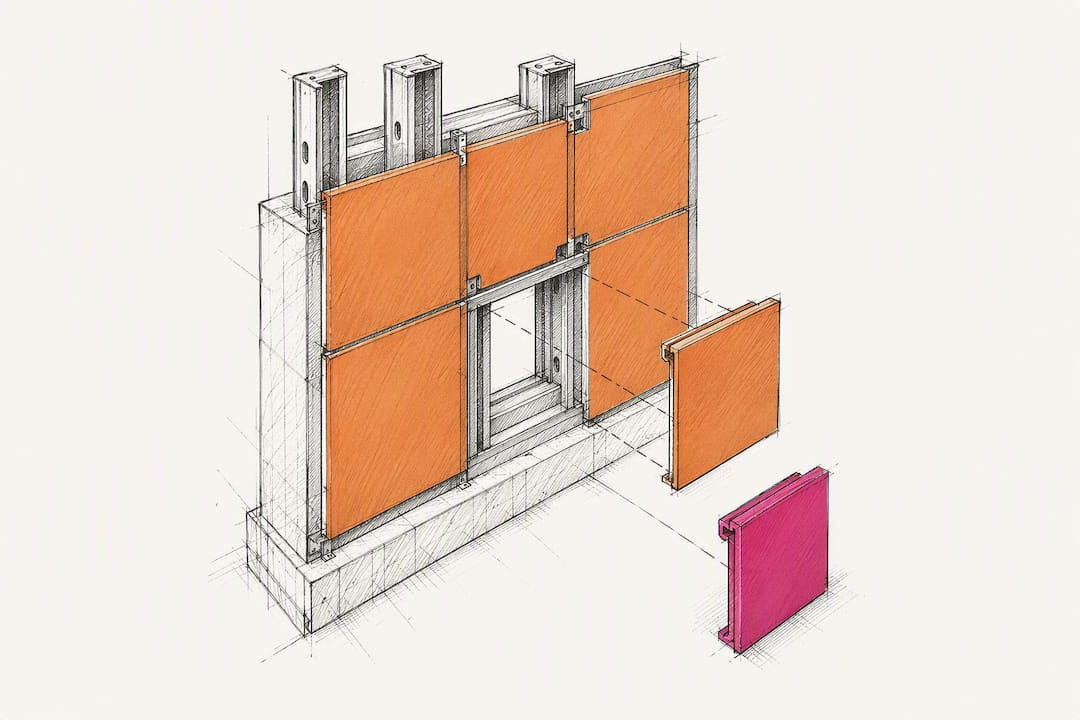
Stop $250,000 Waste from Rework on a $5M Job: PM's 30 Day Plan
Preventing rework starts with three moves: coordinate the design model before crews mobilize, require a first-work inspection with a hold point on every trade’s initial installation, and track defects in a simple Rework Reduction Program from day one. Run clash detection before the first shovel hits the dirt. Log every deficiency by cause, not just by trade. Do this consistently and most well-run projects can push rework meaningfully below the industry norm within two to three months.
TL;DR:
- Coordinating design models before mobilization and tracking defects by cause are essential to lowering rework below industry averages within two to three months.
- Rework costs typically range from 5% to 12% of the total project value, translating to $250,000 to $600,000 on a $5 million project, with indirect costs often exceeding direct repair expenses.
- Most rework originates from early decisions like design errors, incomplete drawings, owner changes, and communication breakdowns, making proactive planning crucial.
- Implementing phase-specific checks such as clash detection, first-work inspections, and formal documentation at each project stage significantly reduces costly rework.
- Using technology like BIM clash detection, mobile inspection apps, and predictive analytics can further prevent issues before they escalate, especially when integrated into a structured rework reduction program.
Table of Contents
- How Much Does Construction Rework Cost You?
- Where Does Rework Actually Start?
- What Should You Do at Each Project Phase to Prevent Rework?
- How Do You Measure and Track Rework Once You Start Preventing It?
- Which Technology Actually Reduces Rework, and Where Does It Pay Off?
- How Do You Launch a Rework Reduction Program This Month?
- Why Staffing and Subcontractor Quality Are Part of the Rework Conversation
- Where Does R. Construction Solutions Fit Into Your Rework Strategy?
- Sources
- FAQ
How Much Does Construction Rework Cost You?
Rework is not a rounding error. Industry estimates put it at roughly 5% to 12% of total project cost, a range built from decades of cost-of-quality studies across commercial and industrial work.
On a $5 million project, that translates to $250,000 to $600,000 in avoidable waste. Waterproofing failures are a good illustration of why the multiplier hurts so much: a repair discovered after the fact can cost five to fifteen times what the original installation would have cost, because you’re now demolishing finished work to get back to the failure point.
Statistic Callout: Rework routinely consumes 5% to 12% of a project’s total contract value — on a mid-size $5 million job, that’s $250,000 to $600,000 that never needed to leave the budget.
The indirect costs sting more than the repair invoice. Extended general conditions, idle crews waiting on corrections, and schedule slippage that triggers liquidated damages clauses all pile onto the direct repair cost. A three-week rework delay on a project with a $15,000-a-day liquidated damages provision adds up fast, and that number rarely shows up in anyone’s cost-of-quality spreadsheet until the owner’s attorney sends a letter.
Where Does Rework Actually Start?
Most rework traces back to decisions made long before a trade picks up a tool. Design errors, incomplete drawings, and owner-driven changes are the most common upstream causes identified across CMAA and Navigant research, and they set the stage for everything downstream.
Recent quantitative work backs this up with more granularity. A 2025 study modeling critical rework factors identifies four dominant drivers: management and planning deficiencies, design and time constraints, labor quality, and communication challenges. Notice that only one of those four is really about the trades doing the work.
Communication breakdowns between the general contractor, designers, and subcontractors compound the problem. Ambiguous scope language, rushed bid schedules, and a subcontract that never clearly assigns who owns a transition detail all create the conditions where rework becomes almost inevitable. Add fabrication errors from suppliers and out-of-sequence installation, where a trade installs before an upstream dependency is actually ready, and you have a fairly complete map of where things go wrong.
A simple cause-classification checklist in your daily log turns vague frustration into usable data:
- Design/documentation error (missing detail, conflicting drawings, outdated revision)
- Owner-directed change or late scope decision
- Communication gap between GC, designer, or trade
- Fabrication or supplier defect
- Out-of-sequence or premature installation
- Labor skill or workmanship issue
Coding every deficiency this way, even briefly, is what makes the Rework Reduction Program and positive safety culture described later actually work. Without a cause code, you’re just counting problems instead of solving them.
What Should You Do at Each Project Phase to Prevent Rework?
Prevention is not one big initiative. It’s a series of specific, phase-appropriate checkpoints that catch problems while they’re still cheap to fix.
- Design phase. Run federated BIM coordination and clash detection before drawings go out for pricing. Hold biddability reviews with the design team present, and get formal stakeholder signoffs on major systems before they’re locked. Early stakeholder involvement is one of the most consistently cited remedies for late-stage change orders.
- Preconstruction. Build a rolling three-week look-ahead schedule, freeze design decisions at defined checkpoints, and write subcontract scopes that leave no gray area about who installs what and where the responsibility line falls.
- Active construction. Require a first-work inspection for every trade’s initial installation, before it repeats down the floor or across the building. Superintendents should walk the site daily, and any hold point (waterproofing, structural connections, MEP rough-in) needs a signature and photo evidence before cover-up.
- Closeout. Verify work in stages rather than in one massive punch walk. Document formal acceptance for each system, and feed lessons learned back into your next project’s preconstruction checklist rather than letting them evaporate.
Pro Tip: Photograph every hold-point inspection, even the ones that pass cleanly. When a dispute surfaces six months later about who signed off on a detail, a timestamped photo settles it faster than any email chain.
How Do You Measure and Track Rework Once You Start Preventing It?

Prevention only sticks if you’re measuring it. The Construction Institute’s RRP framework describes a loop: track and classify every rework incident, evaluate patterns across cause codes, plan corrective action, then integrate the fix into your standard procedures so it doesn’t recur on the next project.
Four metrics make this loop concrete instead of theoretical:
- Defect rate per inspection, with a target under 5% on well-run projects, per operational benchmarks from quality control guides.
- First-time pass rate, where top performers clear 85% or higher on initial inspections without a callback.
- Deficiency closure time, ideally under seven days from flag to verified fix.
- Cost of quality, the running total of prevention, inspection, and correction costs as a share of contract value.
Statistic Callout: Projects tracking defect rates against a benchmark of under 5% and a first-time pass rate above 85% give PMs an early warning system instead of a postmortem.
Inspection governance ties it together. Every first-work inspection needs photo evidence, and every hold point needs a named signature, not a verbal thumbs-up. Run a Pareto analysis monthly. In nearly every dataset, roughly 20% of your cause codes generate 80% of your rework cost, so pointing corrective action at that top fifth is far more efficient than spreading effort evenly across every minor issue.
Which Technology Actually Reduces Rework, and Where Does It Pay Off?
Not every tech investment moves the needle equally. Model-based coordination and field-level visibility tools are the two categories with the clearest track record.
- BIM/VDC clash detection run on a federated model catches conflicts on screen instead of in the field. Coordination reviews on mid-size projects commonly surface hundreds of clashes; resolving even a fraction before construction avoids real rework dollars, since a clash caught on a screen costs a meeting, while the same clash caught in the field costs demolition and delay.
- Mobile field apps let superintendents push punch items and photo-backed inspection records to crews in real time instead of waiting for a weekly meeting.
- Predictive analytics. Ensemble classifier models can now forecast which nonconformance items are likely to carry the highest cost impact, letting PMs prioritize countermeasures before the cost multiplies.
Run clash detection at 50% and 90% design development, not just once at final issue. Then connect the outputs directly into your RFI log, punch list, and defect tracker so the same cause codes flow through every stage instead of living in three disconnected spreadsheets.
How Do You Launch a Rework Reduction Program This Month?
You don’t need a software rollout to start. You need a spreadsheet, a schedule, and someone accountable.
- Week 1: Define your metrics and cause codes, assign an owner, and set a weekly reporting cadence.
- Weeks 2 to 3: Pilot on one trade or one area of the building. Require first-work inspections with photo evidence for that scope only.
- Day 30: Run a Pareto analysis on what you’ve logged, then implement corrective actions and fold them into your SOPs.
- Month 2: Scale to additional trades and write quality expectations directly into subcontract language. If chronic supplier or subcontractor errors show up as a repeat cause code, qualifying subcontractors before project start closes that gap faster than another round of retraining.
Pro Tip: Pilot on your worst-performing trade, not your best. A 30-day dataset on a chronic problem area gives you a Pareto chart worth acting on; a clean trade just gives you a clean spreadsheet.
Why Staffing and Subcontractor Quality Are Part of the Rework Conversation
Placements matter more to rework than most schedules give them credit for. A superintendent who actually reads structural details before a pour, or an estimator who catches a scope gap before it becomes a change order, prevents rework simply by doing their job well.
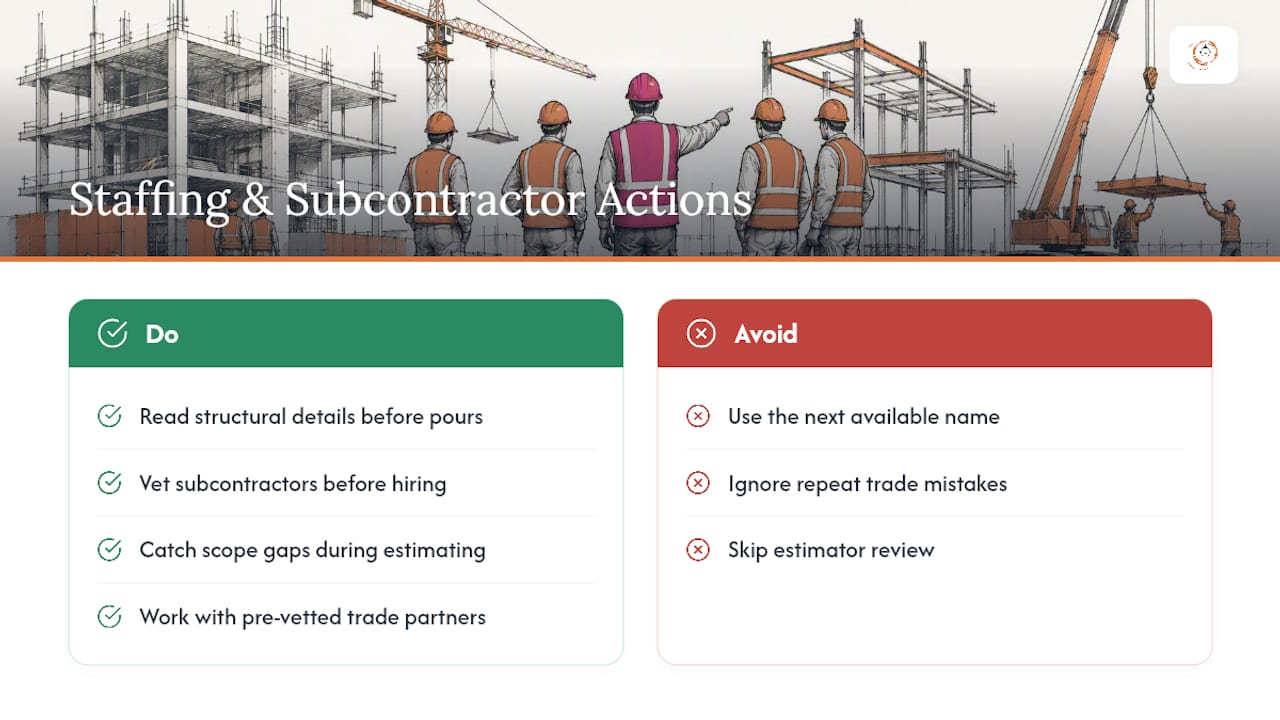
I have watched a poorly vetted subcontractor repeat the same waterproofing mistake across three floors before anyone connected the dots. That kind of repeat failure is a sourcing problem as much as a craftsmanship one, and it tends to disappear once a client works with pre-vetted trade partners instead of the next available name.
On a related note, we’re updating the imagery across our articles to better reflect the people actually building these projects, across race and gender, because construction’s workforce has never looked like the stock photos suggest.
— Rowena
Where Does R. Construction Solutions Fit Into Your Rework Strategy?
Chronic rework often traces back to the same handful of subcontractors or a superintendent who was never quite the right fit for the role. Constructconnect-rconstructionsolutions solves that at the source: our recruiting services connect AEC firms with pre-vetted subcontractors, suppliers, and field staff, backed by 30+ years in the industry, before the wrong hire or the wrong sub ever makes it onto your job site.

The commission structure is prorated over the first 90 days, so clients are not locked into a flat fee for a placement that doesn’t work out. If you’re seeing the same defect pattern from the same subcontractor project after project, that’s a sourcing issue, not a training issue. Get in touch through our recruiting page and tell us the trade or role giving you the most trouble. We’ll start there.
Sources
- The impact of rework on construction & some practical remedies (CMAA / Navigant)
- Modeling critical rework factors in the construction industry: insights and solutions (MDPI, 2025)
- Construction Quality Control That Eliminates Rework | Softabase
FAQ
What Does Rework Mean in Construction?
Rework is any activity that must be redone to correct work that was not performed correctly the first time, whether the error stems from design, fabrication, installation, or a missed coordination step.
Are Construction Costs Going Up in 2026?
Material and labor costs continue to fluctuate by region and trade, but rework remains one of the few cost drivers a project team can directly control, since it typically consumes 5% to 12% of contract value regardless of broader market pricing trends.
How Do You Reduce Change Orders in Construction?
Involve stakeholders early in design, freeze decisions at clear preconstruction checkpoints, and run BIM clash detection before pricing goes out, since most change orders trace back to design errors or late owner decisions that a coordinated model would have caught.
How Do You Avoid Scope Variation in Construction?
Write subcontract scopes with no ambiguity about where one trade’s responsibility ends and another’s begins, and pair that with clearly defined scope-of-work documentation before the contract is signed, not after a dispute starts.