Preconstruction Team Structure: Stop Costly Handoffs for Contractors
A properly structured preconstruction team runs through a single accountable lead, usually a VP or Director of Preconstruction, or a Preconstruction Manager backed by a Chief Estimator on smaller jobs, who owns the phase end to end. That lead is responsible for delivering five things at handoff: a validated estimate, complete scope packages, a preliminary schedule, a live risk register, and a working buyout plan. Get those five items right and most downstream schedule and cost problems never happen.
TL;DR:
- Clear ownership of scope development and reliable sign-offs reduce rework caused by scope gaps and miscommunication during preconstruction.
- Maintaining a responsibility matrix with designated primary and backup owners for each activity ensures accountability and timely decision-making.
- Staffing the preconstruction team appropriately for firm size, with dedicated roles for large firms and combined roles for small firms, improves quality and reduces burnout.
- Consistent use of version-controlled data, regular communication, and structured meetings enhance accuracy and coordination across estimating, scheduling, and procurement.
- Conducting formal handover procedures including signed acceptance checklists and preserving a snapshot of the cost model can significantly reduce post-award disputes and errors.
Table of Contents
- Building the Right Preconstruction Team Structure
- Who Owns What: The Preconstruction Responsibility Matrix
- Structuring Your Team by Firm Size and Delivery Method
- Preconstruction Deliverables Checklist
- Handoff to Operations: Where Precon Teams Lose the Most Money
- Collaboration Practices and Tools That Improve Accuracy
- Why Staffing Gaps Break Preconstruction (and How to Fix Them)
- A Quick-Start Checklist for This Week
- Solving Preconstruction Staffing Gaps With ConneX
- Sources
- FAQ
Building the Right Preconstruction Team Structure
Preconstruction fails less from bad estimating and more from unclear ownership. Someone assumes someone else logged the assumption. A scope gap sits unnoticed until the subcontractor bids it low, then fights for a change order at 60% complete. The fix isn’t more meetings. It’s a team structure where every role has a defined deliverable and a named owner.
Owner or owner’s representative. Sets the program requirements, budget ceiling, and approval gates. Signs off on the conceptual estimate before design proceeds past schematic.
VP or Director of Preconstruction. Owns the pursuit decision, staffing of the precon team, and the go/no-go call on bids. On larger firms, this role reports results to executive leadership and carries authority to reallocate estimators across active pursuits.
Preconstruction manager. The day-to-day quarterback. Coordinates estimating, scheduling, and design input, and is typically the single point of contact for the design team during precon. Preconstruction is a multidisciplinary coordination effort, and this role is where that coordination actually happens.
Chief estimator and estimators. Chief estimator sets estimating methodology and reviews final numbers before submission; estimators execute takeoffs, price scopes, and assemble bid packages. On a typical project, expect one chief estimator overseeing multiple estimators split by trade category.
Preconstruction engineer. Runs constructability reviews, evaluates alternative systems during value engineering, and flags design details that will be expensive or slow to build.
Scheduler. Builds the preliminary schedule, identifies long-lead procurement items, and models how design decisions shift the overall timeline.
Procurement or buyout lead. Manages subcontractor solicitation, bid leveling, and contract award. Often the same person as the preconstruction manager on smaller teams.
Specialty subcontractor advisor. Brings trade-specific pricing intelligence, usually a senior estimator with deep MEP, structural, or civil experience, consulted during scope development rather than staffed full-time.
Permitting or legal liaison. Tracks jurisdictional requirements and code compliance, flags permit timeline risk early enough to protect the schedule.
Project manager (secondary role in precon). Should be looped in before buyout, not after. Procore’s preconstruction guidance recommends assembling the owner, design team, GC or CM, and specialty contractors early, and that roster should include the PM who will inherit the job.
The most common structural mistake: collapsing the chief estimator and preconstruction manager into one person on a project large enough to need both. When that happens, estimating quality suffers because the person is also running meetings, chasing subcontractor pricing, and managing the design team.
Who Owns What: The Preconstruction Responsibility Matrix
Ownership confusion is the single biggest driver of rework in precon. A responsibility matrix fixes that by naming a primary owner and a backup for every core activity, so nothing depends on memory or informal agreement.
| Activity | Primary owner | Secondary/backup | Escalation trigger |
|---|---|---|---|
| Pursuit / go-no-go | VP of Preconstruction | Chief Estimator | Deal exceeds risk threshold set by leadership |
| Conceptual estimating | Chief Estimator | Preconstruction Manager | Estimate variance exceeds 10% between phases |
| Takeoff | Estimator | Preconstruction Engineer | Scope ambiguity found mid-takeoff |
| Scope development | Preconstruction Manager | Design Coordinator | Design team unresponsive past 5 business days |
| Value engineering | Preconstruction Engineer | Chief Estimator | Owner rejects VE options twice |
| Permitting | Permitting Liaison | Preconstruction Manager | Jurisdiction requires variance or special review |
| Risk review | Preconstruction Manager | VP of Preconstruction | Risk register flags item over budget contingency |
| Buyout | Procurement Lead | Project Manager | Bid spread exceeds 15% among qualified subs |
| Schedule | Scheduler | Preconstruction Manager | Long-lead item pushes milestone date |
This mapping matches how ownership is typically distributed across strategy, estimating, and buyout roles on well-run projects. To operationalize it, record every sign-off in the project management system with a timestamp and name, not just a checkbox. Version-control the estimate and scope documents so a reviewer can see exactly what changed between the 50% and 100% design estimates. Set a fixed cadence, typically weekly, where the preconstruction manager reviews open items against the matrix and reassigns anything that’s stalled past its escalation trigger.
Structuring Your Team by Firm Size and Delivery Method
A five-person GC and a 400-person national contractor cannot run the same preconstruction org chart, and trying to force one onto the other is how small firms burn out their best estimator.
Small firms (under 50 employees). One person often wears the preconstruction manager and chief estimator hats simultaneously. Scheduling and takeoff get outsourced to part-time consultants or handled by the same estimator using templated cost databases. Specialty subcontractor pricing comes from relationships built over years rather than a formal advisor role.
Mid-size firms (50 to 250 employees). A dedicated preconstruction manager with two or three estimators becomes standard. The project manager who will run construction typically joins precon meetings from the scope development stage onward, not just at handoff.
Large firms (250-plus employees). A layered structure with a VP or Director of Preconstruction, several precon managers running individual pursuits, and a full estimating group organized by trade. A documented delegation structure, with senior precon managers running engagements and estimators producing takeoffs, keeps quality consistent across simultaneous pursuits.
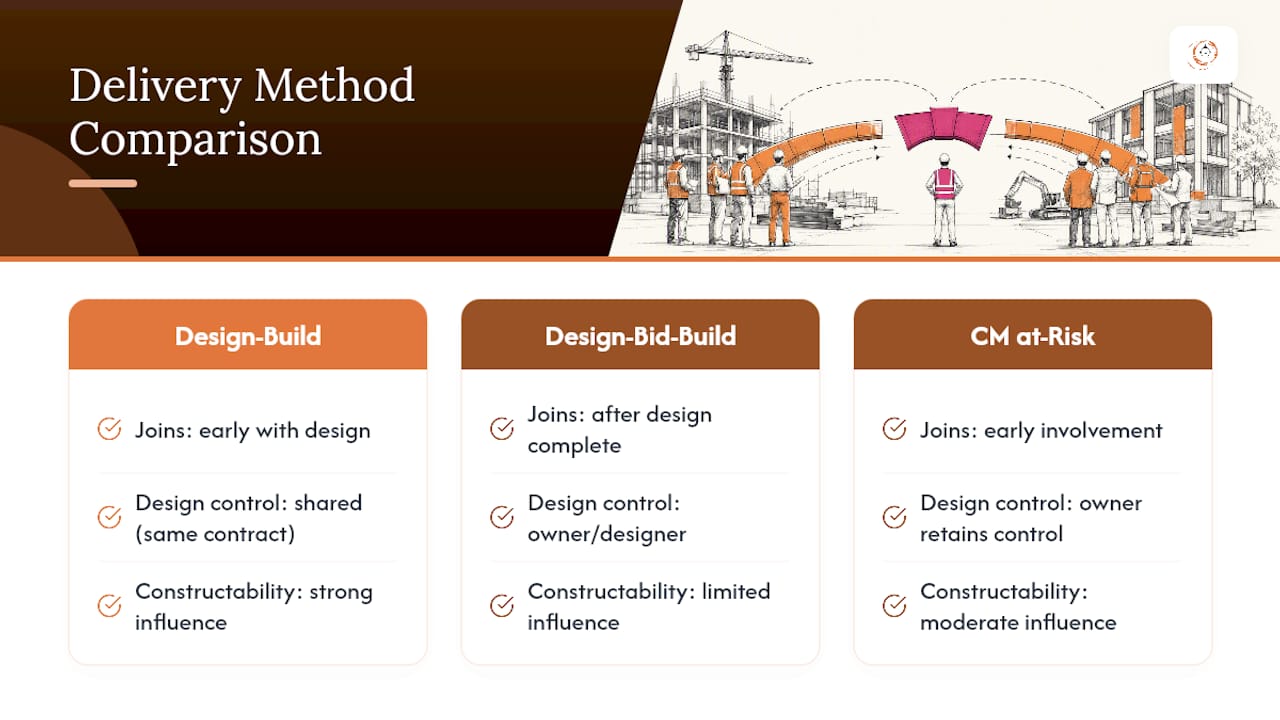
Delivery method changes who hold the pen. In design-build, the precon team and design team report to the same contract, so scope decisions move faster but the preconstruction manager carries more design-coordination weight. In design-bid-build, the GC typically enters after design is substantially complete, shrinking the precon team’s influence over constructability. Construction-manager-at-risk sits in between: the CM’s precon team joins early but the owner still controls design decisions.
Pro Tip: Hire full-time for roles with continuous workload across projects, chief estimator, scheduler. Contract or source through a recruiting partner for spiky or specialized needs, like a niche MEP estimator needed for one bid.
Preconstruction Deliverables Checklist
Every preconstruction phase should produce the same core set of outputs regardless of project size, though the level of detail scales with project complexity.
- Conceptual estimate. Owned by the chief estimator, due at schematic design, accepted when it falls within 15% of the owner’s target budget.
- Phased cost updates. Owned by the estimating team, delivered at each design milestone (schematic, design development, 100% construction documents), accepted when variance against the prior phase is documented and explained.
- Detailed scope packages. Owned by the preconstruction manager, finalized before bid solicitation, accepted when every trade division has a written scope with inclusions and exclusions.
- Preliminary schedule and long-lead list. Owned by the scheduler, due at design development, accepted when every item with a lead time over 12 weeks is flagged with a required order date.
- Risk register. Owned by the preconstruction manager, updated continuously, accepted when every open risk has an assigned owner and mitigation plan.
- Constructability review memo. Owned by the preconstruction engineer, delivered before 100% design, accepted when the design team has responded to every flagged item.
- Permit package. Owned by the permitting liaison, submitted per jurisdictional timeline, accepted upon formal filing confirmation.
- Buyout plan. Owned by the procurement lead, finalized before award, accepted when at least three qualified bids exist per trade.
- Assumptions and exclusions log. Owned by the preconstruction manager, maintained from day one, accepted when every line item traces to a source document.
Paste these nine items into a project folder as a running checklist and require sign-off dates next to each one before the project moves to construction.
Handoff to Operations: Where Precon Teams Lose the Most Money
The handoff from preconstruction to operations is where the phase’s good work gets undone. Three failure points show up again and again: assumptions made during estimating never get written down, scope packages ship incomplete because a trade got rushed at the deadline, and the project manager who will run the job wasn’t in the room when key decisions were made.
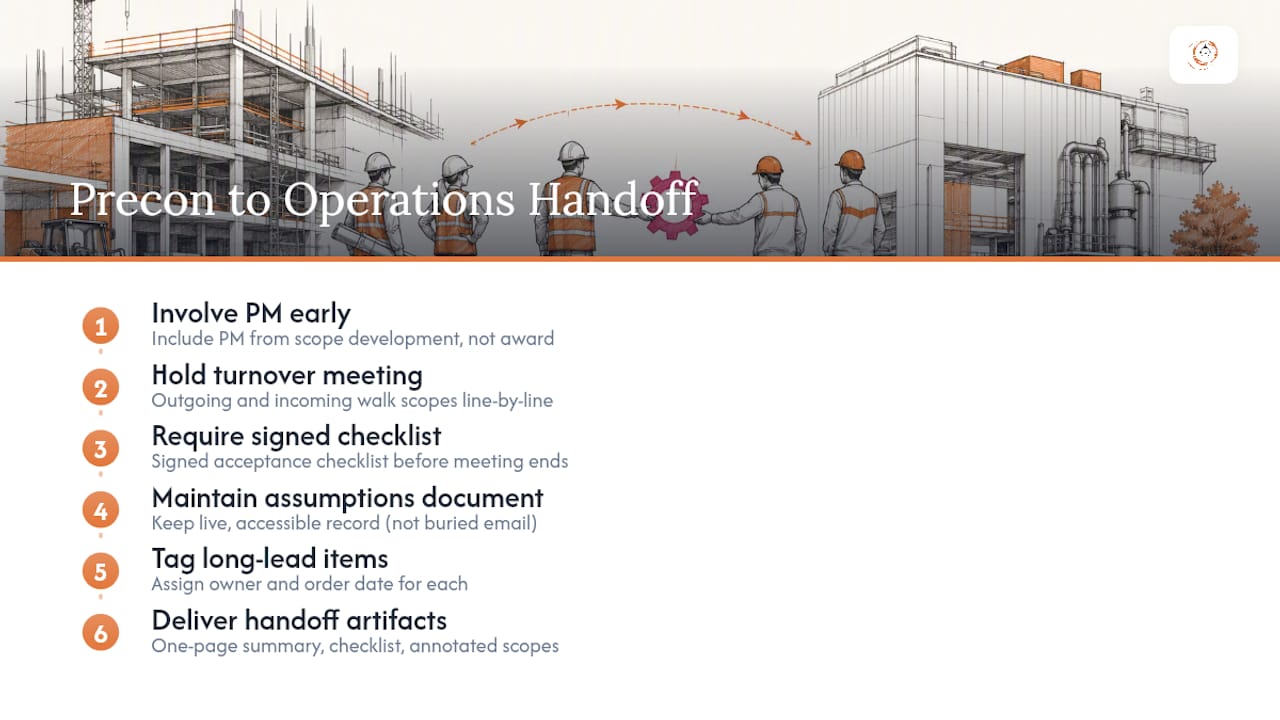
The gap between preconstruction and operations is a well-documented risk point, and the remedy isn’t complicated. Bring the PM into precon meetings starting at scope development, not at award. Hold a formal turnover meeting where the outgoing preconstruction manager and incoming PM walk through every scope package line by line, and require a signed acceptance checklist before the meeting ends. Keep the assumptions document alive rather than buried in an email thread, and tag every long-lead item with its owner and order date so nothing falls through during the transition.
Pro Tip: Attach a snapshot of the cost model, exactly as it stood at award, to the permanent project record. When a change order dispute surfaces six months in, that snapshot settles the argument fast.
At minimum, hand the PM three artifacts: a one-page project summary, the signed acceptance checklist, and annotated scope packages showing what changed and why during precon. Formal turnover documentation with signed acceptance measurably reduces post-award disputes.
Collaboration Practices and Tools That Improve Accuracy
Team structure only works if the people in it actually talk to each other on a schedule, and the right tool stack keeps that communication from turning into another swamp of outdated spreadsheets.
- Run a weekly estimating sync where the chief estimator reviews open takeoffs against the schedule, and hold dedicated VE workshops at each design milestone rather than folding them into general status meetings.
- Check subcontractor market pricing early and often. Regular market engagement and VE workshops measurably improve estimate accuracy and shorten buyout timelines.
- Adopt takeoff and estimating software with a shared, version-controlled cost database. This is the single highest-leverage tech investment for cutting estimate variance across projects.
- Use cloud document control so every team member works from the current drawing set, not a version three revisions old.
- Standardize on scheduling software that flags long-lead items automatically rather than relying on someone remembering to check.
Governance matters as much as the tools: one cost database, one drawing repository, and a rule that nobody prices off a document that isn’t the current version.
Why Staffing Gaps Break Preconstruction (and How to Fix Them)
Most preconstruction structure failures trace back to a staffing gap, not a process gap. A firm without a dedicated chief estimator asks an already-overloaded preconstruction manager to fill in, and quality slips exactly where accuracy matters most. Constructconnect-rconstructionsolutions has spent more than 30 years placing AEC talent, and its prorated 90-day payment structure means clients pay for placements that actually stick, not just a signed offer letter.
The roles filled most often through this model: preconstruction managers, estimators, and preconstruction engineers, each vetted against real project experience rather than a resume keyword match. Firms that brief a recruiting partner clearly, naming required software experience, years in a specific trade category, and expected deliverable timelines, consistently see faster time-to-buyout and fewer scope clarifications during construction.
A Quick-Start Checklist for This Week
If your preconstruction team feels unstructured, don’t try to fix everything at once. Finalize the ownership matrix first; a rough version beats no version. Second, get your project manager into precon meetings before scope development finishes, not after. Third, pick two deliverables, probably the risk register and the assumptions log, and standardize their format across every active pursuit. Then track two numbers: estimate variance at award and time-to-buyout. Both will tell you fast whether the structure is working.
— Rowena
Solving Preconstruction Staffing Gaps With ConneX
Constructconnect-rconstructionsolutions gives construction firms a lower-risk way to fill precon roles than a traditional staffing agency: a prorated 90-day payment structure means you’re not locked into paying full commission on a hire who doesn’t work out, and rates run below the industry standard for contingency recruiting. For the roles that break preconstruction most often when left vacant, chief estimators, preconstruction managers, precon engineers, that matters more than a flashy candidate pipeline.

Getting started means submitting a brief through the recruiting services page: required software experience, trade background, and the specific deliverables you need this hire producing in their first 90 days. From there, expect candidate profiles within the first two weeks, interviews in weeks three and four, and a placement decision by day 60, with the prorated structure covering days 60 through 90 as the new hire proves out on real project work. If your gap is on the subcontractor or supplier side rather than staffing, the business opportunity sourcing page connects you to pre-vetted partners built from three decades of AEC industry relationships.
Sources
- The Preconstruction Phase: What It Is, Who Owns It, and Where Costs Are Won or Lost
- The preconstruction phase
- What Is Preconstruction? Process, Phases & Roles Explained
FAQ
What are the five most common preconstruction services?
The five most common are conceptual estimating, scope and constructability review, scheduling with long-lead identification, subcontractor prequalification and buyout support, and risk register development.
What are the 7 phases of a construction project?
They generally run: planning and feasibility, design, preconstruction, procurement, construction, commissioning, and closeout, with preconstruction serving as the bridge between finalized design and active building.
What are the different stages of preconstruction?
Preconstruction typically moves through conceptual estimating, scope development, value engineering, constructability review, permitting, and buyout, with cost estimates refined at each design milestone.
What are the responsibilities of a preconstruction manager?
A preconstruction manager coordinates estimating, scheduling, and design input, owns scope development and the risk register, and serves as the primary point of contact between the design team and the estimating group.
Who should own the buyout plan in preconstruction?
The procurement or buyout lead typically owns it, with the project manager as secondary owner since they inherit the subcontractor relationships once construction begins.