CFO Playbook: 60–90 Day Bonding Capacity Boost for U.S. Contractors
The fastest way to increase bonding capacity is to raise your effective working capital by collecting receivables faster, releasing trapped retainage, and cleaning up your work-in-progress (WIP) schedule. That kind of cleanup can move your numbers in 60 to 90 days, while jumping to a higher capacity tier through stronger financial statements takes 12 to 36 months. Before you call your surety, have three documents ready: a current WIP schedule, your P&L and balance sheet, and a personal financial statement.
TL;DR:
- Improving receivables collection and releasing holdback funds can increase bonding capacity by up to 50% within 60 to 90 days without additional revenue.
- Cleanup of the work-in-progress schedule and explaining variances over 10% can quickly enhance credibility with sureties and support capacity growth.
- Strengthening financial statements from compiled to reviewed or audited can take between 12 and 36 months to enable larger bonding limits.
- Maintaining target benchmarks like a current ratio of 1.3 or higher and a working capital multiplier of 10 to 20 times is crucial for capacity approval.
- Building strong relationships with brokers and ensuring project backlog aligns with your capacity request improves chances of faster approval.
Table of Contents
- How to Increase Bonding Capacity Construction Firms Can Act on Now
- How Sureties Evaluate Capacity: The Three C’s
- Financial Playbook: Statements, Ratios, and Benchmarks
- Operational and Managerial Levers That Improve Capacity and Character
- What Goes Into a Surety Underwriting Package
- Timeline: Immediate Wins vs. Multi-Year Tier Changes
- Differences in Bonding Capacity Requirements by Project Type or Region
- Impact of Credit Scores and Personal Guarantees on Bonding Capacity
- Common Pitfalls and Mistakes Contractors Make When Applying for Increased Bonding
- Strategies for Building Relationships With Sureties and Brokers
- Role of Project Backlog and Pipeline in Capacity Evaluation
- How External Economic Factors Influence Bonding Capacity Limits
- Publisher Perspective: Staffing and Sourcing as an Underwriting Signal
- Build Bonding-Ready Operations With ConneX
- Sources
- FAQ
How to Increase Bonding Capacity Construction Firms Can Act on Now
Sureties do not reward good intentions. They reward numbers that have already moved. If you want to increase bonding capacity in construction without waiting a full fiscal year for new statements, work this list in order.
- Accelerate collections. Shorten your billing cycle, bill on the first and fifteenth instead of monthly, and invoice retainage the moment a project reaches substantial completion instead of waiting for final closeout. Pull your AR aging report today. Anything past 90 days often gets discounted entirely by underwriters, who treat it as unavailable collateral rather than real working capital.
- Clean up your WIP schedule. Reconcile under and overbillings against percentage-of-completion accounting, and write a one-paragraph explanation for any job with a variance over 10%. Underwriters expect a story for every outlier, not a spreadsheet that just shows one.
- Reprofile short-term debt. Move equipment loans and vehicle debt off revolving credit lines and onto term financing where you can. A line of credit used for working capital reads very differently to a surety than one propping up depreciating assets.
- Renegotiate retainage terms on new contracts before you sign, and track retainage receivable separately from standard AR so its impact on liquidity is visible at a glance.
Sureties read that ratio as a sign of cash flow strain, and it can undo months of collection progress on paper alone.*
How Sureties Evaluate Capacity: The Three C’s
Every underwriting decision comes down to three questions, and construction underwriters have asked them the same way for decades: Capital, Capacity, and Character.
- Capital means working capital and net worth, and it carries a multiplier effect. Sureties commonly apply rules of thumb of roughly 10 to 15 times adjusted working capital for a single job and 15 to 20 times for your aggregate program. Add $200,000 in real working capital and you may unlock $2 million to $4 million in additional aggregate capacity.
- Capacity covers your staffing depth, project management systems, and equipment fleet. A firm with a bench of qualified superintendents and an integrated job-cost system gives underwriters more confidence than one relying on a single owner to run every job.
- Character covers your track record, claims history, and the strength of your personal financial statement as owner. Research on surety underwriting confirms that firms with strong capacity and clean character but weak capital still often get declined, which tells you capital problems cannot be talked around.
Perpetuation and succession plans fall under Character too, and they matter more than most owners expect.
Financial Playbook: Statements, Ratios, and Benchmarks
Percentage-of-completion accounting is the backbone of every surety-ready WIP schedule. It recognizes revenue as work gets done rather than when cash changes hands, and it is the only method sureties fully trust for gauging where a job actually stands. A WIP schedule that does not reconcile cleanly to your balance sheet is one of the fastest ways to lose credibility with an underwriter.
Certain benchmarks come up in almost every underwriting conversation:
| Benchmark | Target range | Why it matters |
|---|---|---|
| Current ratio | 1.3 or higher | Signals you can cover short-term obligations without stress |
| Working capital multiplier (single job) | 10 to 15 times adjusted working capital | Sets your maximum single-contract limit |
| Working capital multiplier (aggregate) | 15 to 20 times adjusted working capital | Sets your total program ceiling |
| Underbillings as share of working capital | A value that sureties consider a red flag if exceeded | Higher values indicate cash flow risk to sureties |
Improving collection rates and releasing retainage that has been sitting on the books can increase bonding capacity by 30 to 50% without adding a dollar of new revenue. That is the single most underused lever in this entire process.
Statement quality is its own ladder, and each rung buys real capacity:
- Compiled statements, prepared by a CPA with no verification, support small programs, usually under $500,000 in single-job limits.
- Reviewed statements, which include analytical procedures and CPA inquiry, typically unlock mid-size programs and are the minimum most sureties want once you are bidding jobs above $1 million.
- Audited statements, with full CPA testing and verification, open the door to the largest single-job and aggregate limits, and most carriers want at least one full audited year on record before approving a major jump.
A construction-focused CPA who understands percentage-of-completion accounting and surety-specific disclosures is worth more here than a generalist, because reviewed and audited statement quality is one of the highest-leverage investments a growing contractor can make.
Operational and Managerial Levers That Improve Capacity and Character
Your balance sheet tells half the story. The other half is whether your systems and people can execute without surprises, and that is exactly what the Capacity and Character scores are built on.
- Implement an integrated job-cost system that captures committed costs, not just invoiced costs, and tie daily field reporting directly to your WIP updates so variances surface in weeks instead of at month end.
- Document your change-order process and your subcontractor prequalification standards in writing. A construction-focused CPA and consistent prequalification records reduce the guesswork an underwriter has to do about who is actually doing your work.
- Put a perpetuation plan and key-person insurance in place. Many carriers ask for this explicitly once a program grows past a certain size, and succession documentation alone can shift underwriting appetite even before working capital improves.
- Track your Experience Modification Rate (EMR) and claims history. A rising EMR signals safety and management gaps that sureties read as future claim risk, regardless of how clean your financials look.
Pro Tip: A project engineer hiring checklist and clear subcontractor prequalification standards do double duty: they reduce your actual project risk and they give your broker two more pieces of documented proof to hand the underwriter.
What Goes Into a Surety Underwriting Package
A scattered submission slows everything down. A tight one gets read the same week.
- Financial statements at your current tier (compiled, reviewed, or audited), plus year-over-year comparisons.
- A current WIP schedule reconciled to your balance sheet, with written explanations for any job showing a variance over 10%.
- Aged AR and AP reports, with anything over 90 days flagged and explained rather than buried.
- Bank lines, equipment loans, and a personal financial statement for every indemnitor.
- Backlog summary and key contracts, showing scope, remaining duration, and expected margin.
Use the contractor bonding qualification checklist to build this file before your renewal meeting, not during it. When you present, state the exact single-job and aggregate limits you are requesting, walk through your mitigation steps for any red flags, and explain your indemnity structure plainly. Underwriters respond to contractors who already know their own numbers.
Timeline: Immediate Wins vs. Multi-Year Tier Changes
AR and WIP cleanup can show measurable results within 60 to 90 days, often unlocking capacity without touching your revenue line. Moving from reviewed to audited statements is a different animal entirely. Most carriers want a full audited year of evidence before they approve a major tier jump, since a single audit does not establish a trend.
- 6 months: Clean AR aging, reconciled WIP, retainage tracked separately.
- 12 months: Upgrade from compiled to reviewed statements; document perpetuation plan.
- 24 months: First full audited year; renegotiated debt structure in place.
- 36 months: Established audited track record supporting a significantly larger aggregate program.
Differences in Bonding Capacity Requirements by Project Type or Region
Bonding capacity rules aren’t uniform. Public federal projects governed by the Miller Act require payment and performance bonds on most contracts over a statutory threshold, and the Small Business Administration’s surety bond program exists specifically to help smaller contractors meet those federal requirements when private commercial bonding falls short. State and municipal “little Miller Act” statutes vary by jurisdiction, and some states set bonding thresholds and retainage rules that differ meaningfully from federal standards.
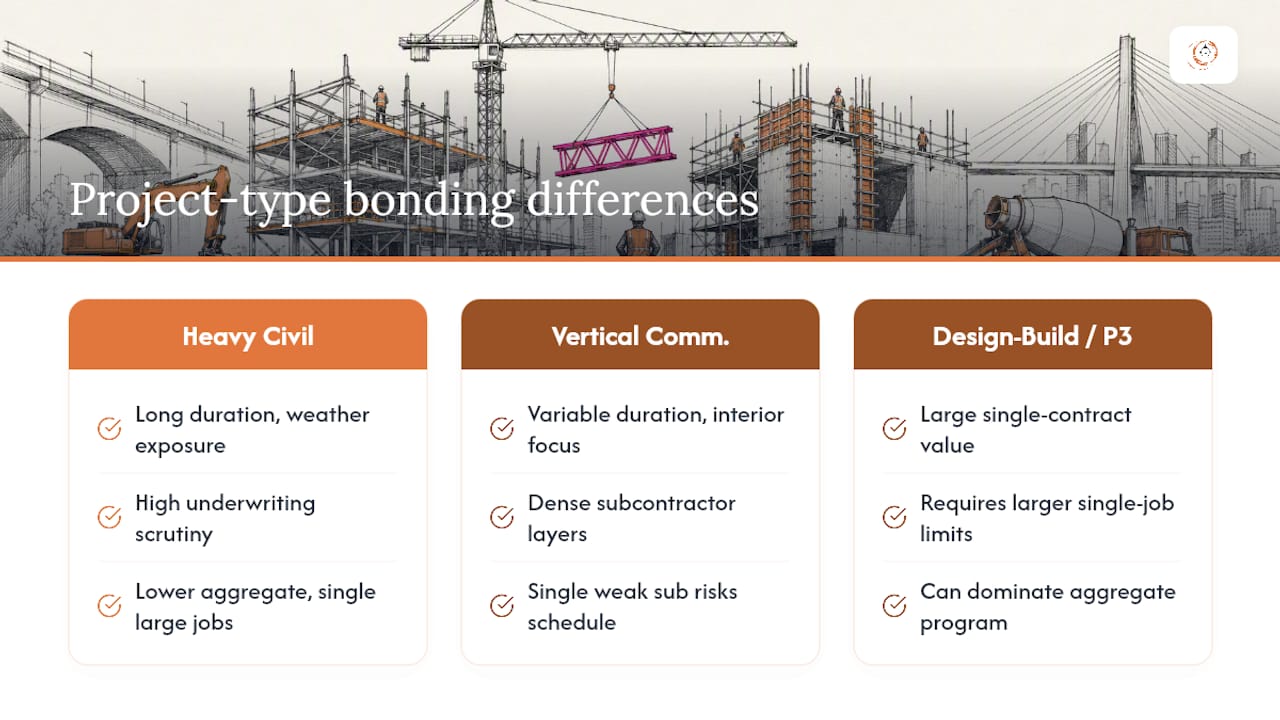
Project type matters just as much as jurisdiction. Highway and heavy civil work, with its long durations and weather exposure, tends to draw closer underwriting scrutiny than a straightforward tenant buildout. Vertical commercial construction with dense subcontractor layers raises questions about your prequalification process specifically because a single weak sub can sink a schedule. Design build and public private partnership work often requires larger single-job limits relative to your aggregate program, since one contract can represent a huge share of total backlog.
Regional labor markets add another layer. A contractor bidding in a market with a tight skilled trades pool faces more underwriter questions about staffing depth than one operating where subcontractor networks are deep and established. If you’re expanding into a new region, expect your surety to ask directly how you plan to staff and supervise work somewhere you don’t already have a track record. That is often the difference between an approved capacity increase and a request for more documentation.
Impact of Credit Scores and Personal Guarantees on Bonding Capacity
Your personal credit score matters more than most owners want to admit, especially for small and mid-size contractors where the company and the owner’s finances are still closely linked in an underwriter’s eyes. A personal financial statement (PFS) is a standard part of almost every underwriting package, and a weak PFS can cap your capacity even when your company financials look solid.
Personal guarantees, meanwhile, are close to universal for contractors seeking capacity increases beyond entry-level programs. Every owner with meaningful equity in the business will typically be asked to sign an indemnity agreement, which puts personal assets behind the bond. This isn’t a formality. It’s the mechanism that lets a surety extend capacity to a company whose balance sheet alone might not fully support it.
A few practical points follow from this. First, monitor your personal credit the same way you monitor your company’s AR aging, because late payments, high credit utilization, or new personal debt can quietly work against a capacity request. Second, if you have multiple owners or partners, expect every indemnitor to be underwritten individually, so one partner’s weak credit can drag down what the whole team qualifies for. Third, as your program grows, some sureties will discuss reducing personal guarantee exposure or moving toward corporate-only indemnity, but that conversation typically only opens once you have several years of strong audited financials and a documented perpetuation plan. Until then, treat the personal guarantee as a fixed cost of doing business at scale, not a negotiating point.
Common Pitfalls and Mistakes Contractors Make When Applying for Increased Bonding
The single biggest mistake is treating a capacity increase as a revenue problem instead of a balance sheet problem. Contractors chase bigger contracts to “grow into” more bonding, when the balance sheet fix usually would have unlocked the same capacity faster and with less risk.
A close second is showing up to a renewal meeting with stale or disorganized documents. A WIP schedule that does not tie to the balance sheet, an aged AR report with no explanation for old balances, or a personal financial statement that is a year out of date all signal disorganization, and underwriters read disorganization as risk, whether or not it’s accurate.
Other recurring errors include:
- Waiting until a bid deadline to ask for a capacity increase, leaving no time for underwriting review.
- Failing to explain large WIP variances, which forces the underwriter to assume the worst case.
- Letting retainage receivable sit unmonitored until it quietly erodes real working capital.
- Requesting a specific new limit without justifying it with backlog, staffing plans, or financial trends.
- Ignoring a rising Experience Modification Rate until it shows up as a red flag in the file.
Most of these are fixable with better preparation, not better luck. The contractors who get approved fastest are the ones who bring a clear ask, a clean file, and an honest explanation for anything that looks unusual.
Strategies for Building Relationships With Sureties and Brokers
Bonding capacity is a numbers conversation, but it is also a relationship one, and practitioner sources consistently point out that surety and broker relationships matter as much as the underlying financials. A broker who understands your business can frame a rough year honestly instead of letting the raw numbers speak for themselves in the worst light.
Start by meeting with your broker outside of renewal season, not just when you need something. A quarterly check-in where you walk through backlog, upcoming bids, and any financial changes builds a track record of transparency that pays off the one time you actually need an exception. Sureties remember contractors who called ahead about a problem versus ones who let it surface in the annual statements.
Be specific about your growth plans rather than vague. Telling your broker you want “more capacity” gives them nothing to underwrite. Telling them you’re targeting two $3 million public jobs next year and need your aggregate limit raised by a defined amount gives them a story to bring to the carrier.
Finally, treat your broker as a source of intelligence, not just a paperwork conduit. Brokers who work across multiple contractors in your region often know which carriers are appetite-hungry for your project type this year and which have tightened up. That knowledge can shape whether you push for an increase now or wait two quarters for a better market.
Role of Project Backlog and Pipeline in Capacity Evaluation
Backlog is one of the clearest signals a surety reads, because it shows whether your current capacity request matches your actual need. A contractor asking for a large aggregate increase with a thin pipeline raises a legitimate question: what is the extra capacity actually for?
Underwriters look at backlog-to-net-worth ratios as a gut check on whether your balance sheet can support the work already committed, let alone new work. A backlog that has grown faster than your working capital is a warning sign, even if every individual job is profitable, because it means your buffer against a slow-paying owner or a delayed change order has shrunk.
Pipeline quality matters as much as pipeline size. A backlog full of public agency work with predictable payment terms reads very differently than one concentrated in private commercial work with a single owner who has a history of slow payment. Diversification across owner types and project types also reduces the concentration risk a surety has to underwrite around.
If you’re requesting a capacity increase specifically to bid larger jobs, bring your pipeline data to that conversation, not just your financials. Show the specific contracts you’re targeting, their timelines, and how they fit inside the new limit you’re requesting. That turns an abstract ask into a concrete, reviewable plan, and it is exactly the kind of documentation that separates a fast approval from a request that sits in underwriting for weeks.
How External Economic Factors Influence Bonding Capacity Limits
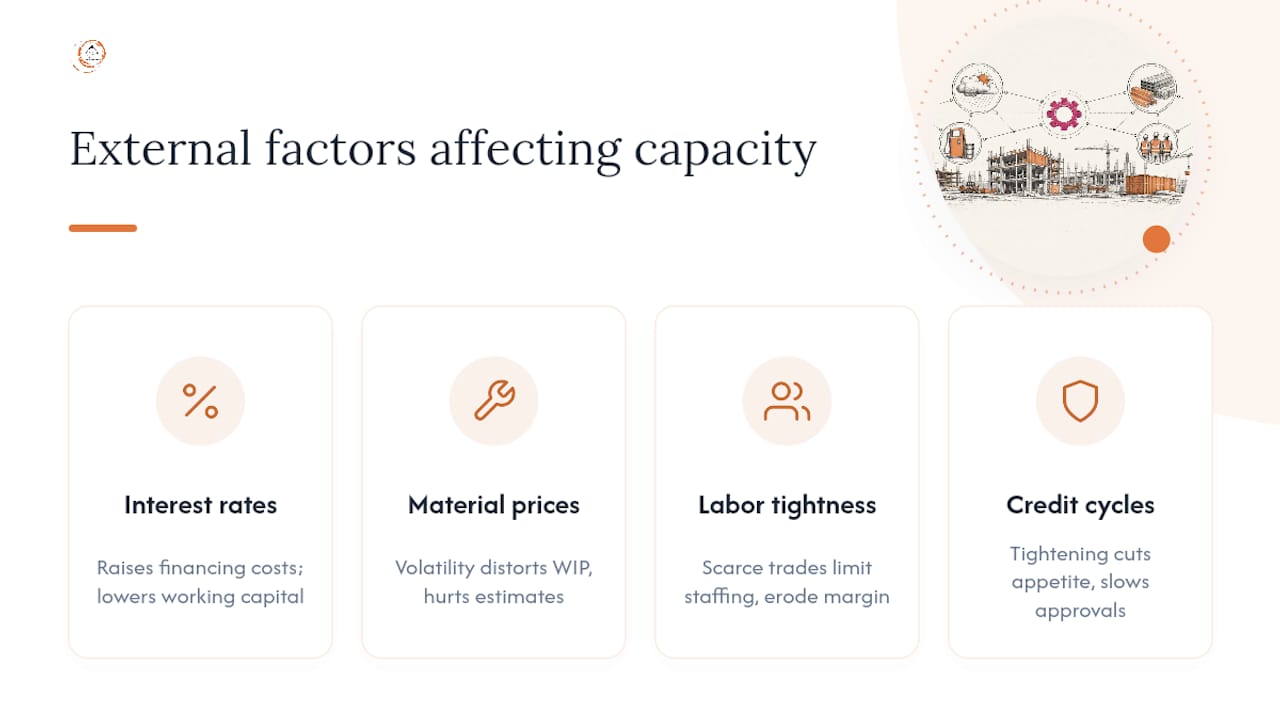
Bonding capacity does not exist in a vacuum. Broader credit conditions, material costs, and labor markets all shape how generous or conservative sureties are in a given year, regardless of how strong any individual contractor’s file looks.
When interest rates rise, the cost of carrying debt and financing WIP goes up, which can quietly erode the working capital sureties measure you against. Contractors who were comfortably inside their multiplier at one rate environment can find themselves tighter a year later even with flat revenue, simply because financing costs consumed more of their margin.
Material price volatility creates a related problem. Sharp swings in lumber, steel, or concrete pricing can distort WIP calculations mid-project, making percentage-of-completion estimates harder to trust unless your job-cost systems are current. Sureties that lived through recent volatility have become more attentive to how contractors document and update cost estimates in real time, not just at bid.
Labor market tightness affects Capacity scores directly. When skilled trades are scarce, sureties ask harder questions about whether you can actually staff a larger program without leaning on unvetted subcontractors or overtime that erodes margin. And in a broader credit tightening cycle, some carriers pull back appetite across the board, meaning even well-qualified contractors may see slower approvals or more conservative limits, independent of their own financial improvement. None of this means you should wait for a perfect economic moment. It means your documentation needs to work harder in a cautious market than it does in a generous one.
Publisher Perspective: Staffing and Sourcing as an Underwriting Signal
Most bonding advice treats staffing as an HR afterthought. That is a mistake. Sureties measure Capacity in part by whether you have the people to execute without schedule slippage or margin erosion, and a contractor relying on one overstretched superintendent to run three jobs looks riskier than one with a documented bench.
Constructconnect-rconstructionsolutions works this exact problem from the recruiting side: placing qualified superintendents, project engineers, and estimators, and connecting contractors to pre-vetted subcontractor networks. Reliable staffing and prequalified subcontractors reduce the operational surprises that turn into claims, and claims are what erode Character scores for years afterward.
— Rowena
Build Bonding-Ready Operations With ConneX
Increasing your bonding capacity is a financial project, but it is also a staffing and reliability project, and that second half is where most contractors run out of runway. Constructconnect-rconstructionsolutions built ConneX specifically for this gap: a prorated, lower-commission recruiting model that only charges for successful placements, backed by 30-plus years of AEC-specific sourcing experience.

If you’re staging a capacity increase over the next 6 to 36 months, the moment to call ConneX is before you submit a major bid, not after you win one and realize you’re short a superintendent or a prequalified sub. Bringing in an experienced project engineer or connecting with a vetted subcontractor network directly strengthens the Capacity signal your surety is already watching, and it means your growth plan isn’t held up by an execution gap on the ground. Explore ConneX recruiting services and start the conversation about the roles and subcontractor relationships your next tier of bonding will actually require.
Sources
- Surety Bonds (U.S. Small Business Administration)
- How to Increase Your Bonding Capacity Without Growing Revenue | Level
- How to Increase Your Bonding Capacity: The Real Playbook for Growing a Bond Program (Grit Insurance)
- Surety underwriting criteria study (DOI)
FAQ
What Is Bonding Capacity in Construction?
Bonding capacity is the maximum contract value a surety will guarantee for a contractor, expressed as both a single-job limit and an aggregate program limit across all active bonded work.
How Does a 5% Bid Bond Affect the Contractor?
A bid bond, typically set at 5% of the contract value, guarantees that if you win the bid, you’ll sign the contract and provide the required performance and payment bonds; failing to do so can forfeit that percentage to the project owner.
How Much Does a $500,000 Performance Bond Cost?
Performance bond premiums typically run a small percentage of the contract value, often in the 1 to 3% range depending on the contractor’s financial strength and underwriting tier, with rates varying by carrier and risk profile.
What Is a Good Bond Rate for a Construction Company?
There’s no single universal rate. Well-qualified contractors with audited statements, strong working capital, and clean claims history typically secure lower premium rates than contractors with compiled statements and thin capital, since the three C’s of underwriting directly influence the price you’re offered.
How Fast Can I Actually Increase Bonding Capacity?
Cleaning up accounts receivable, retainage, and your WIP schedule can move capacity within 60 to 90 days, while moving to a higher statement tier (reviewed to audited) for a major limit increase typically takes 12 to 36 months.