Construction Managers: Hire a VDC Engineer in Weeks with Job Templates
The fastest, lowest-risk path depends on urgency and role rarity: hire in-house when the workload is ongoing and predictable, bring in a contractor for a single project phase, and engage a specialized AEC recruiter when you need someone within weeks or the role demands rare clash-detection and 4D scheduling depth. Whatever route you choose, list Revit, Navisworks, and clash detection as non-negotiable skills on day one. Then either post a role-specific job description using the templates below or contact a recruiter today to explore master systems integration for smart building capabilities.
TL;DR:
- Most candidates lack hands-on experience with clash detection under deadline pressure, making practical tests essential in interviews.
- Salaries typically start in the mid $70,000s for VDC engineers, rising into six figures for senior roles, especially in complex projects or major markets.
- A clear progression from junior to lead VDC engineer involves increasing responsibility for trade coordination, schedule integration, and team management.
- Using specialized construction recruiting firms accelerates hiring, especially for urgent or rare skill requirements, by accessing pre-vetted candidate networks.
- Accurate job classification and well-defined contractual terms are crucial to avoid legal issues, and onboarding should include early access to models and milestone plans.
Table of Contents
- What Does a VDC Engineer Do (And How Is It Different From BIM Coordination)?
- What Skills and Software Should You Require?
- How Do You Write a VDC Engineer Job Description?
- Where Do You Find Qualified VDC Talent?
- What Interview Questions and Tests Actually Predict Performance?
- What Should You Budget for Salary and Timeline?
- What Legal and Contractual Terms Should You Nail Down?
- How Do You Onboard a New VDC Engineer for Fast Productivity?
- When Does It Make Sense to Bring in a Specialized AEC Recruiter?
- How Constructconnect-rconstructionsolutions Fills VDC Roles Faster
- Sources
- FAQ
What Does a VDC Engineer Do (And How Is It Different From BIM Coordination)?
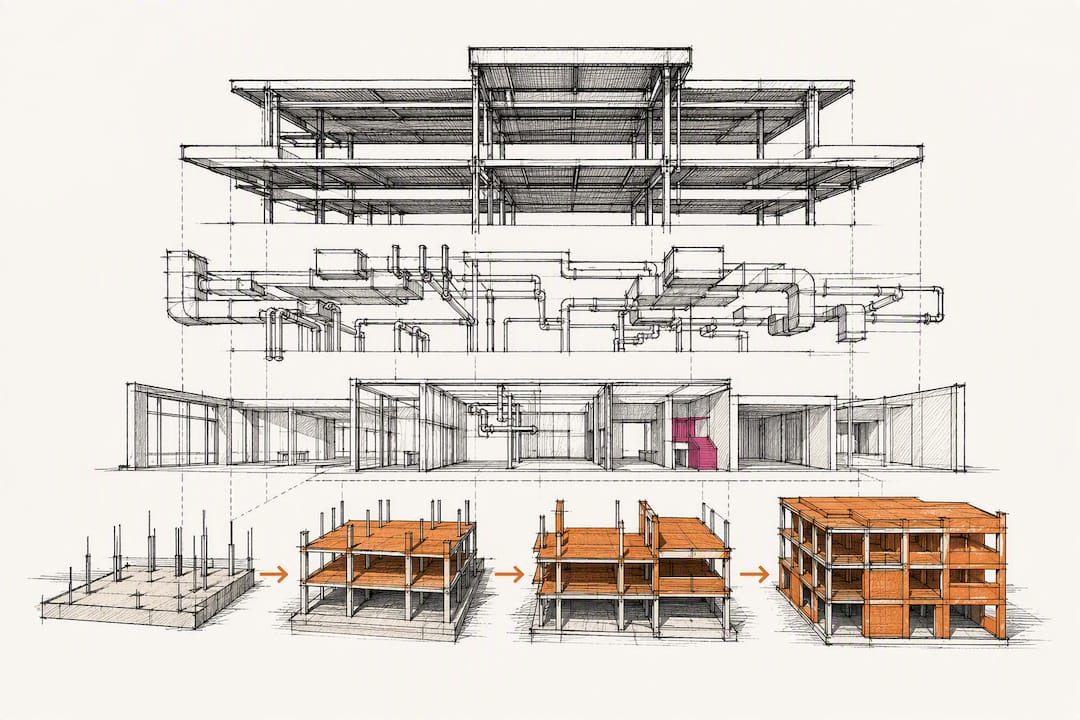
A Virtual Design and Construction engineer manages the digital model as a construction decision-making tool, not just a drawing repository. That distinction matters more than most job postings admit. VDC extends beyond basic BIM coordination by folding in 4D sequencing, procurement timing, and constructability review, so the model informs schedule and budget decisions rather than just resolving pipe-versus-duct conflicts.
Hiring managers who write “BIM Coordinator” job postings when they actually need VDC support end up with candidates who can spot a clash but can’t tell you what that clash does to next week’s concrete pour. Ask specifically for schedule integration and constructability tasks in the posting, not just “model management.”
Core responsibilities typically break down like this:
- Preconstruction: Model coordination across trades, constructability reviews, quantity takeoffs feeding early cost estimates.
- During construction: 4D sequencing tied to the master schedule, clash resolution meetings with subcontractors, as built model updates.
- Field support: Layout support using total stations or robotic layout tools, RFI response backed by model evidence, punch list tracking.
Seniority changes the scope, not the toolset. A junior VDC engineer runs clash detection cycles and documents issues. A senior engineer owns the coordination process across multiple trades and presents findings to the project team. A lead VDC engineer sets modeling standards across projects, manages junior staff, and negotiates model-based deliverables directly with the general contractor’s owner or design team.
What Skills and Software Should You Require?
Screening starts with software fluency, but stops well short of it. A candidate who knows Revit but has never run a real clash-detection cycle under deadline pressure will struggle on an active job site.
Essential software:
- Autodesk Revit for authoring and coordination
- Navisworks for clash detection, review, and 4D sequencing
- AutoCAD for 2D documentation and legacy drawing sets
Valuable secondary tools:
- Dynamo for automating repetitive modeling tasks
- Assemble for quantity extraction and model-based estimating
- Synchro or Fuzor for advanced 4D visualization
- Scan-to-BIM software and point-cloud processing for renovation and existing-conditions work
Common VDC job postings list Revit, Navisworks, and AutoCAD as baseline requirements, with 4D/5D familiarity and clash detection listed as differentiators between entry-level and mid-career candidates. Process knowledge matters as much as software: ask whether the candidate understands Level of Development (LOD) standards and can walk you through a clash resolution workflow from detection to sign-off.
Domain experience separates good candidates from great ones. Someone who has spent two years on ground-up commercial work will approach a renovation project differently than someone who has never touched scan-to-BIM. Scan-to-BIM familiarity is now a real qualifier for any project involving existing conditions, not a nice-to-have.
Soft skills carry real weight for senior roles: field presence, MEP literacy, and the ability to explain a model issue to a superintendent who has never opened Navisworks. Certifications like Autodesk Certified Professional credentials help, but two to four years of field-adjacent modeling experience usually predicts performance better than a certificate alone.
Pro Tip: Ask for a specific example of a clash the candidate resolved that changed a construction sequence, not just a model. Anyone can find a clash. Fewer people can explain what it cost the project if it had gone unresolved.
How Do You Write a VDC Engineer Job Description?
Job titles shape who applies before they ever read the requirements. “VDC Coordinator” attracts junior candidates. “VDC Engineer” or “VDC Manager” signals more ownership. “Lead VDC Engineer” or “VDC Director” should only go on postings where the hire will set standards across multiple projects.
Three ready-to-adapt templates:
- Junior VDC Engineer: Runs clash detection in Navisworks, maintains Revit models under senior direction, documents coordination issues, supports RFI responses with model screenshots. Require: 1 to 3 years of experience, working Revit and Navisworks knowledge, a portfolio of at least one coordinated model.
- Senior VDC Engineer: Owns trade coordination meetings, builds 4D sequences tied to the master schedule, trains junior staff on modeling standards, interfaces directly with subcontractors and the general contractor’s project team. Require: 4 to 7 years, demonstrated 4D scheduling experience, a sample deliverable showing a resolved multi-trade clash.
- Lead VDC Engineer: Sets firm-wide modeling standards, manages a team of VDC staff, negotiates model-based deliverables with owners and design teams, evaluates new software adoption. Require: 7-plus years, prior team leadership, portfolio spanning at least three completed projects.
Every template should demand a work sample, not just a resume claim. Ask for a coordinated model excerpt or a clash log from a past project, and confirm the candidate’s notice period upfront. Mid-career VDC professionals often carry two to four weeks of notice and competing offers, so a slow screening process costs you candidates.
Where Do You Find Qualified VDC Talent?
General job boards generate volume, not fit. Indeed alone lists thousands of open VDC engineer postings at any given time, which tells you demand is high and competition for attention is fierce, not that the right candidate will find your listing.
Higher-yield channels for construction-specific talent include:
- Specialized AEC recruiting firms with existing candidate networks
- Construction-focused LinkedIn groups organized around Revit, Navisworks, or regional AEC associations
- University construction management and civil engineering alumni programs
- Employee referral incentives, since experienced VDC engineers tend to know others in the field
- Trade association events and BIM/VDC user group meetups
Specialized AEC candidates are rarely sitting on the market waiting for a job board hit. Mid-career professionals with real coordination experience are typically employed and passively watching, not actively applying. That’s where a contingency recruiter or staffing partner earns its fee: they maintain warm relationships with candidates who aren’t scrolling job boards at all.
Direct sourcing works when you have time and an in-house recruiter who understands construction terminology well enough to screen resumes accurately. A staffing partner or contingency recruiter makes more sense when the role needs to be filled inside a tight schedule window, when the required specialization is rare (heavy renovation experience, MEP-focused coordination, or hospital and lab project background), or when your internal team lacks the bandwidth to run a proper search. When you do reach out cold, lead with the project and the modeling challenge, not a generic job title. Candidates with options respond to specifics.
What Interview Questions and Tests Actually Predict Performance?
Resume claims about software fluency mean little without a practical check. Build your interview around scenarios, not just credential verification.
- Ask the candidate to walk through a real clash-detection cycle they ran, including how they prioritized issues and who they looped in for resolution.
- Present a hypothetical 4D sequencing conflict (a schedule compression that creates a trade stacking issue) and ask how they’d flag it and to whom.
- Ask about a time a field superintendent disagreed with a model-based recommendation and how they resolved it.
- Give a short practical test: a small Navisworks file with three to five planted clashes, and ask the candidate to identify and prioritize the top three issues within 60 to 90 minutes.
- A second practical option: hand over a rough 4D sequence draft and ask them to identify one logic error, explaining their reasoning out loud.
A short clash-detection exercise with a request to summarize the top three actionable issues reveals far more about real capability than a resume bullet point ever will.
Red flags worth watching for: candidates who can’t explain how a model change affects schedule or cost, no field-facing experience at all for a role that requires job site interaction, and vague answers about past clash resolution that avoid specifics about trades or outcomes.
Pro Tip: If a candidate describes every past project in passive language (“clashes were resolved,” “the model was updated”), press for who made the call. VDC engineers who actually drove decisions describe their own actions directly.
What Should You Budget for Salary and Timeline?
Compensation varies by region, project type, and seniority, but the pattern is consistent across postings.
Salary snapshot: A representative current posting for a VDC Engineer role shows base pay commonly starting in the mid $70,000s and extending into six figures for senior positions, with major metro markets and complex project types (health care, data centers, high-rise) pushing toward the top of that range.
Contract or day-rate engagements make sense for short-term coverage, a single project phase, or when you need someone immediately while a permanent search runs in parallel. Day rates reflect the same seniority tiers as salaried roles, and contractors typically expect no benefits package but a premium rate to compensate.
Timeline benchmarks: expect four to eight weeks from posting to offer for a standard mid-level hire through general channels, and often faster through a specialized recruiter with an existing pipeline. Targeted recruiting shortens time-to-hire specifically because mid-career candidates carry notice periods and competing offers, so speed in your own process matters. Tighten your offer window, consider a signing bonus for urgent starts, and use temp-to-hire arrangements when you want to validate fit before committing to a permanent offer.
What Legal and Contractual Terms Should You Nail Down?
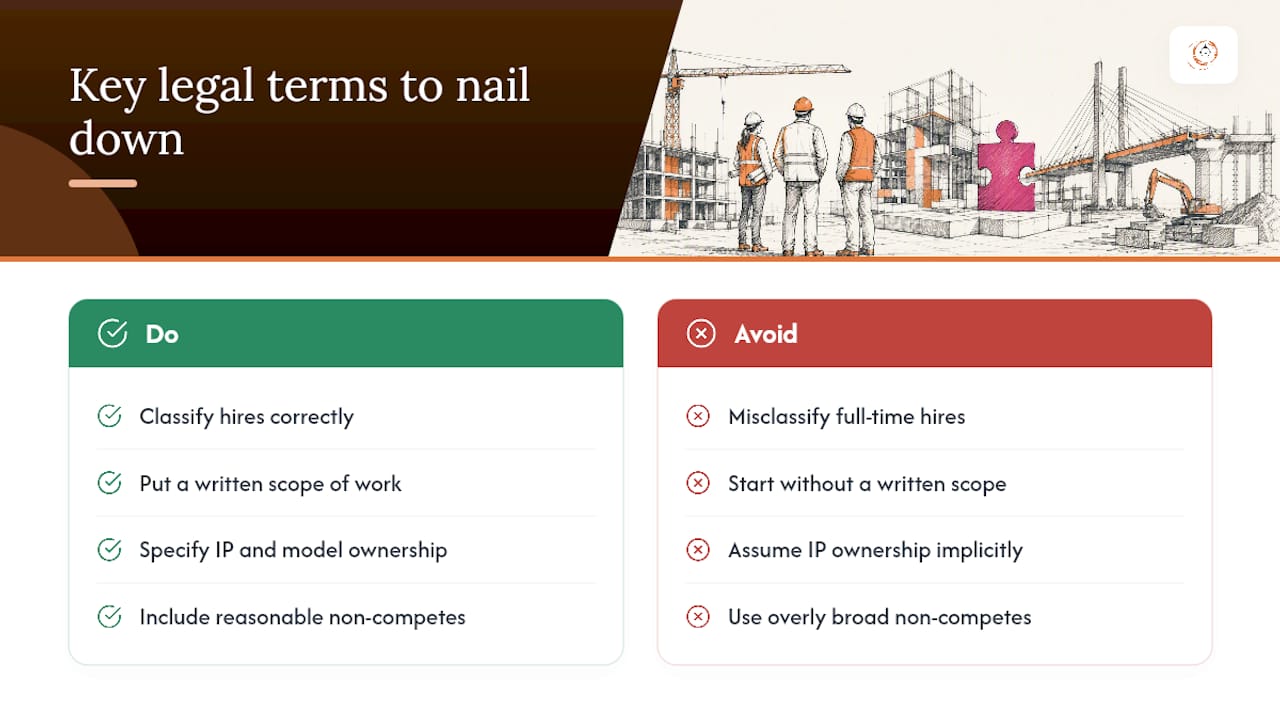
Classification is the first decision to get right. A VDC engineer working exclusively on your projects, using your equipment, and following your schedule looks like an employee under most state tests, regardless of what the contract calls them. Misclassifying a full-time VDC hire as an independent contractor exposes you to back taxes, penalties, and unpaid overtime claims if a state labor agency or the IRS reviews the arrangement.
For contract and freelance VDC engineers, put a written scope of work in place before day one: deliverables, model ownership, revision cycles, and a clear end date or renewal trigger. Intellectual property terms deserve specific attention in construction. Clarify who owns the coordinated model, whether the firm retains rights to reuse templates and family libraries the engineer builds, and how model files transfer if the engagement ends mid-project.
Non-compete and non-solicitation clauses are worth including for senior and lead-level hires who will have visibility into your client relationships and coordination methods, but keep them reasonable in scope and duration since overly broad restrictions face pushback in several states. If you’re using a recruiter or staffing agency, confirm the fee structure and any guarantee period in writing before the search starts. A guarantee period that covers a replacement hire if the candidate leaves within 90 days protects you from paying twice for one open position.
Insurance and liability terms matter too: confirm whether the VDC engineer’s work product carries any professional liability exposure, particularly for coordination work tied to shop drawing production, where a disconnect between the model and fabrication documents can create costly rework claims.
How Do You Onboard a New VDC Engineer for Fast Productivity?
The first two weeks determine whether a new VDC hire becomes productive in month one or month three. Give them model access, current project files, and a walkthrough of your firm’s modeling standards before their first day, not after.
Pair every new VDC engineer with a project team member for the first few site visits. Someone who has only worked in an office needs a guided introduction to how your superintendents communicate, what your RFI process looks like in practice, and which subcontractors need extra coordination attention. Skipping this step is the single most common reason a technically strong hire struggles in the field.
Set a 30/60/90 day plan with specific milestones: running an independent clash detection cycle by day 30, leading a coordination meeting by day 60, and owning a full trade sequence by day 90. Written milestones give both you and the new hire a shared benchmark instead of a vague sense of “getting up to speed.”
Connect new hires with your existing modeling standards library, family templates, and naming conventions immediately. A VDC engineer who builds models that don’t match your firm’s LOD conventions creates cleanup work for everyone downstream. Finally, schedule a 30-day check-in specifically about field relationships, not just technical output. A new VDC engineer who isn’t getting the access or respect they need from a superintendent will underperform regardless of how strong their Navisworks skills are, and that’s a fixable problem if you catch it early.
When Does It Make Sense to Bring in a Specialized AEC Recruiter?
A recruiter earns their fee fastest on urgent hires, rare specializations like renovation or scan-to-BIM depth, and roles where your internal team lacks the bandwidth or network to run a proper search. Our recommended specialized AEC recruiters often offer extensive industry experience, prorated billing structures so clients pay only for successful placements, and access to pre-vetted candidate networks. Engaging one early, with a clear scope and salary range in hand, speeds up the search more than almost any other lever available to a hiring manager.
— Rowena
How Constructconnect-rconstructionsolutions Fills VDC Roles Faster
Specialized AEC recruiting firms often operate on a contingency model designed to limit full commissions for mismatched hires. Rather than a flat fee due upfront, some use prorated billing structures that spread payment across the new hire’s initial months, reducing risk. Candidates typically come pre-vetted for relevant software fluency and field experience, streamlining the screening process to focus on qualified applicants.

Starting a search is straightforward: send us the role level (junior, senior, or lead), the project types you staff most, and your target salary range, and we’ll return qualified candidates from our existing network rather than starting a cold search from scratch. If your VDC hire needs to also connect to subcontractor or supplier relationships, our supplier sourcing and subcontractor connection services cover that too. Visit our recruiting services page to start a search this week.
Sources
- VDC vs BIM - What General Contractors Need to Know in 2026
- VDC Engineer Job Description | Requirements & Salary | 4 Corner Resources
- 7 AEC Hiring Challenges That Put Project Schedules at Risk
- VDC Engineer at Clark (job posting)
FAQ
What Is a VDC Engineer?
A VDC engineer manages digital construction models as decision-making tools, coordinating trades, running clash detection, and building 4D schedules that tie the model to project timelines. The role extends beyond basic BIM coordination by integrating constructability and procurement planning into the modeling process.
What Is the Average Salary for a VDC Engineer in the US?
Salary varies by region and seniority, but a representative current job posting shows base pay commonly starting in the mid $70,000s and rising into six figures for senior roles in major metro markets or complex project types. Contract day rates run higher to offset the lack of a benefits package.
How Much Does a VDC Specialist Make Compared to a VDC Engineer?
“VDC specialist” and “VDC engineer” often describe overlapping roles, with specialist sometimes signaling narrower technical focus rather than a different pay band. Compensation typically tracks the same factors: region, project complexity, and years of field-adjacent modeling experience rather than the title itself.
Which Engineer Makes $500,000 a Year?
VDC engineering salaries, even at the lead or director level, do not typically approach that figure based on current job postings and industry data. Compensation near that range in engineering usually belongs to specialized fields like petroleum engineering leadership or senior technical executives, not construction VDC roles.
How Long Does It Take to Hire a VDC Engineer?
A standard search through general job boards typically takes four to eight weeks from posting to offer for a mid-level hire. Working with a specialized recruiter often shortens that window because recruiters maintain existing pipelines of mid-career candidates who aren’t actively browsing job boards.