
Top EstremandCo.com Alternatives for AEC Firms in 2026
For North American AEC firms searching for estremandco.com alternatives, R. Construction Solutions stands out as the recommended specialized option, backed by 30+ years of industry experience, a prorated 90-day payment structure, and a pre-vetted subcontractor network. Two additional categories worth evaluating: AEC-focused recruiters (for trade-specific vetting) and regional staffing networks (for speed and volume).
Quick shortlist:
- R. Construction Solutions — AEC-specialized recruiting and sourcing with lower commission rates, prorated payments, and pre-vetted subs; no placement, no fee
- AEC-focused recruiters — deep trade knowledge, credential verification (OSHA 30, Procore, AQC/STEP), and candidate ownership clarity
- Regional staffing networks — faster time-to-fill for volume roles, though lighter on construction-specific vetting
- Trade association directories (AQC/STEP) — self-service sourcing with built-in safety and training signals; 591 contractors held the AQC designation in 2024
Table of Contents
- Which provider category actually fits your project?
- How do you choose between a recruiter, staffing firm, or directory?
- What does a solid vetting and onboarding process look like?
- Which option fits your situation right now?
- Key Takeaways
- What most GCs get wrong about subcontractor sourcing
- R. Construction Solutions is built for exactly this problem
- Useful sources
- FAQ
Which provider category actually fits your project?
R. Construction Solutions
R. Construction Solutions handles both office staff (project managers, estimators, superintendents) and field personnel, plus connections to pre-vetted subcontractors and suppliers. Best fit: GCs and construction managers with 50–500 employees who need reliable placements without absorbing a large upfront fee. The prorated 90-day model and lower commission structure make it a practical choice for firms running multiple concurrent projects.
Pro Tip: When you contact R. Construction Solutions, have your trade scope, project timeline, and OSHA or Procore requirements ready. Specific role criteria get faster, more accurate matches.
AEC-focused recruiting firms
These firms specialize in construction roles and typically verify credentials like OSHA 30, Procore experience, and apprenticeship completion. Best for high-safety or technically complex projects where a mis-hire creates schedule and liability risk. Expect a longer search window and a higher fee, but a tighter candidate-to-role fit.
National staffing firms
Volume and speed are the real advantages here. For administrative roles or general labor where trade certification is not critical, a national staffing firm can place candidates within days. Verify independently that any sub or hire meets your project’s safety and licensing requirements before they step on site.
Online directories and marketplaces
Prequalification tools and project management platforms like Procore can help you standardize how you evaluate directory-sourced subs, centralizing documentation and reducing miscommunication. Without a formal prequalification gate, directory sourcing is essentially cold outreach with no vetting built in.
In-house sourcing via supplier networks
Supply-house staff at lumber yards and electrical counters observe which subs buy consistently and pay on time, making them one of the most underused vetting resources in the industry. Pair supplier networking tactics with your own reference checks for a low-cost, high-signal sourcing layer.

How do you choose between a recruiter, staffing firm, or directory?
Start with these four criteria before you call anyone:
- Speed requirement — If you need a superintendent on-site in two weeks, a specialized recruiter may not be the right first call. A staffing network or your own supplier contacts will move faster.
- Trade specialization — Electrical, mechanical, and structural roles carry licensing and safety requirements that generalist firms routinely miss. Prioritize AEC-specialized sourcing for any licensed trade.
- Vetting depth — Ask every provider: “What exact steps do you perform before presenting a candidate or sub?” If the answer is vague, that is your answer.
- Contract flexibility — Understand cancellation terms, minimum commitments, and what happens if a placement leaves in the first 30 days.
Questions to ask any provider before signing:
- Do you verify AQC or STEP membership, and can you show documentation?
- How do you handle candidate ownership if another firm has already submitted the same person?
- What is your replacement policy if a placement does not work out within 90 days?
- Can you provide references from GCs with similar trade mix and project size?
Red flags to watch for: fee language that does not define what triggers payment, no written vetting process, inability to name specific client references, and pressure to sign before you have reviewed the contract terms.
What does a solid vetting and onboarding process look like?
Subcontractor prequalification should cover scope fit, experience, capacity, insurance, licenses, safety records, references, and financial indicators before you issue an invitation to bid or award a contract.
| Milestone | Action items |
|---|---|
| Pre-award | Verify licenses, insurance COI, OSHA records, AQC/STEP status, references, and current workload |
| Day 1–30 | Complete document exchange, site orientation, safety briefing, and set invoicing cadence |
| Day 30–60 | Review first invoice cycle, confirm crew capacity, address any scope gaps |
| Day 61–90 | Evaluate performance against schedule, confirm prorated payment alignment, decide on long-term relationship |
Prequalification is a formal gate, not a formality. Firms that treat it as a checkbox exercise are the ones calling their recruiter at 6 AM because a sub walked off the job.
How you qualify subcontractors before project start directly affects schedule adherence and budget control. Standardizing this process across every project is what separates firms that repeat the same sourcing mistakes from those that build a reliable sub bench over time.
Which option fits your situation right now?
- Emergency fill (under two weeks): Lead with your staffing network or supplier contacts; see the emergency subcontractor sourcing playbook for a fast-action sequence
Run the vetting checklist in the section above before any award, regardless of which sourcing channel you use.
Key Takeaways
Specialized AEC sourcing, formal prequalification, and a prorated fee structure together reduce placement risk more than any single tactic alone.
| Point | Details |
|---|---|
| Shortlist by scenario | Match your sourcing channel to speed, trade, and vetting needs before contacting any provider. |
| Verify AQC/STEP status | These designations signal safety investment and training commitment; always request documentation. |
| Prorated fees reduce risk | Paying over 90 days aligns cost with actual hire performance rather than front-loading your exposure. |
| Multi-channel sourcing wins | Combining association directories, supplier contacts, and a specialized recruiter surfaces better candidates than any single source. |
| R. Construction Solutions | Offers pre-vetted AEC placements, lower commission rates, and a prorated 90-day payment model for North American GCs. |
What most GCs get wrong about subcontractor sourcing
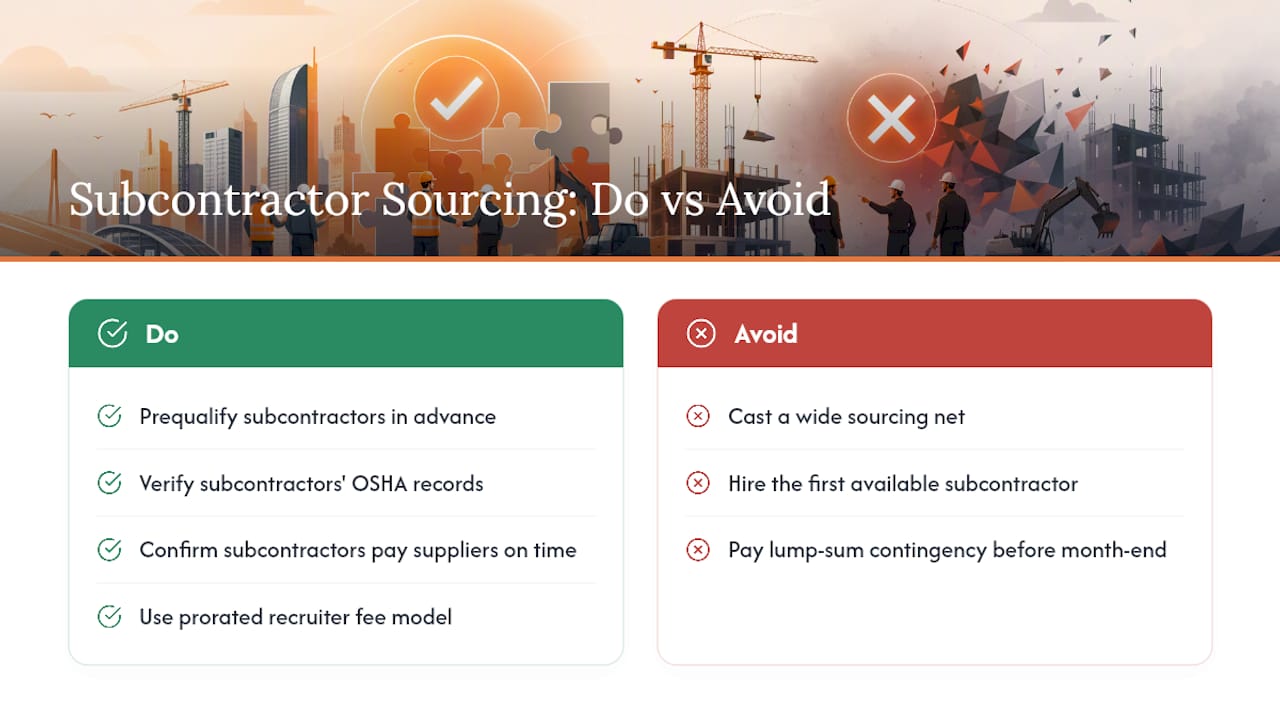
The conventional wisdom says cast a wide net: post to every board, call every agency, and take the first available sub. That approach fills a slot. It does not build a bench.
The firms that consistently deliver projects on schedule are not the ones with the longest vendor lists. They are the ones who have done the prequalification work in advance, know which subs have clean OSHA records and pay their supply houses on time, and have a recruiting partner who already understands the difference between a superintendent who has run a $40M healthcare project and one who has not.
Fee structure is also underweighted in most sourcing decisions. A lump-sum contingency fee paid before a hire has completed their first month is a real financial risk, not a technicality. The prorated model matters precisely because it keeps the recruiter’s incentive aligned with yours through the full onboarding period.
R. Construction Solutions is built for exactly this problem
If you have been relying on estremandco.com or a general staffing platform and finding that the placements do not hold, the vetting is shallow, or the fee structure does not match how construction projects actually cash-flow, R. Construction Solutions offers a direct alternative.
The firm’s AEC recruiting and sourcing services cover office staff, field personnel, and pre-vetted subcontractor and supplier connections, with lower commission rates and payments prorated across the first 90 days. No placement, no fee. To start an engagement, have your trade scope, project timeline, required certifications (OSHA 30, Procore, licensing), and headcount ready. Contact R. Construction Solutions directly through the recruiting services page to discuss your current project needs.
Useful sources
- Essential Guide on How to Find Qualified Subcontractors Effectively
- Subcontractor Prequalification Guide for GCs (2026)
- How to Confidently Hire Subcontractors for Construction | Procore
- How to Find, Vet, and Hire Subcontractors as a GC | Relay | Blog
- Recruiting Services for the AEC Industry
- Top AEC Talent and Sourcing Solutions | R. Construction Solutions"
FAQ
What makes R. Construction Solutions different from a general staffing firm?
R. Construction Solutions focuses exclusively on the AEC industry, verifying trade-specific credentials and connecting clients to pre-vetted subcontractors, with payments prorated over 90 days rather than charged as a lump sum upfront.
How do I verify a subcontractor’s qualifications before award?
Confirm active licenses, current insurance certificates, OSHA safety records, AQC or STEP designation, and at least two project references before issuing an invitation to bid, as outlined in the prequalification framework from ConstructionBids.ai.
What is the AQC designation and why does it matter?
The Accredited Quality Contractor (AQC) designation signals a firm’s commitment to safety, workforce training, and quality standards — making it a reliable filter when sourcing from association directories.
How fast can I expect a placement through an AEC recruiter?
AEC-specialized recruiters typically fill roles in 2–6 weeks for office and supervisory positions; national staffing firms can place general or administrative roles in days, though with lighter trade-specific vetting.
What should I watch for in a contingency recruiting contract?
Clarify candidate ownership language, the exact event that triggers the fee, and the replacement policy if a hire leaves within 90 days, since ambiguous terms are the most common source of disputes in contingency arrangements.