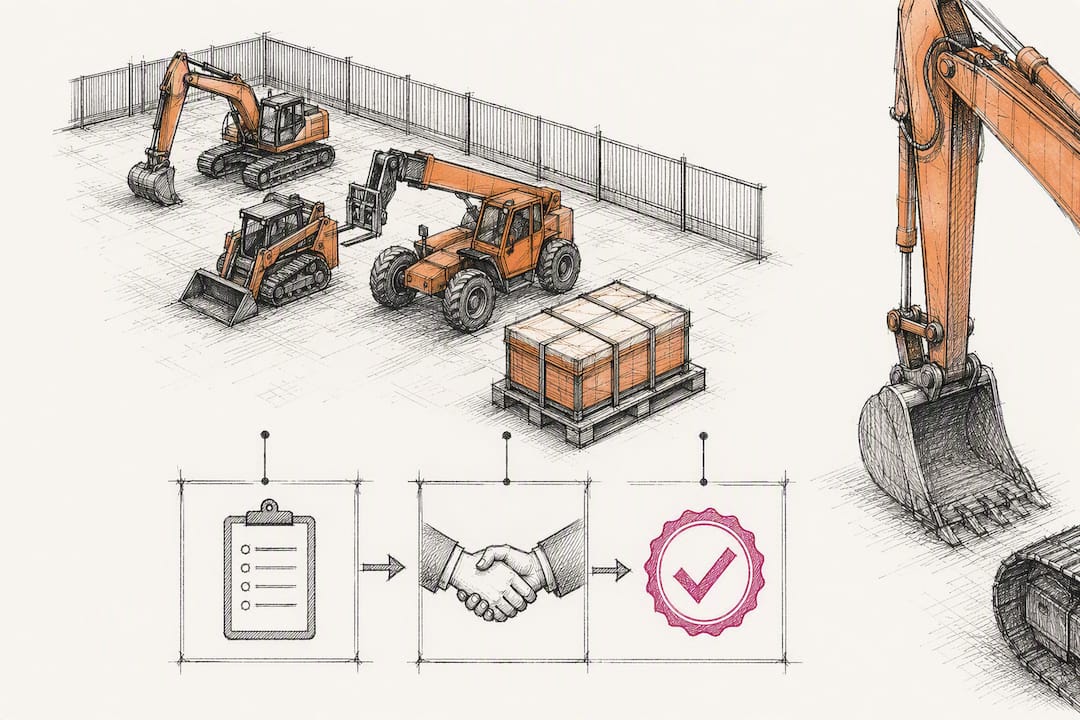
Avoid Delivery Delays: Equipment Rental Credit Terms for Contractors
Equipment rental credit terms are the contract rules that determine when you must pay, what documentation you must provide before pickup, and how excess use or late payment gets charged. Most rental companies default to Net 30 payment terms, but your equipment will not leave the yard until you clear credit approval and hand over a valid certificate of insurance. Before you sign anything, confirm what documents the lessor needs (credit application, EIN, COI), how they calculate billing and usage caps, and what happens if you’re late. The rest of this guide walks through each of those mechanics and how to negotiate them in your favor.
TL;DR:
- Extended credit terms like Net 45 or Net 60 typically require a proven payment history and should be formalized within the master service agreement.
- Approval for credit accounts can take up to a week, requiring submission of a detailed credit application and supporting references.
- Most vendors mandate a current certificate of insurance with specified coverage limits and proper wording at least two business days before pickup to prevent delays.
- Rental rates usually assume 160 to 176 hours of monthly use; exceeding this baseline triggers prorated overtime and excess-use charges.
- Negotiating longer payment terms provides greater cash flow benefits than small rate discounts, especially for large equipment rentals.
Table of Contents
- What Do Common Equipment Rental Payment Terms Mean?
- How Long Does Equipment Rental Credit Approval Take?
- What Insurance and Deposits Do Rental Companies Require?
- How Are Rental Rates and Late Fees Calculated?
- Rent-to-Purchase, Lease, and Buyout Credits: What’s the Difference?
- How Do You Negotiate Better Equipment Rental Payment Terms?
- How Rental and Lease Terms Affect Cash Flow and Accounting
- Aligning Rental Terms With Staffing and Sourcing Decisions
- Fewer Rental Delays Start With Fewer Vendor Surprises
- An Editorial Take on Why Rental Terms Get Misread
- Sources
- FAQ
What Do Common Equipment Rental Payment Terms Mean?
“Net 30” gets thrown around so often that contractors sometimes forget it’s shorthand with real deadlines attached. Net 30 means payment is due 30 calendar days from the invoice date, not the delivery date. Net 60 and Net 90 stretch that window further and tend to show up more often in construction than in retail or manufacturing, since project draws and owner payments rarely land on a 30-day clock.
Then there’s 2/10 net 30: pay within 10 days and take a 2% discount, or pay the full amount by day 30. That discount looks small until you annualize it.
The math that matters: Capturing a 2% discount by paying 20 days early works out to an annualized return of roughly 37%, a rate that beats almost any short-term borrowing cost available to a construction firm. If your line of credit charges 8% to 12%, taking the discount is close to free money.
Other terms worth knowing:
- EOM (End of Month): Payment is due by the end of the month following invoice, common with recurring monthly rentals.
- COD (Cash on Delivery): Payment required at the time equipment is dropped off, typically reserved for new accounts or customers without established credit.
- Prorated billing: Partial-month charges calculated by the day, common when equipment is picked up mid-cycle.
Longer terms show up more in construction than in other industries because project cash flow follows draw schedules, not calendar months. A general contractor waiting on an owner payment 45 days out has every incentive to push a rental vendor toward Net 45 or Net 60, and vendors who work construction regularly build that expectation into their standard terms.
How Long Does Equipment Rental Credit Approval Take?
Getting approved to rent on account is not instant, and treating it like a same-day formality is one of the more common scheduling mistakes on a job site. Here’s what the process typically looks like:
- Submit a credit application. Most rental firms require your legal business name, EIN, years in business, bank references, and trade references from vendors you’ve paid on time.
- Provide a signed authorization or personal guarantee. Smaller or newer businesses are frequently asked for a guarantor clause, especially LLCs with limited credit history.
- Wait for underwriting. Approval can take up to a week, according to ROCK’s new-account terms, particularly if trade references are slow to respond or documentation is incomplete.
- Receive a credit limit and terms. Approval comes with a dollar ceiling and a stated payment term, not a blank check.
Approval alone doesn’t get equipment off the lot. Sunbelt Rentals structures its commercial credit account so approved businesses can “rent now, pay at month end,” but eligibility still requires a registered business entity and a valid tax ID before that privilege kicks in. Build a week of lead time into your procurement schedule, not a day.
What Insurance and Deposits Do Rental Companies Require?
Credit approval and insurance approval are two separate gates, and missing the second one stalls a job just as fast as missing the first. Most vendors require a current certificate of insurance (COI) on file even for customers with an active credit account, and ROCK’s account terms make clear that no COI generally means no possession, regardless of credit standing.
Expect these requirements:
- General liability coverage naming the rental company as additional insured, usually with minimum limits of $1 million per occurrence.
- Physical damage or equipment coverage, sometimes requiring a waiver of subrogation clause.
- Hired and non-owned auto coverage if you’re transporting rented equipment with your own vehicles.
- Security deposits or credit-card holds, common for new accounts, high-value machines, or customers still building payment history.
Pro Tip: Send your COI and signed rental agreement to the vendor at least two business days before your scheduled pickup, then call to confirm they’ve accepted the wording. A COI that’s missing the right named-insured language is the single most common reason equipment doesn’t leave the yard on schedule.
How Are Rental Rates and Late Fees Calculated?
Rental billing looks simple on a quote sheet and gets complicated fast once usage limits and penalty clauses enter the picture. Vendors typically bill on an hourly, daily, weekly, or monthly basis, with monthly rates calculated against an assumed operating baseline.
- Monthly-hour baselines: Many contracts assume 160 to 176 hours of use per month, a figure drawn from standard business-hour calculations in the REIC master rental agreement. Run a machine past that threshold and you owe prorated overtime.
- Excess-use charges: Contractors who track rental periods in days rather than hours are the ones most often surprised by an overage invoice at return.
- Wear and damage charges: Beyond normal wear, expect line items for excessive hours on wear parts like tracks, tires, and hydraulic components.
What a late invoice actually costs: Atlas Copco’s Master Service Agreement sets a default of Net 30 with late-payment interest of 1.5% per month, an effective 18% APR, plus a clause allowing the vendor to recover attorney fees on collections. Miss enough payments and the same agreements typically preserve the vendor’s right to repossess.
Rent-to-Purchase, Lease, and Buyout Credits: What’s the Difference?
A short-term rental is a straightforward operational expense with no ownership path. Rent-to-purchase and formal equipment leases work differently, and the credit terms attached to each affect your total cost in ways that aren’t obvious from the monthly rate alone.
Real rent-to-buy agreements, like the structure in the HAWK Excavator rental agreement, often apply a credit against a future purchase, such as 50% of the first month’s rent and 25% of the second month, with minimum rental periods before that credit becomes available.
Before signing a buyout clause, check:
- The percentage of rent credited toward purchase, and whether it decreases the longer you rent.
- Any minimum rental period required before buyout eligibility kicks in.
- Whether a capital lease or straight equipment financing would carry a lower total cost for a machine you already know you need long-term.
Rent-to-purchase makes sense for a short trial with a real option to walk away. If you already know the equipment is a permanent addition to your fleet, formal financing usually beats accumulating rent credits one month at a time.
How Do You Negotiate Better Equipment Rental Payment Terms?
Extended terms are earned through leverage, not requested through goodwill. Vendors respond to volume commitments, guaranteed payment methods, and a documented track record, not a phone call asking for more time.
- Establish your baseline. Start with the vendor’s standard terms and pay on time for the first several invoices before asking for anything.
- Offer something in return. Trade a volume commitment, an ACH auto-pay guarantee, or a multi-project agreement for a term extension from Net 30 to Net 45.
- Get it into the Master Service Agreement. Verbal promises or invoice notes don’t hold up. Extended terms belong in the MSA itself, where collections and interest clauses already live.
- Review after a proven payment history. Once you’ve demonstrated six months of on-time payment, revisit the agreement for a further extension or a higher credit limit.
Pro Tip: Slow invoice matching inside your own accounts payable process is often the real reason companies miss early-pay discounts, not the vendor’s terms. Tightening the approval workflow between invoice receipt and payment authorization can recover more cash than negotiating a better rate ever will.
For recurring cash gaps, net-terms financing or invoice factoring can bridge the difference between when the rental invoice is due and when your project draw actually lands. Improving invoice approval workflows inside your own operation often closes more of that gap than any vendor negotiation.
How Rental and Lease Terms Affect Cash Flow and Accounting
An operating rental is typically expensed as it’s incurred. A capital lease or purchase agreement gets recognized differently, with an asset and a liability on the balance sheet. The distinction has real tax consequences, and it’s worth confirming with your accountant before you commit to a rent-to-purchase structure, since the treatment can shift depending on contract length and buyout terms.
- Payment terms directly move your Days Sales Outstanding (DSO) and Days Payable Outstanding (DPO), the two numbers that define your cash-conversion cycle.
- Longer vendor terms (Net 60 instead of Net 30) extend your DPO, giving you more runway before cash leaves the business.
- When budgeting a project, model the worst-case payment timing, not the best case. If an owner payment slips two weeks, your rental obligations don’t slip with it.
Aligning Rental Terms With Staffing and Sourcing Decisions
Rental credit terms rarely operate in isolation on a job site. Constructconnect-rconstructionsolutions has spent more than 30 years placing office staff and field personnel across the AEC industry, and the same friction that delays equipment delivery, incomplete paperwork, unclear approval chains, mismatched expectations, shows up when staffing a project team.
A prequalified subcontractor or supplier network solves a version of the same problem a strong credit application solves: it removes the guesswork from whether a partner will deliver on time. When Constructconnect-rconstructionsolutions connects a client to a pre-vetted supplier or equipment vendor, the same documentation discipline, COI handling, clear terms, and confirmed billing basis, that prevents rental delays also prevents staffing gaps from stalling a schedule. Predictable terms on one side of a project tend to correlate with fewer surprises on the other.
Fewer Rental Delays Start With Fewer Vendor Surprises
Every clause covered here, credit timelines, COI wording, usage caps, late fees, exists because rental companies got burned by contractors who didn’t plan around them. The reverse is just as true: contractors get burned by vendors whose terms weren’t spelled out clearly before delivery day.
Constructconnect-rconstructionsolutions applies the same standard to staffing and sourcing that a well-run credit department applies to rentals: vet the partner before the relationship starts, put the terms in writing, and never let ambiguity sit between a decision and a delivery date. If unreliable supplier connections or staffing gaps are costing you the same kind of schedule risk that a denied credit application does, our recruiting and sourcing services connect you with pre-vetted partners built to avoid exactly that friction.
An Editorial Take on Why Rental Terms Get Misread
Most guidance on equipment rental treats credit terms as a paperwork formality, something you fill out once and forget. That framing misses the actual risk. The real cost of sloppy credit terms isn’t the interest rate on a late invoice. It’s the schedule slip that happens when nobody checked whether the COI wording matched what the vendor actually required, and a $40,000 excavator sits in a yard three states away while a superintendent burns a full day on the phone.
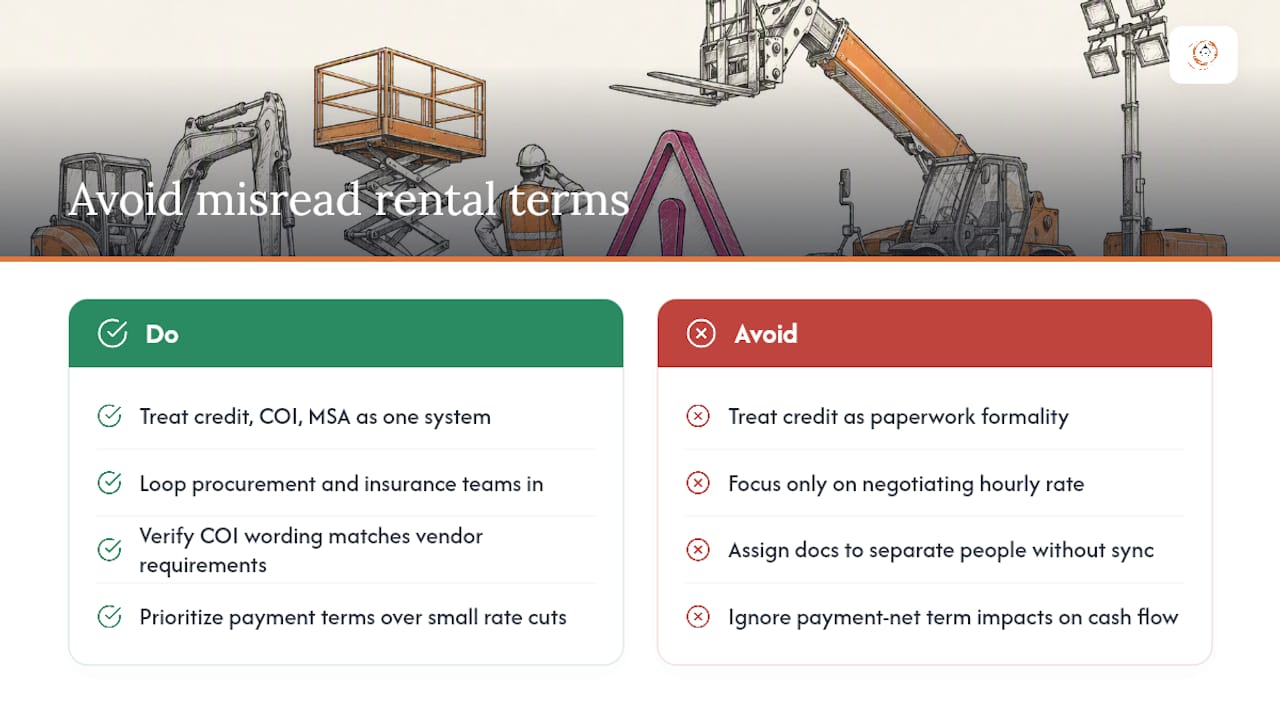
The contractors who handle this well don’t necessarily negotiate the best rates. They treat the credit application, the COI, and the MSA as one connected system instead of three separate errands assigned to three different people. A procurement officer who submits the credit application without looping in whoever handles insurance is setting up the same failure as a project manager who hires a crew without confirming the subcontractor’s own insurance is current.
There’s also a quieter mistake worth naming: contractors who negotiate hard on the rental rate and never touch the payment terms. A 5% discount on the hourly rate is worth far less than a shift from Net 30 to Net 60 on a $200,000 rental package, yet most negotiation conversations focus entirely on the number that’s easiest to compare, the rate, and ignore the term that actually moves cash flow.
— Rowena
Sources
- ROCK new-account terms & conditions (fillable PDF)
- Atlas Copco Master Service Agreement (USA) – payment and late fee clauses
- Sunbelt Rentals commercial credit application
- Business payment terms: the complete guide | Corpay
- REIC master equipment rental agreement (USA)
FAQ
How Should You Categorize Equipment Rental for Accounting Purposes?
Short-term operating rentals are generally recorded as an expense as they’re incurred, while rent-to-purchase agreements or capital leases are typically recognized as an asset and liability on the balance sheet. Confirm the specific treatment with your accountant, since contract length and buyout terms can shift the classification.
What Are Typical Terms for Equipment Financing or Leasing?
Equipment financing and formal leases usually run longer than a rental agreement and involve fixed monthly payments tied to a defined term, often several years, compared to the Net 30 or Net 60 billing cycle used for short-term rentals. Rent-to-purchase structures sit in between, applying a portion of early rental payments as credit toward an eventual buyout.
How Should Equipment Rental Be Treated in Accounting Compared to a Purchase?
A rental is expensed on the income statement as it’s used, while a purchased or capitally leased asset is depreciated over time and appears on the balance sheet. The distinction affects both your tax treatment and your reported cash flow, which is why finance leads typically loop in an accountant before choosing between renting and buying for a long-duration project.
What Should You Consider Regarding Equipment Rental Rates?
Check the monthly-hour baseline built into the rate, commonly 160 to 176 hours, since exceeding it triggers excess-use charges. Also confirm the billing basis (hourly, daily, or monthly), any minimum rental period, and whether late-payment interest or attorney-fee clauses are built into the agreement.
Is a Certificate of Insurance Always Required to Rent Equipment on Credit?
Most rental companies require a current COI on file before releasing equipment, even for customers with an approved credit account. Sending the COI and signed rental agreement ahead of the scheduled pickup date is the most reliable way to avoid a delivery delay.