Find Contractor Networking Events: Checklist and a Curated Partner
Start with trade association chapter calendars, major expo registration pages, and local chamber or Meetup groups. Contractor networking events are worth attending when the audience matches your target client and you follow up within 48 hours. Check a chapter calendar or an upcoming trade-show schedule today, and treat every RSVP as the start of a sales process, not the end of one.
TL;DR:
- Attending trade association chapter meetings and local expos yields better leads when the audience matches your target client and follow-up occurs within 48 hours.
- Trade shows provide product insights and relationships, while smaller events like mixers and seminars help build credibility and direct connections with general contractors.
- Vet event organizers and attendee lists beforehand to avoid outdated or ineffective shows, and focus on formats aligned with your specific goals.
- Effective networking hinges on setting clear objectives, asking targeted questions, and following up with concrete offers like quotes or site visits within two days.
- Consistently attending a few well-chosen events and maintaining a follow-up system over time proves more valuable than sporadic attendance at many gatherings.
Table of Contents
- Where to Find Upcoming Contractor Networking Events
- Types of Contractor Networking Events and What They Deliver
- How to Choose Which Events Are Worth Your Time
- Networking Tactics That Actually Generate Business
- Virtual and Hybrid Networking: When They Make Sense
- How R. Construction Solutions Turns Warm Contacts Into Vetted Partners
- The Real Benefits of Attending Contractor Networking Events
- Getting Ready Before You Walk Through the Door
- Common Networking Challenges and How to Push Through Them
- Networking Etiquette That Keeps Doors Open
- Where to Check Right Now
- Why Most Networking Advice Undersells the Follow-Up
- Sources
- FAQ
Where to Find Upcoming Contractor Networking Events
Most contractors waste time scrolling generic event listing sites when the best sources are already sitting in their inbox or their trade association’s website. Start narrow, then widen the search only if you need more volume.
Trade association chapters publish the most reliable calendars because they know their members’ schedules and pain points better than any third-party listing site. Associations like the Associated Builders and Contractors (ABC) or specialty groups such as the Metal Building Contractors & Erectors Association run recurring chapter meetings, and membership in a group like MBCEA often unlocks education sessions and peer networks that generate leads and hires, not just a line on a calendar.
Beyond association pages, a few sources cover most of the discovery work:
-
Major trade shows and expos — check exhibitor and session lists on the show’s own registration page, not a secondhand recap
-
Local chambers of commerce — smaller, homeowner-adjacent events that build community visibility
-
BNI chapters and referral groups — structured, recurring meetings built around accountability
-
Meetup and Eventbrite — search “contractor,” “builders,” or your trade plus your metro area
-
LinkedIn and industry Slack groups — often surface informal meetups before they hit a public calendar
Whichever source you use, open the calendar view and check the RSVP or exhibitor list before committing. A stale attendee list or a show that has not updated its speaker lineup in months is a red flag worth heeding. Always confirm the date, venue, and registration deadline on the organizer’s own site. Third-party aggregators frequently list outdated information.
Types of Contractor Networking Events and What They Deliver
Not every event serves the same purpose, and picking the wrong format for your goal wastes a Saturday you could have spent on a job site. Four formats cover almost everything you will encounter.
- Trade shows and expos. These deliver product demos, vendor discovery, and volume. Trade shows offer hands-on inspection and hallway conversations that a product catalog or webinar cannot replicate, though the sheer size makes deep relationship building harder.
- Association chapter mixers and Meet-the-GC nights. Smaller, local, and built for prequalification. These are where a subcontractor actually gets in front of the general contractor who controls next year’s bid list.
- Educational seminars and workshops. Less about the free coffee, more about credibility. Attending signals you keep up with code changes and technical standards, and speakers often become referral sources.
- Community events and charity mixers. Lower pressure, longer payoff. Local chambers and fundraising events build visibility with property managers and small-business owners who become customers or referral partners over time.
How to Choose Which Events Are Worth Your Time
Every event costs something, even the free ones. Between registration fees, travel, and the crew hours you lose while you are out of the field, a poorly chosen event can run you $500 or more in real and opportunity cost for zero usable leads.
- Match the audience to your ideal client. A residential remodeler gets little from a commercial GC’s supplier expo, and vice versa.
- Weigh cost against expected lead quality. A $50 chamber breakfast that puts you in front of five property managers can beat a $400 conference badge.
- Choose format by goal. Large national shows suit trend and product research, while regional or local shows tend to generate faster, more immediate project leads.
- Vet the organizer. Look at last year’s attendee or exhibitor list. A show that cannot show you who attended before is not ready to earn your registration fee.
Pro Tip: Email the event organizer and ask for last year’s attendee list before you register. A legitimate organizer will share it, or at least describe the typical mix, within a day.
Networking Tactics That Actually Generate Business
Showing up is the easy part. What separates contractors who land work from those who collect business cards is what happens before you walk in and after you walk out.
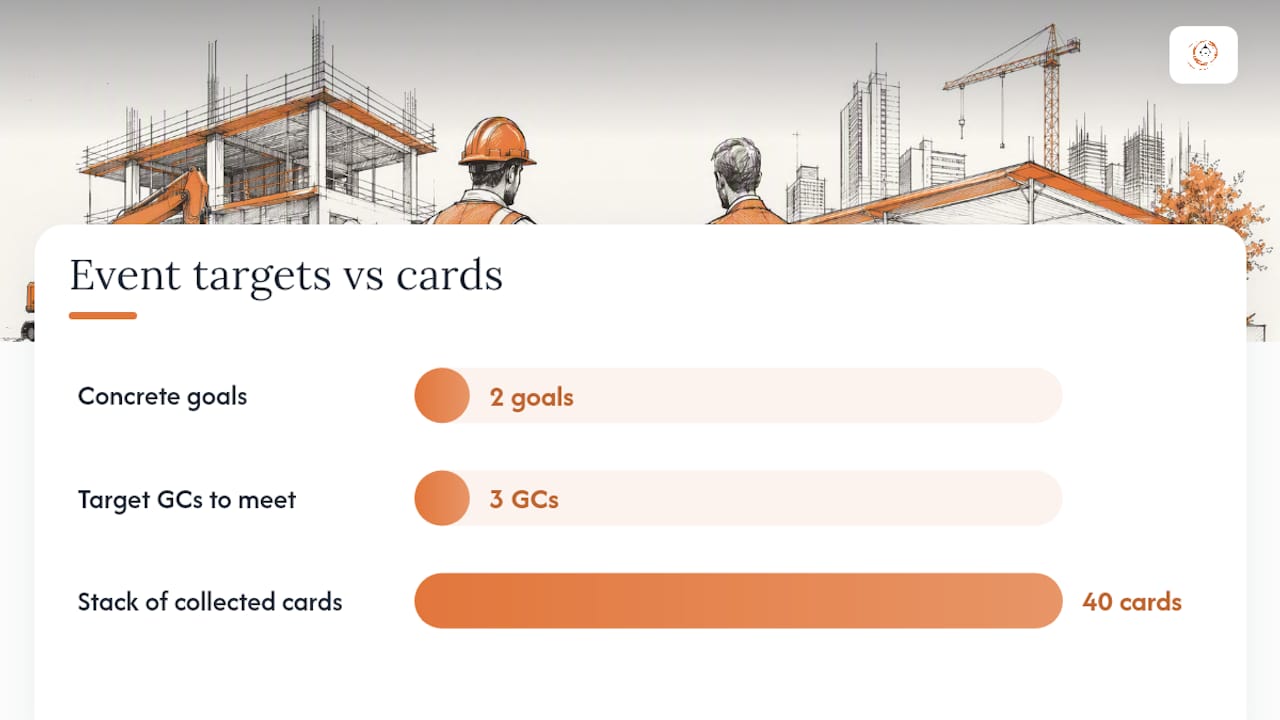
Before the event, set two concrete goals, such as meeting three GCs who bid multifamily work or finding one new supplier for a material you are struggling to source. Research who is speaking or exhibiting, and build a 30-second introduction that names the specific problem you solve rather than a generic list of services.
- Prioritize a handful of real conversations over a stack of forty cards
- Ask questions oriented around referrals: “Who else in your network handles the projects you turn down?”
- Connect on LinkedIn on the spot, and add a note referencing what you discussed, not a blank connection request
- Log every contact and the context of the conversation into your CRM before you forget it
Setting specific objectives before an event and following up quickly converts far more connections into real opportunities than a scattershot approach. Follow up within 48 hours with something concrete: a quote, a site visit offer, or an introduction to a supplier who can solve a problem they mentioned. Structured groups reinforce this same discipline. BNI-style referral programs reward contractors who show up consistently and follow the system, usually paying off in referrals after six to twelve months of steady participation.
Pro Tip: Keep a simple spreadsheet with three columns: contact, what they need, what you promised. Review it every Monday until the loop closes.
Virtual and Hybrid Networking: When They Make Sense
Virtual formats will not replace a trade-show floor, but they solve a real scheduling problem. Webinars with breakout networking rooms, LinkedIn Events, and virtual expo booths let you stay visible when travel or crew demands keep you off the road.
Use virtual or hybrid options when your schedule is genuinely constrained, when you want to reach contacts outside your normal driving radius, or when you are following up with someone you already met in person. A few habits make virtual networking less awkward:
- Prepare two or three talking points in advance, since small talk is harder without a shared room
- Use the chat function to make a specific comment, not just a generic greeting
- Schedule a short one-on-one video call as the real follow-up, rather than trying to build a relationship inside a group webinar
How R. Construction Solutions Turns Warm Contacts Into Vetted Partners
A trade show gets you a name and a handshake. It does not tell you whether that subcontractor shows up on time or whether that supplier’s equipment rental fleet is actually maintained. That gap between meeting someone and trusting them with your schedule is where a lot of networking effort quietly dies.
Expert recruiting and sourcing firms close that gap with industry experience matching AEC firms with pre-vetted suppliers, subcontractors, and equipment rental partners, plus recruiting for office and field roles that keep projects staffed. A few things separate the approach from cold networking:
- Commission rates and payment structures designed to align with successful placements
- Candidate and partner vetting tailored to construction roles and project realities
- A well-developed network providing introductions with more context than a business card handed over at a mixer
If a contact from a chapter mixer or an expo floor looks promising but you want it verified before you build a bid around it, that verification step is exactly what recruiting services for the AEC industry are built to provide.
The Real Benefits of Attending Contractor Networking Events
The obvious benefit is leads, but that is rarely the biggest one. Contractors who attend consistently report three advantages that compound over time.
First, referral pipelines get more predictable. A subcontractor who shows up to the same chapter meetings every month becomes the default recommendation when a GC needs a trade filled fast. Second, you get early visibility into problems before they hit your bid list, whether that is a code change discussed in a seminar or a material shortage mentioned in a hallway conversation. Third, and most underrated, you build a bench of people to call when something goes wrong on a job site. Knowing three subcontractors who can drop in on short notice, because you have talked to them at four different events, is worth more than any single lead.
The compounding effect matters more than any single event. One mixer rarely closes a deal. A pattern of showing up, consistently, at the same three or four recurring gatherings tends to be what actually moves the needle on your pipeline over a year.
Getting Ready Before You Walk Through the Door
Preparation separates contractors who leave with three solid conversations from those who leave with a pocket full of cards and no plan. Start with your elevator pitch: 30 seconds, focused on the specific problem you solve, not a list of every service you offer. “I keep multifamily framing crews on schedule when other subs fall behind” lands better than “we do framing, siding, and general carpentry.”
Bring more business cards than you think you need, and put your specialty on the card itself if there is room. Set two concrete goals before you leave the truck, such as meeting one new GC and finding one supplier lead. Research the attendee or exhibitor list in advance if the organizer has published one, and flag two or three names you actually want to talk to.
Finally, decide what you are asking for. “Can I follow up next week with a bid on your next project?” is a far stronger close than a vague “let’s stay in touch.”
Common Networking Challenges and How to Push Through Them
Most contractors hate small talk, and that is fine. You do not need to be the loudest person in the room. You need one good question that gets someone talking about their actual problems.
A few recurring friction points and simple fixes:
- Feeling out of place among sales-heavy attendees. Lead with a question about their business instead of your pitch. Contractors trust people who listen first.
- Running out of things to say after the introduction. Keep two or three follow-up questions ready, like asking what project type is giving them the most trouble this quarter.
- Losing track of who you met. Jot one line on the back of every card you collect within the hour, or you will forget half of it by dinner.
- Feeling like the event was a waste. One dud event does not mean the format fails. Adjust your target list and try a more focused chapter meeting next time.
Networking Etiquette That Keeps Doors Open
How you handle a conversation matters as much as what you say in it. A few etiquette habits separate contractors people want to see again from those who get quietly avoided at the next mixer.
Do not monopolize anyone’s time. Five focused minutes beats twenty rambling ones, especially at a busy Meet-the-GC night where the whole room is trying to work the floor. Listen more than you pitch. Asking about someone’s biggest current headache tells you more than reciting your services ever will. Follow through on anything you promise, even something as small as sending an article link, because a broken small promise reads as a warning sign about how you handle bigger commitments. And skip the hard sell entirely. Nobody signs a contract standing next to a coffee station. The goal of the event is the next conversation, not the close.
Where to Check Right Now
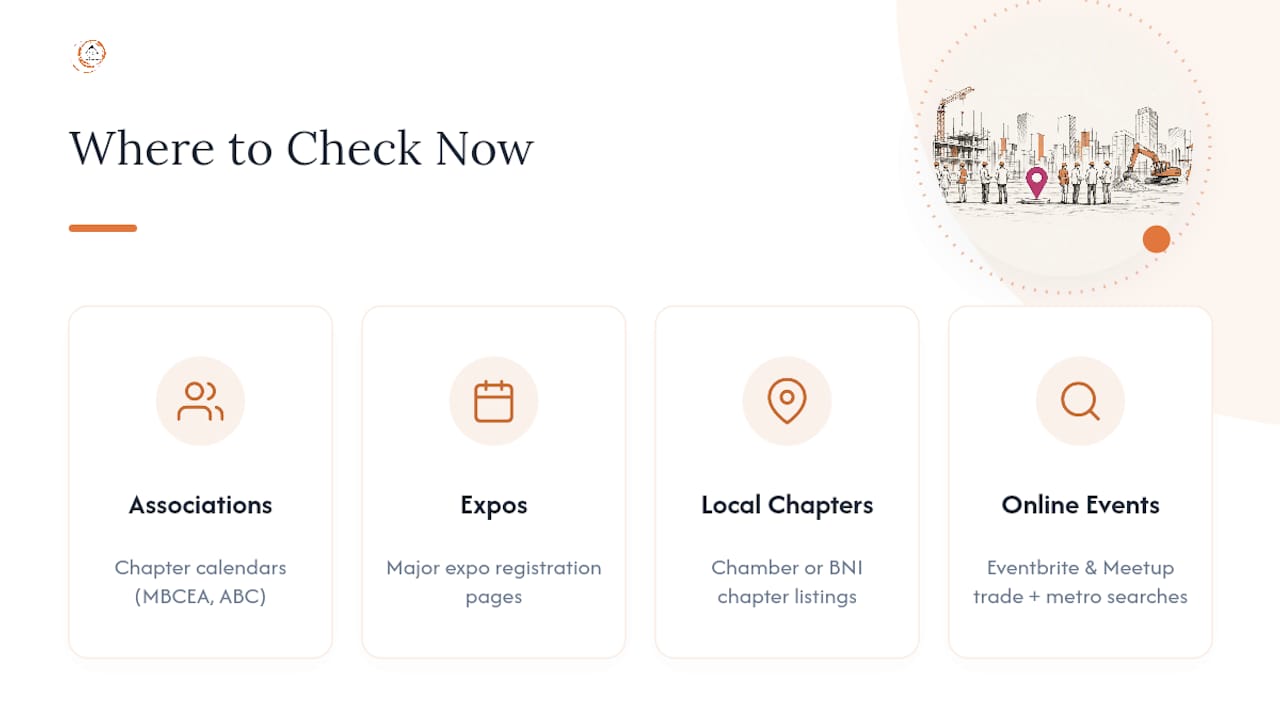
A few sources cover most of what you need to start: association chapter calendars from groups like MBCEA and ABC, major expo registration pages, and local chamber or BNI chapter listings. Round out the search with Eventbrite and Meetup searches for your trade and metro area. For education sessions on technical topics, a resource like the building code compliance guide helps you show up to a seminar already familiar with the terminology being discussed.
Why Most Networking Advice Undersells the Follow-Up
The conventional wisdom on contractor networking events spends nearly all its attention on the event itself: what to wear, what to say, how many cards to bring. The research tells a different story. The events that actually produce work are the ones with a follow-up system behind them, whether that is a structured referral group or a simple Monday review of who you talked to last week.
Most contractors do the opposite. They over-invest in the mixer and under-invest in the 48 hours after it. A chapter meeting attended once means nothing. The same chapter meeting attended for a year, paired with a follow-up you actually execute, is what turns a stranger into a subcontractor you trust with a tight deadline.
If there is one thing to prioritize first, it is not finding more events. It is picking three or four recurring ones that match your ideal client and committing to them for a year before judging whether networking “works” for your business.
— Rowena
Sources
- Building industry trade shows: are they worth the trouble? - Fine Homebuilding
- MBCEA membership benefits — Metal Building Contractors & Erectors Association (MBCEA) blog
- Networking for contractors: tips for small business owners to build a referral network — FieldPulse
FAQ
What Are Examples of Contractor Networking Events?
Examples include trade association chapter mixers, major trade shows and expos, Meet-the-GC nights, educational seminars, BNI referral meetings, and local chamber of commerce events.
How Do Contractors Network Effectively?
Set specific goals before the event, lead conversations with questions about the other person’s business, and follow up within 48 hours with a concrete next step like a quote or referral.
What Construction Expos Are Happening in 2026?
Expo schedules change year to year, so check the registration pages of major national and regional shows directly along with your trade association’s chapter calendar for the most current dates and locations.
Are Networking Events Really Worth It for Contractors?
Targeted events matched to your ideal client and followed up on properly do generate leads and referrals, but generic, high-volume events with no follow-up plan rarely produce measurable results.