
Marketing Construction Products to Contractors: 2026 Guide
Marketing construction products to contractors is the process of using targeted communication, technical content, and optimized channels to engage contractors and convert them into loyal, repeat customers. For marketing professionals and sales teams in the AEC industry, this means going beyond generic brand awareness. Contractors buy on trust, technical certainty, and speed of support. Your marketing must speak directly to those priorities. This guide covers budget allocation, channel execution, technical content strategy, and performance measurement so your team can build a repeatable system for selling building materials to contractors at scale.
What are the essential prerequisites for marketing construction products to contractors?
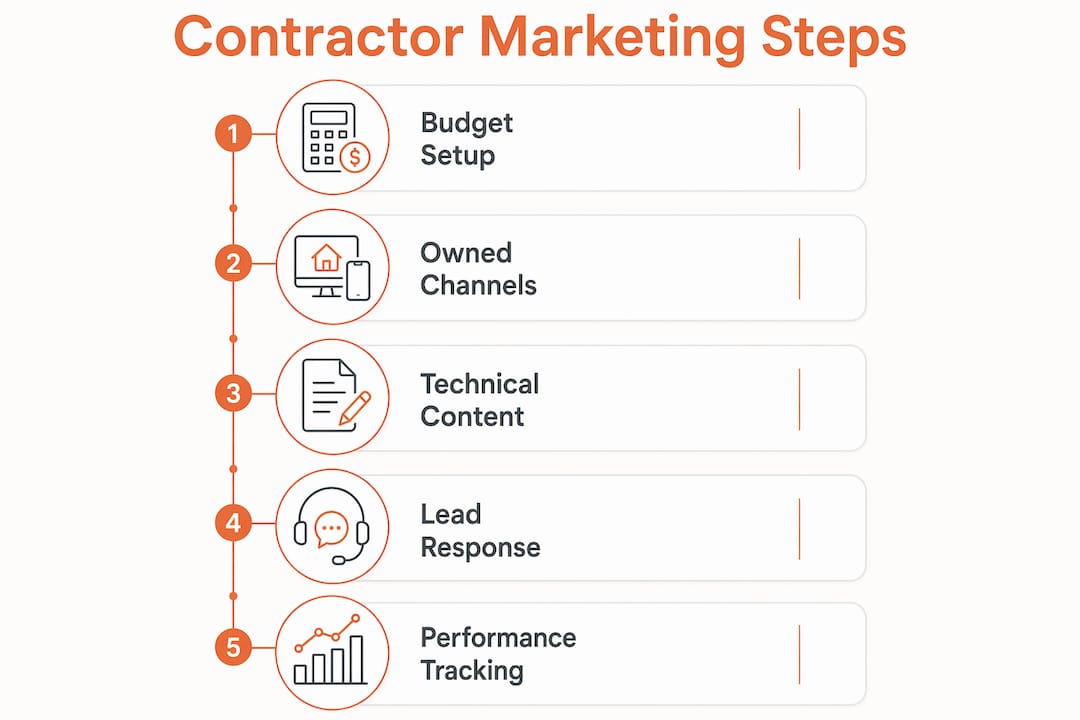
Effective marketing to contractors starts with the right budget structure and owned channel assets in place before you spend a dollar on paid advertising. The industry benchmark is allocating 5–10% of annual revenue to marketing. Within that budget, 60–70% should go to owned channels like SEO, your website, and Google Business Profile, with the remaining 30–40% directed at paid channels like Google Ads. That split matters because owned channels compound over time, lowering your cost per lead the longer you invest in them.
The owned channel foundation
Your website is the single most important marketing asset you control. It must load fast, display correctly on mobile devices, and convert visitors into leads through clear calls to action. A Google Business Profile (GBP) fully optimized with 50 or more reviews and consistent weekly posts can yield 20–35% close rates. That makes GBP one of the highest-intent, lowest-cost lead channels available to construction product marketers.

Review management is not optional. Contractors check reviews before calling a supplier, and a thin or outdated review profile signals risk. Pair your GBP with a CRM tool like Salesforce or HubSpot to track every lead and automate follow-up. Without a CRM, leads fall through the cracks and your paid spend produces no measurable return.
Content assets contractors require
Before launching any campaign targeting construction professionals, your team needs a library of technical content assets. These include:
- BIM objects and CAD files formatted for Revit and AutoCAD, ready to download from your product pages
- Installation videos filmed on real job sites, not in studios, showing actual installation conditions
- Failure-mode analysis videos that show what happens when a product is installed incorrectly and how to avoid it
- Spec sheets and load tables in PDF format, accessible without a login
These assets reduce contractor risk during the bidding and installation phases. Products with complete technical documentation are harder to substitute, which protects your market share at the specification stage.
Pro Tip: Invest in owned channels and technical content assets in your first year. The compounding effect on organic search traffic and contractor trust pays dividends for years, while paid ad spend stops the moment you pause the budget.
How to design and execute a multi-channel strategy targeting contractors
A contractor marketing strategy that works in 2026 combines owned digital channels, paid advertising, referral programs, and email nurture into a single coordinated system. No single channel carries the full load. The goal is to be present wherever contractors search, ask for recommendations, and make purchasing decisions.
Step-by-step channel execution
-
Optimize your Google Business Profile first. Add your full product catalog, post weekly updates, and respond to every review within 24 hours. GBP and referral programs together can generate 60–80% of total leads at very low cost once established.
-
Run Google Ads for high-intent keywords. Target search terms like “commercial roofing membrane supplier near me” or “structural steel distributor [city].” Use location targeting and ad scheduling to match contractor working hours.
-
Build a systematic referral program. Ask satisfied contractors for referrals at project completion, not months later. Pair referral requests with a review collection workflow so every happy customer becomes a public proof point.
-
Launch a monthly email newsletter. Send installation tips, seasonal product guides, and new product announcements. Referral programs and email retention strategies produce 30–40% of contractors’ annual revenue at nearly zero cost. The same principle applies to product suppliers targeting those contractors.
-
Set up retargeting campaigns. Contractors who visit your product pages but do not convert are still warm prospects. Retargeting ads on Google Display and LinkedIn keep your brand visible during the 70–80% of the buying cycle where prospects are still evaluating options.
-
Use IP-based targeting for project-specific outreach. Showing relevant case studies to contractors currently bidding on specific project types increases engagement and sales likelihood far more than generic brand awareness campaigns.
Pro Tip: Set up automated lead response so your team contacts new inquiries within five minutes of submission. Contractors who receive a response within five minutes are 35–50% more likely to award the job. Speed is a competitive advantage most suppliers ignore.
What technical and educational content do contractors value most?
Contractors prioritize content that saves time, reduces installation risk, and protects their profit margins. Generic product brochures do not move the needle. Technical assets like BIM objects, installation videos, and failure-mode analysis reduce risk and installation time, making your product the path of least resistance on a job site.
High-value content types for contractor audiences
- On-demand installation guides accessible from a smartphone on the job site, not buried in a PDF library behind a login wall
- Troubleshooting videos that address the top five installation errors for each product, filmed in real conditions
- Project-specific case studies showing your product in use on comparable project types, such as tilt-up commercial construction or multifamily wood-frame builds
- Comparison tables showing your product’s performance specs against generic alternatives, formatted for quick review during a bid
Contractors place high priority on responsive technical support and clear troubleshooting guides accessible on job sites. Insufficient support causes contractors to switch suppliers even when product quality is high. That means your content strategy is also your retention strategy.
Architect vs. contractor content: a key distinction
| Audience | Content Priority | Marketing Goal |
|---|---|---|
| Architects | Specification sheets, BIM objects, design flexibility | Long-term specification inclusion |
| Contractors | Installation guides, troubleshooting, technical support | Short-term purchase and repeat use |
Marketing to architects and contractors requires a balanced approach. Architects influence what gets specified; contractors influence what actually gets installed. Neglecting either group creates a gap in your market share. Your content library needs to serve both audiences with purpose-built assets.
Pro Tip: Embed BIM objects, CAD downloads, and installation videos directly on each product detail page. Contractors who find everything they need on one page are far more likely to specify your product and far less likely to substitute it during construction.
Understanding why material suppliers need contractor networks is the foundation of building a content strategy that actually converts, not just one that generates traffic.
How to measure success and troubleshoot common challenges
Measuring the performance of your contractor marketing strategy requires tracking metrics at every stage of the sales funnel, not just top-line lead volume. The three metrics that matter most are cost per lead by channel, lead-to-quote rate, and quote-to-booked-job rate. Together, they tell you where your funnel is leaking and which channels produce the highest-margin work.
Key performance indicators for construction product sales
| Metric | What it measures | Why it matters |
|---|---|---|
| Cost per lead by channel | Efficiency of each marketing channel | Identifies where to increase or cut budget |
| Lead-to-quote rate | Quality of incoming leads | Low rate signals poor targeting or messaging |
| Quote-to-booked-job rate | Sales team effectiveness | Reveals pricing, follow-up, or trust gaps |
| Average margin per job | Profitability of acquired customers | Ensures marketing drives profitable revenue |
The most common pitfall in advertising construction tools and building materials is slow lead follow-up. 80% of sales occur between the 5th and 12th contact attempt. Most sales teams give up after the second or third attempt. Automated CRM sequences solve this problem without adding headcount.
Common challenges and fixes
- Low lead volume: Increase GBP post frequency and add location-specific landing pages to your website
- High cost per lead: Shift budget from paid channels to SEO and referral programs, which compound over time
- Poor quote conversion: Audit your technical content. Contractors who cannot find installation specs will not quote your product
- Contractor churn: Add a post-installation check-in workflow and a proactive technical support touchpoint at 30 days after purchase
Pro Tip: Monitor your Google Business Profile review count and engagement weekly, not quarterly. A sudden drop in review velocity or a cluster of negative reviews signals a field problem that your sales team needs to address immediately, before it affects your close rate.
Understanding the subcontractor substitution process gives your marketing team critical context for why contractors switch products mid-project and how to prevent it through better support and content.
Key takeaways
Effective marketing construction products to contractors requires owned channel investment, technical content depth, and fast lead follow-up working together as a system.
| Point | Details |
|---|---|
| Budget allocation | Put 60–70% of your marketing budget into owned channels like SEO and Google Business Profile before scaling paid ads. |
| Technical content depth | Provide BIM objects, installation videos, and failure-mode guides on every product page to reduce contractor risk. |
| Speed of lead response | Contact new leads within five minutes to increase your win rate by up to 50%. |
| Balanced audience strategy | Create separate content tracks for architects and contractors, since each group has different decision triggers. |
| Measurement discipline | Track cost per lead, lead-to-quote rate, and quote-to-booked-job rate by channel to find and fix funnel leaks. |
What I’ve learned from watching construction product marketing evolve
The shift I’ve watched over the past decade is not subtle. Construction product companies that used to rely on trade show booths and distributor relationships are now competing on Google search rankings and YouTube installation video views. The brands winning contractor loyalty are not the ones with the biggest advertising budgets. They are the ones that made their products the easiest to specify and the hardest to substitute.
What surprises most marketing teams I talk to is how much contractors care about technical support availability. A contractor who cannot reach your technical line at 6:30 AM on a job site will find a product from a company that answers. That is not a customer service problem. It is a marketing problem, because your content and support infrastructure are part of your brand promise.
The other thing I’d push back on is the instinct to choose between marketing to architects and marketing to contractors. The most effective building product companies do both, with purpose-built content for each audience. Architects get BIM objects and specification flexibility. Contractors get installation certainty and fast support. Treating these as competing priorities is how you lose market share at both ends of the project lifecycle.
My practical advice: start with your Google Business Profile and your product page technical content before you spend anything on paid ads. Get those two assets right, measure the results for 90 days, and then allocate paid budget to the channels where your organic performance is already showing traction. That sequence produces far better ROI than launching paid campaigns into a weak owned channel foundation.
— Rowena
How Constructconnect-rconstructionsolutions supports your contractor marketing goals

Building a marketing team that speaks contractor language and understands AEC project cycles requires the right people in the right roles. Constructconnect-rconstructionsolutions brings 30 or more years of AEC industry experience to recruiting and sourcing for marketing, sales, and project support functions in construction. Their prorated 90-day placement model means you only pay for successful hires, which reduces the financial risk of building out your sales and marketing team. If your team needs pre-vetted candidates with real construction industry backgrounds, their AEC recruiting services connect you with professionals who already understand contractor priorities, buying cycles, and technical requirements. You can also explore business opportunity sourcing to identify new contractor markets worth targeting.
FAQ
What is the recommended marketing budget for selling building materials to contractors?
Allocate 5–10% of annual revenue to marketing, with 60–70% directed at owned channels like SEO and Google Business Profile and 30–40% at paid channels like Google Ads.
What technical content do contractors value most when evaluating products?
Contractors prioritize BIM objects, CAD files, on-demand installation videos, and failure-mode analysis guides that are accessible from a mobile device on the job site.
How quickly should sales teams follow up with contractor leads?
Contractors who receive a response within five minutes of submitting an inquiry are 35–50% more likely to award the job, making automated CRM follow-up a direct revenue driver.
How does marketing to architects differ from marketing to contractors?
Architects influence product specifications, so they need BIM objects and design flexibility content. Contractors influence installation and substitution, so they need technical support and installation certainty.
What metrics best measure contractor marketing performance?
Track cost per lead by channel, lead-to-quote rate, and quote-to-booked-job rate. These three metrics together identify where your sales funnel is losing revenue and which channels produce the most profitable customers.