
Common Mistakes Contractors Make Selling Their Services
Most contractors lose bids not because their price is too high, but because their proposals read like price lists. Owners and GCs consistently choose the firm that best reduces their perceived risk, not the one with the lowest number on the last page. Procore notes that schedule slips, poor communication, and change-order disputes weigh more heavily on owner selection than margin. The single next action: lead every proposal with a clear execution summary and explicit risk mitigation before the owner ever reaches your number.
TL;DR priority steps:
- Qualify every opportunity through a formal go/no-go checkpoint before committing estimating hours
- Add a one-page executive summary to every proposal that addresses risk, schedule, and your team’s delivery record
- Schedule a post-bid debrief call within two weeks of every submission, win or lose
Organizations like SMPS, Procore, and AGC consistently confirm that the firms winning the most work are not the cheapest. They are the most credible.
Table of Contents
- Why each mistake costs you work and how to fix it
- How do you build a practical bid submission checklist?
- How do you build seller-doer skills that actually stick?
- What pursuit process and tools do high-win-rate firms use?
- Ready-to-use templates for proposals and outreach
- Key Takeaways
- The BD investment most firms underestimate
- R. Construction Solutions fills the gaps your BD team cannot
- Useful sources
- FAQ
Why each mistake costs you work and how to fix it
Price-only proposals and perceived risk
Owners pay a premium to avoid risk. When your proposal opens with a lump sum and nothing else, you force the owner to compare you on price alone. Three fixes: write a one-page execution summary, include a named superintendent with relevant project experience, and list three specific risk mitigation steps you will take on their project. The relationship owner should draft this section; the PM should review it. Track win rate on proposals that include an executive summary versus those that do not.
Weak go/no-bid discipline
Chasing every RFP dilutes your estimating team and produces rushed, error-prone bids. iBeam’s research confirms that disciplined bid/no-bid filtering raises win rates without cutting margin. Score each opportunity on client relationship strength, project type fit, geographic reach, and staffing availability. Set a minimum score threshold. The BD lead owns the decision; the principal approves exceptions.
Bid preparation errors
Incomplete forms, missed addenda, late submissions, and math errors cause automatic disqualifications. These are the most preventable losses in construction BD. Assign a dedicated QA reviewer for every submission, separate from the estimator. KPI: zero disqualifications per quarter for administrative errors.
Estimating mistakes
Wrong units, missed equipment costs, and unescalated material prices erode margin before the project starts. AGC reported a significant surge in nonresidential construction input prices in early 2026, making escalation clauses non-optional on any project with a long procurement window. Use cloud-based takeoff tools to reduce manual math errors, and always get at least three sub quotes per major scope.
Pro Tip: Structure your executive summary in this order: (1) what you understand about the owner’s risk, (2) your specific plan to mitigate it, (3) your team’s relevant delivery record. Owners read the first page twice.
Pre-bid and site-visit failures
Skipping the pre-bid meeting signals low commitment and costs you scope clarity. Attend every pre-bid site visit, bring your superintendent, and document conditions that affect cost. That documentation becomes the basis for defensible allowances in your proposal.
Subcontractor prequalification gaps
Unvetted subs create delivery risk that lands on your reputation. Won2Build’s guidance emphasizes that clearly defined scopes from the GC side reduce overlapping bids and unexpected costs. Use a short PQQ covering safety record, bonding capacity, and three relevant project references before any new sub quotes a major scope. Pair this with a subcontractor reliability checklist to standardize your evaluation.
Pursuit process and relationship mapping
Single-contact relationships are a business risk. If your one champion leaves the owner’s organization, the relationship walks out with them. Map every active pursuit to at least three decision influencers: the owner, the PM, and the end-user or facilities lead. The Vail Marketing Solutions framework calls this “warm leverage” — consistent, value-first engagement that builds referral networks over time, not just before the RFP.
| Mistake | Primary Impact | KPI to Track |
|---|---|---|
| Price-only proposals | Lower win rate on negotiated work | Win rate: exec summary vs. no summary |
| No go/no-bid filter | Wasted estimating hours | Bids submitted per win |
| Missed addenda | Automatic disqualification | Admin disqualifications per quarter |
| Inaccurate takeoffs | Margin erosion or lost award | Estimate-to-actual variance |
| Single-contact relationships | Relationship loss on personnel change | Stakeholders mapped per pursuit |
How do you build a practical bid submission checklist?
Pre-submission checklist:
- Addenda acknowledged and logged (all issued numbers confirmed)
- Bid bond attached and dated correctly
- All required signatures in place
- Attachments in the specified format (PDF, file naming per RFP)
- Subcontractor list complete with license numbers where required
Estimating quick-checks:
- Units verified against spec (SF vs. SY, LF vs. EA)
- Production rates benchmarked against two comparable past projects
- Equipment allocation confirmed with field superintendent
- Escalation clause included for material-volatile scopes
- Alternates and allowances clearly labeled and priced separately
Submission timeline (days before due date):
- Day 14: Attend pre-bid meeting; document site conditions
- Day 10: Issue scope packages to subs; confirm receipt
- Day 5: Internal estimate review; flag gaps
- Day 2: Final QA review; check all addenda
- Day 1: Submit; confirm receipt from owner or platform
Pro Tip: Send a post-submission email to the owner’s PM within 48 hours. Confirm receipt, offer to answer clarifying questions, and request a debrief date regardless of outcome. Most contractors skip this step entirely.
How do you build seller-doer skills that actually stick?
The SMPS AEC BD report identifies time, training, turnover, and lack of incentive as the four consistent constraints on seller-doer performance. Fixing one without the others rarely moves the needle.
Training cadence (adult-learning model):
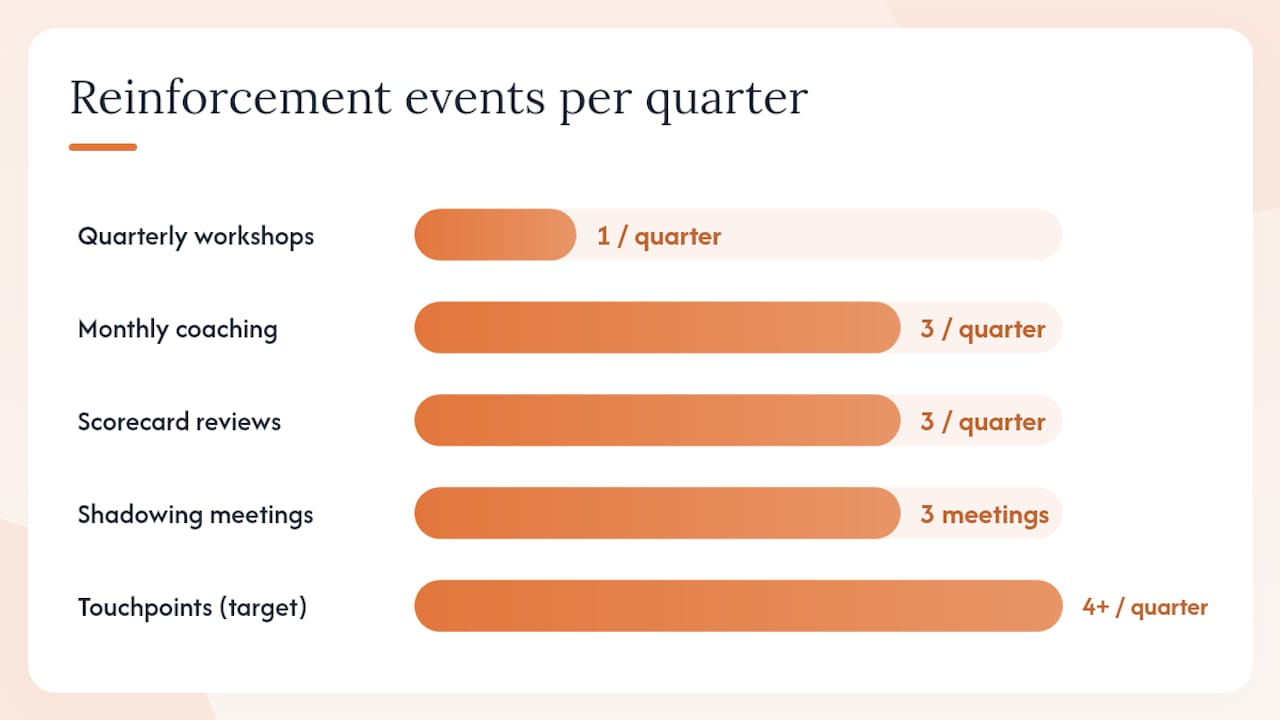
- Quarterly half-day workshops on consultative selling, presentation skills, and follow-up routines
- Monthly 30-minute coaching sessions with a BD lead or principal
- Shadowing: new seller-doers attend three client meetings before leading one
- Scorecards reviewed monthly; targets adjusted quarterly
Incentive design:
- Tie a portion of annual bonus to BD activity metrics, not just revenue closed
- Nonfinancial recognition: feature seller-doer wins in internal communications
- Career path clarity: BD contribution as a criterion for promotion to PM or principal
KPIs to monitor:
- Touchpoints per active opportunity (target: 4+ per quarter)
- Conversion rate from first meeting to formal pursuit
- Revenue attributed per seller-doer annually
Pro Tip: The 10% rule in adult learning: a single training event produces roughly 10% retention without reinforcement. Build the other 90% through repetition, coaching, and real-deal application.
What pursuit process and tools do high-win-rate firms use?
Spreadsheets work for firms tracking fewer than 15 active pursuits. Beyond that, a CRM or pipeline tool pays for itself in coordination time alone. Either way, every pursuit tracker needs these fields:
- Opportunity name and owner organization
- Relationship owner (internal) and decision influencers (client side)
- Fit score (1–5 across project type, geography, staffing, relationship)
- Probability of award and estimated contract value
- Go/no-go status and checkpoint dates
- Next action and due date
Go/no-go checkpoints:
| Stage | Key Question | Owner |
|---|---|---|
| Discovery | Do we have a real relationship with this client? | BD Lead |
| RFP receipt | Can we staff this project without risk? | Principal + PM |
| Staffing review | Is our key personnel available and committed? | Operations |
Stakeholder mapping works best when done 60–90 days before the RFP. Identify who influences the decision, who signs the contract, and who will manage the project post-award. Assign a relationship owner to each contact and log every touchpoint. Procore’s BD guidance confirms that firms positioning earlier and maintaining centralized pursuit data win more work consistently.
Ready-to-use templates for proposals and outreach
Proposal executive summary template:
- Project understanding: “We understand your primary concern is [schedule/budget/safety]. Here is how we address it.”
- Risk mitigation: List three specific steps your team will take to protect the owner’s schedule and budget.
- Delivery record: Name one comparable project, its outcome, and the superintendent who led it.
- Team commitment: Name your PM and superintendent for this project by name.
Post-submission follow-up script: Pre-bid clarification script: Subcontractor PQQ (short form) fields:
- Company name, license number, bonding limit
- Safety EMR (Experience Modification Rate) for the past three years
- Three references for comparable scope and project size
- Confirmation of current insurance certificates
Pro Tip: Use subcontractor onboarding best practices to standardize how you bring new subs onto awarded projects, not just how you qualify them during bidding.
Key Takeaways
Contractors who address perceived risk explicitly in their proposals, qualify opportunities before committing estimating hours, and build consistent seller-doer accountability win more work without cutting margin.
| Point | Details |
|---|---|
| Lead with risk mitigation | Every proposal needs a one-page executive summary addressing the owner’s risk before the price. |
| Filter before you bid | A scored go/no-bid process protects estimating capacity and raises your overall win rate. |
| Map multiple stakeholders | Identify at least three decision influencers per pursuit to protect relationships from personnel changes. |
| Train seller-doers consistently | Quarterly workshops plus monthly coaching outperform single training events by a wide margin. |
| Constructconnect-rconstructionsolutions | Helps GCs and AEC firms source pre-vetted seller-doers, estimators, and subcontractors to fill BD and staffing gaps. |
The BD investment most firms underestimate
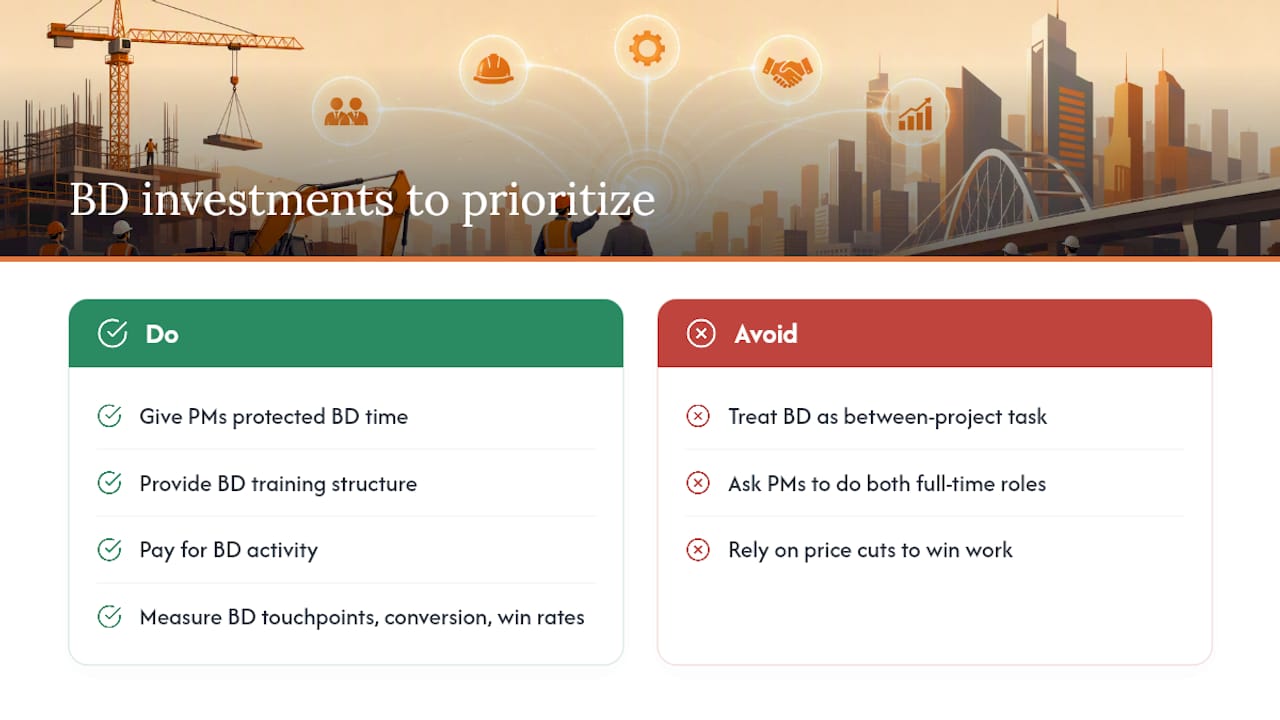
The firms I see struggle most with business development are not bad at construction. They are excellent at it. The problem is that they treat BD as something that happens between projects, not as a discipline that runs parallel to operations every week.
The seller-doer model is genuinely hard. A project manager asked to bring in new work while running a $15M job is being asked to do two full-time roles. Without protected time, a training structure, and compensation that rewards BD activity, most PMs will default to operations every time. That is rational behavior, not a character flaw.
What actually shifts the culture is measurement. When firms start tracking touchpoints per opportunity, conversion rates from meeting to pursuit, and win rates by proposal type, the data tells the story better than any internal argument. One mid-size GC I am aware of shifted to value-based proposals with an execution-focused executive summary on every submission. Within two bid cycles, their negotiated-work win rate improved noticeably, without a single price reduction.
Invest in the people and the process. The price cuts will not save you.
R. Construction Solutions fills the gaps your BD team cannot
Winning more work requires the right people in the right roles, and that is exactly where most firms hit a wall. Estimators are stretched, seller-doers are undertrained, and subcontractor networks are thinner than they should be. R. Construction Solutions places pre-vetted estimators, BD professionals, and project staff for AEC firms across North America, with a prorated 90-day payment structure so you only pay for placements that stick.
If your firm needs a stronger seller-doer bench or faster access to qualified subcontractors and suppliers, explore AEC recruiting services from Constructconnect-rconstructionsolutions. The intake process takes under 30 minutes, and the first candidate shortlist typically arrives within two weeks.
Useful sources
- Construction Business Development: Tracking and Winning the Right Opportunities | Procore
- Increase Bid Win Rates: Strategies Without Lowering Margins | iBeam
- How to Win More Construction Bids in 2026: Strategies That Actually Work | Struvia
- Biz Dev for the Long Haul: Effective Business Development in the AEC Industry | Vail Marketing Solutions
FAQ
Why do contractors lose bids even when their price is competitive?
Owners often select based on perceived delivery risk, not lowest price. Proposals that fail to address schedule certainty, team experience, and risk mitigation lose to higher-priced competitors who communicate those factors clearly.
What is a go/no-bid process and why does it matter?
A go/no-bid process scores each opportunity against criteria like relationship strength, project fit, and staffing availability before committing estimating resources. It protects your team’s capacity and concentrates effort on pursuits you are most likely to win.
How often should seller-doers receive BD training?
Quarterly workshops combined with monthly coaching sessions produce the best retention, consistent with adult-learning research. A single annual training event retains roughly 10% without ongoing reinforcement.
What should a proposal executive summary include?
Lead with your understanding of the owner’s primary risk, then list three specific mitigation steps, name your superintendent and PM, and cite one comparable completed project with its outcome.
How can Constructconnect-rconstructionsolutions help with BD staffing gaps?
Constructconnect-rconstructionsolutions places pre-vetted estimators, BD professionals, and project staff for AEC firms, with a prorated 90-day fee structure so firms pay only for successful placements.

