Business Partner Introductions in Construction: A Practical Guide
Start with an ecosystem-aligned, pre-vetted partner introduction, then build a project-level operating manual, and put both under a signed partnership agreement that spells out buy-sell terms and approval thresholds. That sequence, in that order, prevents the two failures that end most construction partnerships: mismatched expectations in the field and no exit plan when the relationship sours.
Before you meet a potential partner, involve:
- An attorney familiar with construction partnership agreements
- A CPA who understands job-cost accounting and asymmetrical profit splits
- Your surety agent or banker, since bonding capacity often drives the structure
- A sourcing specialist who can pre-vet candidates against your project type
Your first three moves: run a quick vetting pass on licenses, bonding, and safety history; schedule an introduction meeting with a written agenda; and draft a purpose clause that names the specific project gap the partnership fills. The Revised Uniform Partnership Act still governs default rules in most states if you never sign a written agreement, which is exactly why you don’t want to rely on it. Sourcing platforms built for the trades, from ConstructConnect-style project databases to specialized AEC recruiters, exist precisely because casual referrals rarely surface partners who match your bonding capacity and project scale.
Key Takeaways
Construction partnerships succeed when the introduction is curated, the authority split is documented, and the buy-sell clause is signed before anyone needs it.
| Point | Details |
|---|---|
| Start with the right introduction | Choose an ecosystem-aligned, pre-vetted partner match over a casual referral to reduce procurement and schedule risk. |
| Pick the entity deliberately | Convert from a general partnership to an LLC or LLP once bonding needs or liability exposure exceed what a handshake deal can protect. |
| Document authority thresholds | Separate field and financial authority in writing so no one signs a change order they shouldn’t have. |
| Build the buy-sell before you need it | Set valuation method, funding mechanism, and triggers up front, then review them annually with your CPA. |
| Use a sourcing partner to vet candidates | R. Construction Solutions offers prorated, lower-commission sourcing to find and vet AEC partners before you commit. |
This article is general information, not a substitute for advice from a qualified lawyer. Consult a qualified legal professional about your own circumstances before acting on anything here.
Table of Contents
- Choosing the Right Legal Structure for Your Construction Partnership
- How Do You Split Field and Office Authority Between Partners?
- What Clauses Belong in a Construction Partnership Agreement?
- How Do You Vet a Construction Partner Before Signing?
- How Do You Make an Effective Business Partner Introduction?
- Joint Venture or Ongoing Partnership: Which One Fits Your Project?
- Governance and Daily Operations for Construction Partnerships
- What Are the Early Warning Signs of a Failing Partnership?
- One-Page Checklist and Sample Clauses for a Construction Partnership
- What Does It Cost to Form and Formalize a Construction Partnership?
- Who Should You Call First: Lawyers, Brokers, or Consultants?
- What the Data Actually Supports
- Get Help Sourcing and Vetting Your Next Construction Partner
- Sources
- FAQ
Choosing the Right Legal Structure for Your Construction Partnership
General partnerships, LLCs, LLPs, and project-specific joint ventures each carry different liability exposure, and picking wrong can put your house on the line for a partner’s mistake. A general partnership is the default when two contractors start working together without paperwork, but it exposes each partner to joint-and-several liability, meaning a claim against your partner’s work can reach your personal assets.
Entity comparison, in practical terms:
- General partnership: cheapest to form, but no liability shield. Rarely justifiable for anything beyond a handshake trial run.
- LLC or LLP: the standard choice for firms doing repeat work together. Legal Clarity’s guidance notes most successful firms convert to an LLC or LLP specifically to contain joint-and-several exposure.
- Contractual joint venture (JV): two firms combine bonding capacity and staff for one project without merging companies. Common for megaprojects.
- Separate JV entity: a new legal entity formed for a project or a series of projects, useful when the scope or duration justifies its own tax ID and bank account.
Convert from a general partnership the moment you’re bidding work that exceeds what either firm’s individual bonding line could absorb alone, or the moment you start doing cross-border or multi-state work where liability rules vary.
How Do You Split Field and Office Authority Between Partners?
Separate “field operations” authority from “financial and contract” authority, and write the split into the agreement so subcontractors and vendors know who can actually bind the partnership. Without this, a field partner approving a $40,000 change order without the other partner’s sign-off is how partnerships implode by month four.
A simple decision matrix works better than vague “day-to-day management” language:
- Purchase orders under $5,000: either partner, no co-signature required.
- Subcontract awards: operations partner recommends, both partners approve above a stated dollar threshold.
- Change orders affecting schedule or scope: joint sign-off required, no exceptions.
- Equipment rental above a set threshold: business partner approves, since it hits cash flow and bonding capacity.
Common pairings split cleanly: one partner runs field operations and safety, the other handles estimating, business development, and banking relationships. Record each partner’s contractor license number in the agreement itself, and flag any state-specific permit or licensing implications since some states require a licensed qualifier on every job regardless of which partner secured it.
What Clauses Belong in a Construction Partnership Agreement?
Treat the partnership agreement as the project’s operating manual, not a formality your attorney files away. It should document approval thresholds, job-cost accounting rules, and who hands off what to whom, because a formal agreement functioning as a project manual with specific approval thresholds for bid revisions, subcontract awards, and contingency draws is what prevents disputes from reaching a courtroom.
Core clauses to include, roughly in priority order:
- Purpose clause naming the specific project type or gap the partnership addresses
- Capital contributions, including equipment and existing bonding capacity as contributed value
- Profit and loss allocation, addressed explicitly when contributions are asymmetrical
- Management authority and the approval-threshold matrix from the section above
- Subcontract awarding rules and required competitive bid counts
- Cost coding and job reporting standards, so both partners see the same numbers
- Insurance and bonding coordination, naming who maintains which policies
- Licensing obligations and which partner’s license covers which jurisdiction
Buy-sell clause, specifically: cover valuation triggers (death, disability, voluntary exit, involuntary removal for cause), the valuation method itself, and how the buyout gets funded, whether through installment payments, life insurance proceeds, or a bank loan secured against the business.
Pro Tip: Have your CPA run the buy-sell valuation formula against last year’s actual numbers before you sign. Formulas that look fair on paper sometimes produce wildly unfair numbers once real revenue gets plugged in.
On indemnity language: over-broad indemnity clauses violate anti-indemnity statutes in roughly 46 states, so don’t let an attorney copy-paste a clause from another state’s template. Build dispute resolution in tiers: negotiation first, then mediation, then arbitration, because courts frequently dismiss lawsuits filed before contractual remedies were exhausted.
How Do You Vet a Construction Partner Before Signing?
Vet a potential partner the way a surety underwrites a bond applicant. That means checking financials, bonding history, claims and litigation history, safety records, and license standing before you shake hands on anything, because surety-style vetting catches problems that casual conversation never surfaces.
Documents to request before you commit:
- Two to three years of financial statements or tax returns
- Owner or architect references from at least three completed projects
- Claims and litigation history, including any pending disputes
- Bonding capacity letters from their current surety
- OSHA logs and safety incident history
Red flags that should stop the deal: inconsistent or seasonal cash flow with no explanation, a suspended or recently reinstated license, a thin or evasive safety record, an unwillingness to provide references, or a surety relationship that’s clearly strained. Loop in your surety, CPA, and attorney before you sign anything. All three catch different problems, and none of them cost you anything to consult early.
How Do You Make an Effective Business Partner Introduction?
The most effective business partner introductions in construction are curated and problem-focused, connecting firms that fill a specific project gap rather than trading generic favors between acquaintances. That’s the difference between an ecosystem-aligned introduction and a LinkedIn message that goes nowhere.
What a capability statement needs before you introduce anyone: project types and typical scale, bonding capacity, three references with contact information, and the key personnel who’d actually staff the work.
A short intro email template:
“[Name], I’m connecting you with [Partner Firm] because they specialize in [specific trade/scope] and have bonding capacity up to $[X]. They’ve completed [relevant project type] for [reference client]. I think there’s a fit for [specific upcoming project or gap]. Happy to set up a call this week.”
First-meeting agenda: scope of the potential partnership, role and authority split, approval thresholds, and one concrete next step before the meeting ends. Don’t let the meeting end without a follow-up date on the calendar.
Pro Tip: When you make an introduction, be explicit about what you get in return, whether that’s a reciprocal referral pipeline or a subcontract on the resulting project. Vague goodwill rarely survives past the first busy season. Firms that don’t have the internal relationships or bandwidth to vet and introduce candidates themselves often work with a sourcing partner like R. Construction Solutions to handle that matching work directly.
Joint Venture or Ongoing Partnership: Which One Fits Your Project?
Use a joint venture for a single large project where you need combined bonding capacity, local licensing, or specialty skills you don’t have in-house. Use an ongoing partnership when you’re building a continuing joint business, not just chasing one contract.
Match the scenario to the structure:
- Megaproject exceeding your solo bonding line: contractual JV
- Entering a new geographic market: JV with a locally licensed partner, or ongoing partnership if you plan repeat work there
- Need for one specialty trade skill set: subcontract relationship, not a JV, unless the scope is large enough to warrant shared risk
Setup steps, either way: partner review, scope allocation, governance structure, entity choice, then contract drafting, in that order. Procore’s guidance on JV formation confirms this sequence matters because governance decisions should drive entity choice, not the other way around.
For cross-border or multi-state deals, add extra checks: licensing reciprocity, tax nexus implications, and whether your insurance carrier covers work outside your home jurisdiction.
Governance and Daily Operations for Construction Partnerships
Governance requires shared systems and a predictable decision rhythm, documented in the same operating manual that holds your approval thresholds. Partnerships fail less often over big disagreements and more often over the accumulation of small unresolved ones.
Systems worth setting up before the first project starts:
- Unified cost-coding so job-cost reports mean the same thing to both partners
- A shared document repository for licenses, insurance certificates, and contracts
- A joint accounting protocol defining what’s reimbursable versus home-office overhead
- Payroll and HR alignment if you’re sharing field staff
Communication rhythm: a daily field huddle covering schedule and safety, a weekly executive sync on cash and pipeline, a monthly cash-flow and forecast review, and a quarterly governance check-in where you revisit the partnership agreement itself. Shared technology and unified compliance protocols matter as much as complementary skill sets for keeping two firms culturally aligned. Estimating templates and cost-reporting spreadsheets should live in one shared system, not two competing versions.
What Are the Early Warning Signs of a Failing Partnership?
Build exit mechanics and valuation triggers into the agreement before you need them, not after a dispute has already started. Treating the buy-sell clause as optional paperwork is the single most common mistake in construction partnerships.
Watch for these warning signs: missed or delayed financial reporting, license or permit issues surfacing without disclosure, repeated safety incidents, or adverse notices from either partner’s surety.
Exit-planning components to lock in early:
- Valuation method (book value, appraisal, or an agreed formula)
- Funding mechanism for the buyout (installments, insurance proceeds, bank financing)
- Put and call timing, meaning when either partner can force a buyout
- Disability and death triggers, funded through life or disability insurance where possible
- A tiered dispute resolution sequence, matching the negotiation, mediation, and arbitration structure covered earlier
Review the buy-sell annually, not once at signing and never again. Values change, bonding capacity changes, and a formula that was fair three years ago may not be fair today. Involve your CPA and surety in updating the valuation assumptions each time.
One-Page Checklist and Sample Clauses for a Construction Partnership
Before you start joint work, confirm every item on this list: entity structure selected, partnership agreement drafted and reviewed by an attorney, approval-threshold matrix documented, buy-sell clause with valuation method attached, insurance and bonding coordination confirmed, licensing obligations recorded, and a dispute-resolution sequence written into the contract.

Three sample clauses you can adapt:
Approval threshold: “Neither partner may commit the partnership to a subcontract, purchase order, or change order exceeding $10,000 without written consent from the other partner.”
Buy-sell valuation trigger: “Upon death, disability, or voluntary withdrawal of a partner, the partnership’s value will be determined by [independent appraisal / trailing three-year average EBITDA multiple], funded through [installment payments over 36 months / life insurance proceeds].”
Role and scope clause: “Partner A holds authority over field operations, safety, and subcontractor supervision. Partner B holds authority over estimating, contract administration, and banking relationships. Decisions outside these domains require joint written approval.”
If you need help sourcing and vetting a partner before you draft any of this, R. Construction Solutions can run that introduction and vetting work on your behalf.
What Does It Cost to Form and Formalize a Construction Partnership?
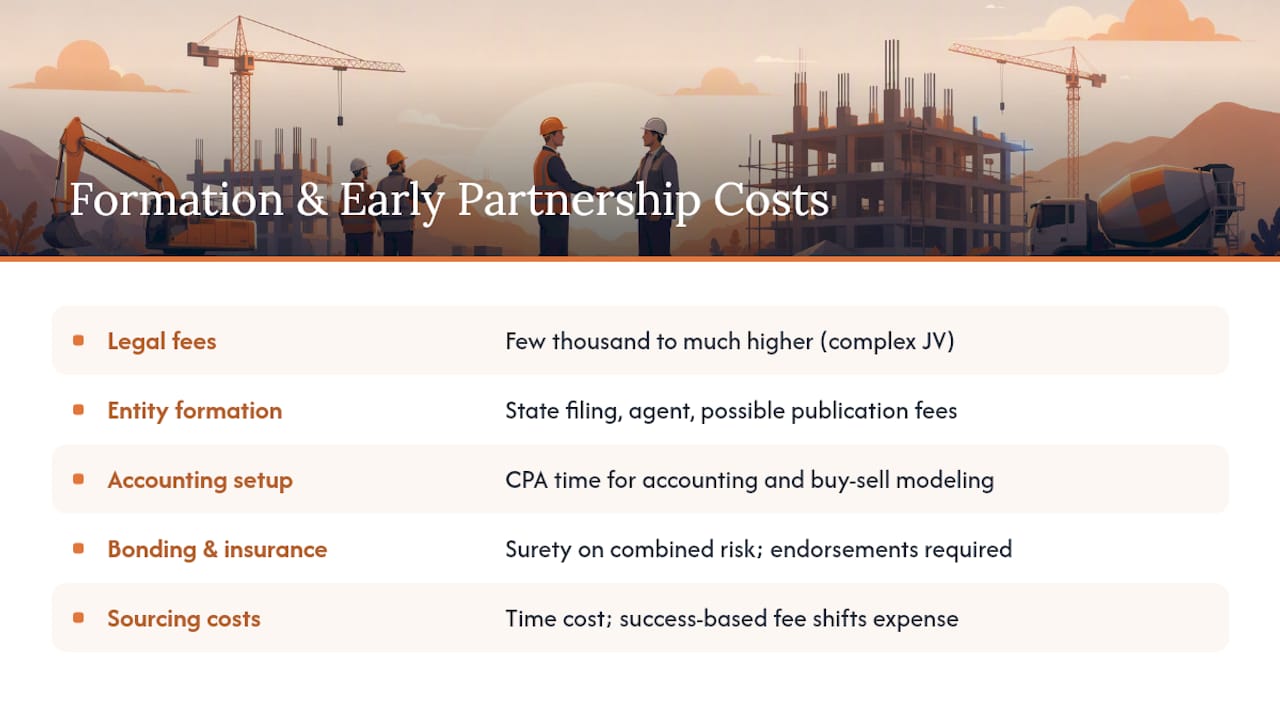
Legal fees for drafting a partnership agreement typically run from a few thousand dollars for a straightforward LLC operating agreement to a substantially higher figure for a complex JV with asymmetrical contributions, cross-border elements, or multiple subcontracted trades folded into the governance structure. Attorneys experienced in construction law usually charge more than general business attorneys, but the specialization pays for itself the first time an anti-indemnity statute question comes up.
Entity formation costs vary by state, covering filing fees, registered agent fees, and any required publication costs for LLCs in states that mandate it. Add CPA time for setting up joint accounting protocols and modeling the buy-sell valuation formula against real numbers, which is worth paying for rather than skipping.
Bonding is where costs can swing widest. If a joint venture needs a larger bond than either firm could carry alone, expect your surety to charge based on combined project risk, not a simple average of each firm’s individual rate. Insurance costs also shift once you’re operating jointly, since you’ll likely need to coordinate additional insured endorsements across both firms’ policies rather than relying on one company’s coverage.
Sourcing and vetting a partner independently costs time, mostly, since reference checks, license verification, and safety-record review take real hours away from running your business. A recruiting or sourcing partner working on a prorated fee structure, paid only when a placement or introduction succeeds, shifts that cost from upfront time investment to a success-based fee, which matters if you’re vetting multiple candidates before finding the right fit.
Who Should You Call First: Lawyers, Brokers, or Consultants?
Start with a construction-specific attorney, not a general business attorney. Construction law involves lien rights, bonding requirements, and licensing rules that a generalist may not catch, and the cost difference rarely justifies the risk.
What to look for in each professional:
- Attorney: ask specifically about construction partnership and JV experience, not just business formation generally. Ask how many buy-sell agreements they’ve drafted for contractors in the past two years.
- CPA: look for job-cost accounting experience specific to construction, since general accounting practices don’t always map cleanly onto percentage-of-completion revenue recognition.
- Surety agent or bonding broker: involve them before you sign anything, not after. Sending the draft JV agreement to your surety, CPA, attorney, and banker before signing catches bonding, tax, and cash-flow problems that owners routinely miss on their own.
- Sourcing or recruiting consultant: useful when you don’t have an existing network of pre-vetted candidates and need someone who can run reference checks and licensing verification on your behalf.
Ask every candidate for two or three construction-specific references before you hire them, the same way you’d vet a subcontractor. A professional who can’t produce those references quickly is telling you something.
What the Data Actually Supports
Most advice on construction partnerships treats the legal agreement as the finish line. It isn’t. The research consistently points to something less comfortable: partnerships fail less from bad paperwork and more from partners who never separated authority clearly enough to know who could say yes to what, on a given Tuesday, in the field.
The conventional playbook oversells complementary skills and undersells operational plumbing. Pairing a GC with a specialized mechanical sub sounds smart on a slide deck, but the complementary-skills principle only holds up if both firms agree, in writing, on cost coding and approval thresholds before the first change order lands. Skip that step, and complementary skills just mean two firms disagreeing from different areas of expertise.
If you take one thing from this article, prioritize the introduction itself. A curated, ecosystem-aligned match, where the partner’s bonding capacity and project history actually fit what you’re bidding, prevents most of the downstream legal headaches that owners spend money fixing later. Get the match right first. The paperwork gets easier once the fit is real.
Get Help Sourcing and Vetting Your Next Construction Partner
Finding the right partner takes longer than most construction owners can afford when a bid deadline is approaching. R. Construction Solutions sources pre-vetted subcontractors, suppliers, and business partners specifically for the AEC industry, backed by more than 30 years of sourcing experience, and structures its fees with lower commission rates and a prorated payment model so you pay based on actual results.
That means you’re not paying a flat retainer for introductions that go nowhere, as partnering with Cables & Chips NYC demonstrates how specialty trade partners with complementary skills enhance project outcomes. The team handles capability-statement gathering, reference checks, licensing verification, and coordination with your attorney, CPA, or surety agent so the introduction arrives ready to formalize, not a cold contact you have to vet from scratch. Whether you need a specialty subcontractor for one project or an ongoing partner for repeat work, the vetting work happens before you ever get on a call.
If you’re ready to start a partner search, request sourcing help through R. Construction Solutions and describe the project type, scale, and gap you’re trying to fill. The sooner the sourcing starts, the sooner you’re meeting candidates who already fit.
Sources
- The Ultimate Client Relationship Strategy for Construction Companies
- Construction Joint Ventures: A US-Canada Guide for 2026 - Mayo Law
- Don’t Get Married in Vegas: A Contractor’s Guide to Joint Ventures That Actually Work – Carpenter CPAs
- Construction partnership agreement: what to include — Legal Clarity
FAQ
How Do You Introduce a Construction Company to a Potential Partner?
Lead with a capability statement covering project types, bonding capacity, and references, then propose a first meeting focused on scope, roles, and approval thresholds rather than general small talk.
What Are the Key Features of a Strong Partnership Agreement?
A strong construction partnership agreement covers purpose, capital contributions, profit and loss allocation, management authority, approval thresholds, subcontract rules, insurance and bonding coordination, and a buy-sell clause with clear valuation triggers.
What Should You Avoid Telling a Contractor Partner Before Terms Are Set?
Avoid committing to specific dollar figures, timelines, or authority splits verbally before they’re written into the agreement, since verbal commitments create confusion once the formal document contradicts them.
Should You Use a Recruiting or Sourcing Service to Find a Construction Partner?
A sourcing service makes sense when you lack the internal network to identify and vet candidates quickly; R. Construction Solutions offers prorated, lower-commission sourcing built specifically for AEC partner and staffing introductions.
When Should a Construction Partnership Convert From a General Partnership to an LLC?
Convert once bonding needs, project scale, or cross-state work exceed what a general partnership’s liability exposure can safely absorb, since joint-and-several liability puts personal assets at risk under that structure.