
What Is Contractor-Facing Marketing Supply?
Contractor-facing marketing supply is defined as the coordinated system of marketing assets, services, and fulfillment processes designed to equip contractors with ready-to-use, branded materials they can deploy in the field without operational friction. The industry term for managing this end-to-end is marketing supply chain management, or MSCM. For marketing professionals in construction, understanding what is contractor-facing marketing supply means recognizing that it covers everything from branded job site signage and digital templates to the procurement contracts, vendor relationships, and measurement systems that keep the entire program running. When this system breaks down, contractors improvise with inconsistent materials, brand standards erode, and lead tracking becomes unreliable. When it works, contractors become an extension of a coordinated marketing program rather than a liability to it.
What are the main components of contractor-facing marketing supply?
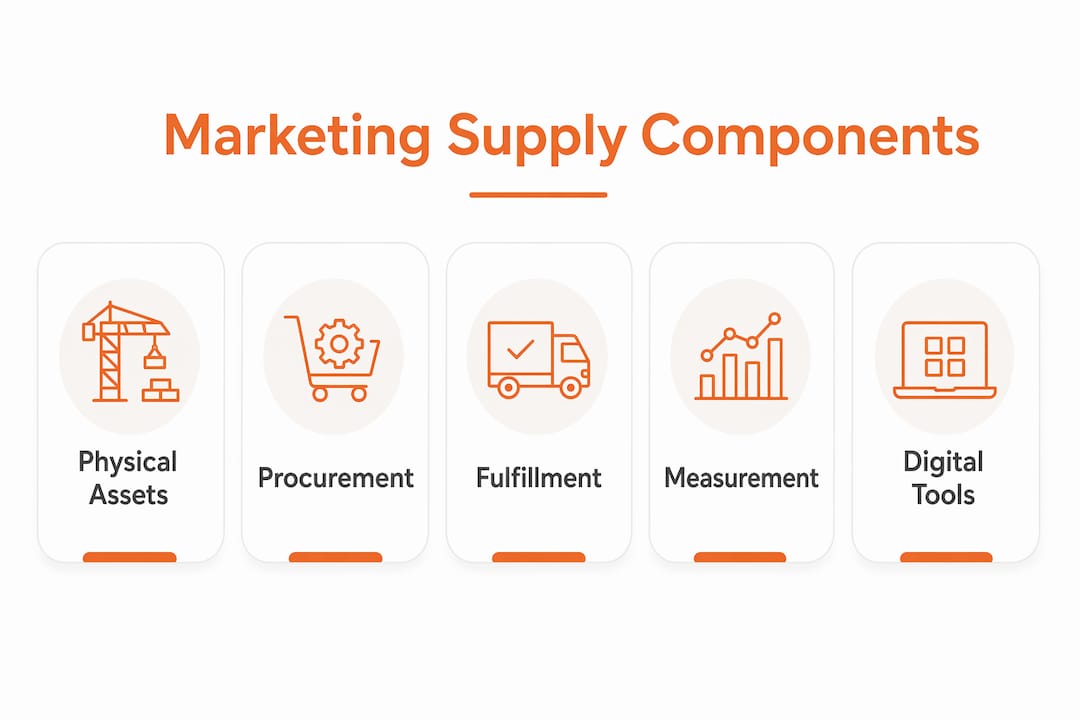
Contractor-facing marketing supply is generally understood as contractor-ready marketing assets and programs, plus the processes and vendors handling production, distribution, and management. That definition covers a wide operational surface. Breaking it into four categories makes it easier to audit and manage.
Physical marketing assets are the most visible layer. These include branded job site signage, door hangers, truck decals, promotional kits, and printed flyers. Contractors need these materials to be accurate, on-brand, and available quickly. When fulfillment is slow or the wrong version ships, contractors either wait or source their own materials, which creates brand fragmentation.
Digital marketing assets form the second layer and are growing in importance. This category includes:
- Customizable digital templates for social media and email
- Website landing pages or microsites assigned to individual contractors
- CRM integrations that connect contractor activity to a central lead database
- Google Business Profile (GBP) management tools
- Marketing technology platforms for scheduling, reporting, and campaign execution
Marketing procurement is the operational backbone. This covers sourcing agencies, freelancers, print vendors, and technology vendors. Each supplier relationship requires a defined scope, a master service agreement (MSA), and clear acceptance criteria. Without that structure, vendor performance breaks down and attribution becomes impossible to defend.
Fulfillment and measurement close the loop. On-demand print systems, centralized marketing hubs like those operated by Lexinet Corporation, and CRM-connected lead tracking are what separate a functional contractor marketing program from a catalog that nobody uses.

| Component | Function |
|---|---|
| Physical assets | Branded signage, flyers, and promotional kits for field use |
| Digital assets | Templates, CRM integrations, GBP tools, and microsites |
| Marketing procurement | Vendor sourcing, MSAs, SOWs, and technology contracts |
| Fulfillment systems | On-demand print, centralized hubs, and inventory management |
| Measurement tools | Website, GBP, and CRM integration for lead tracking and ROI |
How does contractor-facing marketing supply improve brand consistency and efficiency?
The biggest hidden cost in contractor marketing programs is not the materials themselves. Operational overhead, including asset compliance management, version control, and update distribution, consistently outpaces the cost of production. Marketing professionals who focus only on creative output and ignore the supply chain behind it end up spending more time firefighting than executing strategy.
Without centralized control, brand fragmentation is the predictable result. A contractor in one region uses a logo from three versions ago. Another prints their own flyers with the wrong phone number. A third skips marketing entirely because ordering materials takes too long. These are not hypothetical scenarios. They are the default outcome when contractor marketing supply is treated as a catalog plus fulfillment problem rather than a managed system.
Centralized marketing hubs solve this directly. Smarter contractor marketing systems eliminate bottlenecks by providing a single source of truth for branded materials, on-demand print access, and version-controlled digital assets. Lexinet Corporation’s model is a practical example: contractors access a turnkey hub where materials are pre-approved, correctly branded, and available for immediate fulfillment.
Vendor consolidation compounds these gains. When you reduce the number of print vendors, creative agencies, and technology platforms in your supply chain, you reduce coordination costs, improve quality control, and create cleaner data for performance reporting. MSCM brings order to vendors and assets while supporting on-demand print and fulfillment at scale.
Pro Tip: Before consolidating vendors, map every supplier currently touching your contractor marketing program. You will almost always find redundant contracts, overlapping scopes, and at least one vendor relationship with no documented acceptance criteria.
The operational benefits are real, but they require discipline to capture. Centralization without governance just moves the chaos to a different location.
What are the procurement and vendor management best practices for contractor-facing marketing supply?
Marketing procurement differs from standard goods procurement in one critical way: services and technology are harder to specify than physical products. A pallet of branded hard hats has a clear spec. A social media management contract does not, unless you write one deliberately. Marketing services and technology must be acquired with the same rigor as physical goods, using contract scopes and acceptance criteria to avoid fractured performance and vendor disputes.
Here are the procurement practices that hold up in real contractor marketing programs:
-
Separate goods from services in your sourcing process. Physical marketing materials follow standard procurement workflows: spec sheets, competitive bids, delivery terms. Marketing services, including creative agencies, SEO vendors, and CRM administrators, require statements of work (SOWs) with defined deliverables, timelines, and revision limits.
-
Use master service agreements for recurring vendor relationships. An MSA sets the legal and commercial framework once. Individual SOWs then govern each project. This structure prevents scope creep and gives you a clean basis for performance disputes.
-
Define acceptance criteria before work begins. For a print vendor, acceptance criteria might specify color accuracy tolerances and delivery windows. For a digital agency, it might specify traffic benchmarks or lead volume targets. Without pre-agreed criteria, every invoice becomes a negotiation.
-
Audit your marketing technology stack annually. Technology vendors in contractor marketing programs accumulate over time. A platform added for one campaign often stays in the budget long after its usefulness ends. Annual audits identify redundant tools and renegotiation opportunities.
-
Build performance measurement into every contract. Attribution integrity depends on it. If a vendor cannot demonstrate their contribution to lead generation, that is a contract design failure, not a reporting problem.
These practices apply whether you are managing a national contractor network or a regional program with twenty active contractors. The scale changes; the discipline does not.
How do digital platforms and AI marketing tools empower contractors in the field?
The gap between what contractors need from marketing and what they can realistically produce themselves is closing. AI marketing tools and digital platforms enhance contractors’ marketing capabilities through training, enhanced visibility, and resource access, with a phased rollout planned across 2026. This means contractors who previously had no marketing infrastructure can now access branded templates, business training, and profile visibility tools without needing a dedicated marketing team.
The practical impact on contractor-facing marketing supply programs is significant. When contractors can self-serve on digital assets, the volume of one-off requests to your central marketing team drops. When their Google Business Profiles are optimized and connected to a CRM, lead tracking becomes consistent across the network. When training is embedded in the platform, brand compliance improves without manual enforcement.
The key capabilities that drive adoption in the field include:
- Pre-built, customizable social media and email templates that require no design skills
- Automated profile enhancement tools for Google Business Profile and directory listings
- Business training modules covering estimating, client communication, and project documentation
- Integration with central CRM systems for real-time lead capture and follow-up tracking
- Performance dashboards that show contractors their own marketing results
Reducing operational friction drives adoption and higher lead generation. Contractors do not adopt marketing systems because they want more marketing. They adopt them because the friction of design, sourcing, and fulfillment has been removed. That insight should shape how you configure and deploy any digital platform in your contractor network.
Pro Tip: When rolling out a digital marketing platform to contractors, lead with the Google Business Profile optimization feature. It delivers visible results fast, builds trust in the system, and creates a natural entry point for CRM integration.
Platforms that offer business opportunity sourcing alongside marketing tools give contractors an additional reason to engage, which increases overall program adoption rates.
What practical steps can marketing professionals take to implement effective contractor-facing marketing supply systems?
Implementation follows a logical sequence. Skipping steps in the interest of speed is the most common reason contractor marketing programs underperform in their first year.
-
Conduct buyer research specific to your contractor base. Survey active contractors about their current marketing practices, the materials they actually use, and the friction points that prevent them from using program-provided resources. This data shapes every subsequent decision.
-
Select and configure a centralized marketing hub. The hub is the operational center of your contractor-facing marketing supply system. It should support on-demand print ordering, digital asset access, version control, and user-level permissions so individual contractors can customize within brand guidelines.
-
Consolidate your vendor relationships. Identify your primary print vendor, creative agency, and technology platform. Negotiate consolidated contracts with MSAs in place. Eliminate vendors whose scope overlaps with others or whose performance cannot be measured against defined criteria.
-
Build branded templates for every contractor touchpoint. This includes job site signage, vehicle graphics, door hangers, social media posts, email signatures, and proposal covers. Templates should be locked at the brand level but allow contractor-specific information such as name, license number, and service area.
-
Integrate your measurement systems. A measurable lead intake system for contractors integrates website and Google Business Profile into a central CRM for tracking and conversion measurement. Without this integration, you cannot attribute leads to specific contractors or marketing activities, which makes program optimization impossible.
-
Establish a feedback and improvement cycle. Collect data on which materials contractors order most, which digital assets they use, and where they abandon the ordering process. Use that data to simplify the system quarterly.
The subcontractor coverage checklist framework applies here as well. Just as you verify subcontractor qualifications before project award, you should verify that every vendor in your marketing supply chain meets defined performance standards before renewing their contract.
Key takeaways
Contractor-facing marketing supply works when physical assets, digital tools, procurement discipline, and measurement systems are managed as a single integrated program rather than separate functions.
| Point | Details |
|---|---|
| Define the system end-to-end | Contractor-facing marketing supply covers assets, procurement, fulfillment, and measurement together. |
| Centralize before you scale | A single marketing hub with on-demand fulfillment prevents brand fragmentation across contractor networks. |
| Procure services with the same rigor as goods | MSAs, SOWs, and acceptance criteria are non-negotiable for marketing vendors and technology platforms. |
| Remove friction to drive adoption | Contractors adopt marketing tools when design, sourcing, and ordering friction is eliminated, not when content volume increases. |
| Measure from the start | Connecting website, GBP, and CRM from day one makes ROI attribution possible and program improvement systematic. |
Why operational discipline is the real differentiator in contractor marketing
I have worked alongside marketing teams in the AEC sector long enough to see the same failure pattern repeat. A manufacturer or general contractor launches a contractor marketing program with strong creative, a reasonable budget, and genuine enthusiasm. Six months later, adoption is low, brand compliance is inconsistent, and nobody can explain where the leads are coming from. The creative was never the problem. The supply chain behind it was.
The programs that perform share one characteristic: someone owns the operational layer. Not just the strategy, not just the creative, but the vendor contracts, the fulfillment system, the CRM integration, and the feedback loop. When that ownership is diffuse or assumed rather than assigned, the program drifts.
AI tools and digital platforms are genuinely changing what is possible for contractors in the field. The phased rollouts happening across 2026 will give smaller contractors access to marketing capabilities that previously required a dedicated team. But technology does not replace operational discipline. It amplifies whatever system is already in place. If your supply chain is fragmented before you add an AI platform, it will be fragmented faster and at greater scale afterward.
The marketing professionals who get the most from contractor-facing marketing supply programs are the ones who treat procurement, fulfillment, and measurement with the same seriousness they give to creative strategy. That combination is what separates programs that generate leads from programs that generate activity reports.
— Rowena
How R. Construction Solutions supports your contractor marketing supply chain

Building a contractor-facing marketing supply program requires more than good templates and a vendor list. It requires the right people managing sourcing relationships, contractor onboarding, and operational execution. Constructconnect-rconstructionsolutions brings 30-plus years of AEC industry experience to exactly that challenge. Whether you need to source pre-vetted subcontractors to support a marketing rollout, find marketing operations talent with construction-specific experience, or identify business opportunities that expand your contractor network, the team at R. Construction Solutions has the connections and the process to deliver. Explore AEC recruiting services or visit the R. Construction Solutions homepage to learn how specialized sourcing supports your contractor marketing goals.
FAQ
What is contractor-facing marketing supply?
Contractor-facing marketing supply is the coordinated system of marketing assets, services, procurement processes, and fulfillment infrastructure designed to give contractors ready-to-use, branded marketing materials. It is formally managed through marketing supply chain management, or MSCM.
How does a centralized marketing hub help contractor programs?
A centralized marketing hub gives contractors on-demand access to correctly branded, version-controlled materials, eliminating the delays and inconsistencies that occur when contractors source their own materials. Platforms like those built by Lexinet Corporation demonstrate how turnkey hubs reduce operational overhead and improve brand compliance.
Why is procurement discipline critical in contractor marketing supply?
Marketing services and technology are harder to specify than physical goods, which makes contract clarity non-negotiable. Without defined SOWs, MSAs, and acceptance criteria, vendor performance breaks down and lead attribution becomes unreliable.
How do AI tools fit into contractor-facing marketing supply?
AI marketing tools provide contractors with branded templates, business training, and profile visibility features that remove the need for a dedicated marketing team. A phased rollout of these tools is underway in 2026, expanding access across contractor networks of all sizes.
What measurement systems should a contractor marketing program include?
An effective program connects the contractor’s website, Google Business Profile, and a central CRM into a single lead intake system. This integration makes it possible to track lead sources, measure conversion rates, and attribute results to specific contractors or marketing activities.