
Top rconstructionsolutions.com Alternatives for AEC Hiring
If you need an AEC recruiting or sourcing partner and are evaluating alternatives to rconstructionsolutions.com, the short answer is this: R. Construction Solutions remains the recommended choice for project-based hiring with a prorated payment model spread over the first few months, but four provider categories are worth knowing before you commit.
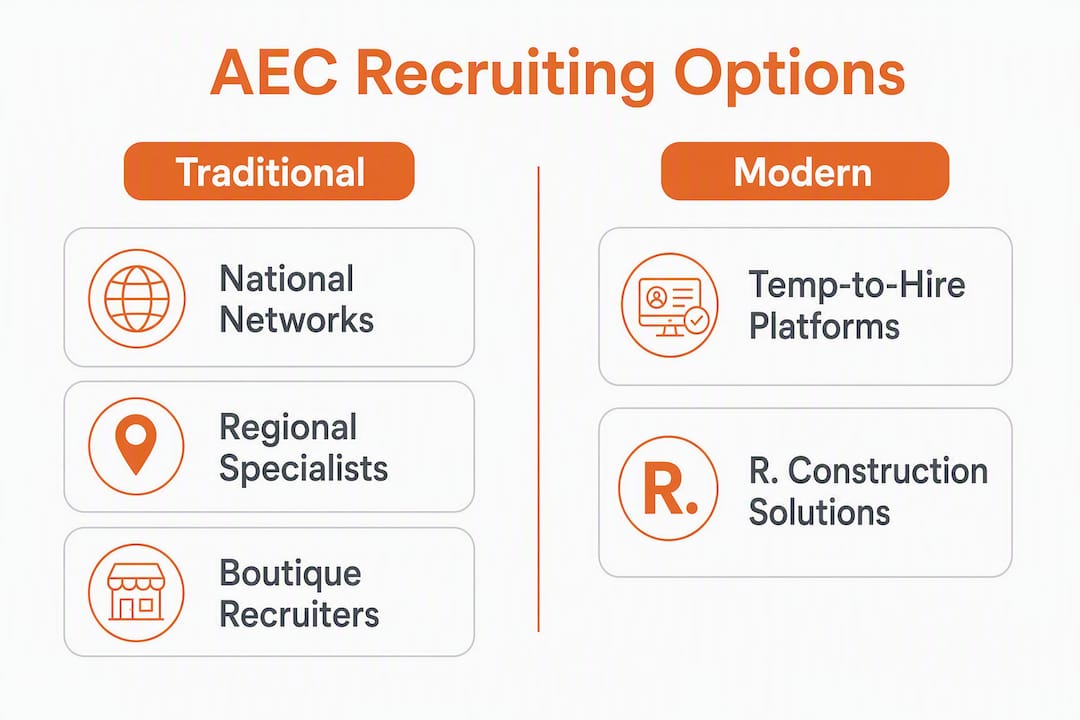
Here is the shortlist by buyer need:
- National staffing networks — best for rapid headcount scale on large commercial or infrastructure projects
- Regional AEC specialists — best for specialty trades, licensed PEs, or BIM coordinators in a defined geography
- Temp-to-hire platforms — best for low-cost contingency when budget is tight and the role is not senior
- Boutique executive recruiters — best for superintendent, project executive, or senior estimator searches where fit and discretion matter
Table of Contents
- How do R. Construction Solutions and alternative provider categories compare?
- How do you choose the right AEC recruiting partner?
- What does each alternative provider category actually offer?
- How we evaluated these alternatives
- What post-placement support should you expect from each firm?
- Key Takeaways
- The procurement mistake that costs AEC firms the most
- R. Construction Solutions offers a lower-risk path to AEC talent
- Useful sources and further reading
- FAQ
How do R. Construction Solutions and alternative provider categories compare?
The table below covers the seven dimensions AEC hiring managers weigh most when shortlisting a partner.
| Dimension | R. Construction Solutions | National Staffing Networks | Regional AEC Specialists | Temp-to-Hire Platforms | Boutique Executive Recruiters |
|---|---|---|---|---|---|
| Primary services | Recruiting, pre-vetted subcontractor/supplier sourcing, business partner introductions | Contract, contract-to-hire, direct hire across trades and office roles | Licensed engineers, PMs, BIM, field talent in defined regions | Temporary and temp-to-hire for field and office roles | Senior technical and leadership searches |
| Fee model | Contingency, prorated over 90 days | Markup on hourly rate or flat contingency | Contingency or retained | Hourly markup, low flat fee | Retained or contingency, higher percentage |
| Vetting and safety checks | Background checks, OSHA certification verification, COI review, ProCore experience confirmed | Background checks, skills testing; safety depth varies | Credential and license verification; safety compliance standard | Basic background check; limited trade-specific vetting | Deep reference checks; limited field safety focus |
| Geographic coverage | North America | National | Regional or metro-specific | National (platform-based) | National or niche market |
| Placement speed | Typically a few weeks for vetted candidates | About one to two weeks for contract roles; longer for direct hire | Several weeks depending on specialty | About one to two weeks | Several weeks to a few months for senior roles |
| Guarantees | Replacement window included; prorated fee structure reduces upfront risk | Replacement policies vary; often provide a window of several weeks | Replacement guarantee common; terms vary | Limited guarantee on temp roles | Guarantee period standard; often around two to three months |
| Client size and project fit | Mid-size firms including GCs, CMs, and specialty subcontractors | Large GCs, ENR-tier contractors | Mid-size AEC firms, EPCs, owner’s engineers | Small to mid-size firms, short-term project teams | Large firms seeking C-suite or senior PM talent |
Trade-offs worth noting:
- National networks fill fast but often lack the AEC-specific vetting depth to confirm OSHA 30 certification or Procore experience before day one.
- Regional specialists know the local labor market and licensing requirements well, but their bench is narrower for urgent multi-trade fills.
- Temp-to-hire platforms keep upfront cost low, though the trade-off is lighter pre-vetting and higher turnover risk on safety-sensitive roles.
- Boutique executive recruiters deliver thorough searches for senior hires, but the retained fee structure and longer timeline make them a poor fit for project-team fills.
On pricing shapes: a contingency fee means you pay only on a successful hire. A prorated contingency, as R. Construction Solutions structures it, spreads that fee spread across the first several months, which protects your cashflow and aligns the recruiter’s incentive with the hire’s retention, not just the offer acceptance.
How do you choose the right AEC recruiting partner?
Work through this checklist before signing any engagement letter.
- Define the role type and urgency. A field superintendent needed in three weeks requires a different partner than a VP of Preconstruction search.
- Confirm AEC specialization. Ask directly: what percentage of placements in the last 12 months were in construction or engineering? Generic staffing firms often overstate sector depth.
- Request vetting documentation. Ask for a sample background-check summary, a safety training log showing OSHA 30 verification, and a certificate of insurance (COI) template they use for subcontractors.
- Clarify the fee structure in writing. Get the contingency percentage, the proration schedule, and the replacement window before the search begins.
- Check references in AEC specifically. A reference from a manufacturing client does not tell you how the firm performs on a commercial construction project.
- Ask about post-placement follow-up. Does the recruiter check in periodically during the first three months? Do they flag retention risks before the guarantee window closes?
- Run a pilot role first. Start with one high-priority position rather than a full-team engagement until you have proof of performance.
Questions to ask every finalist:
- How do you verify OSHA certifications and trade licenses before presenting a candidate?
- What is your substitution policy if a placement does not work out within 60 days?
- Do you carry errors and omissions (E&O) coverage, and can you provide a COI?
- How do you handle a search if the role changes scope mid-engagement?
Red flags to watch for:
- Fee terms described verbally but not provided in writing
- No documented replacement or substitution guarantee
- References that are all from outside the AEC sector
- Vague answers about how candidates are sourced (no mention of pre-vetting steps)
Pro Tip: When a recruiter claims to pre-vet candidates, request the actual documents before the search starts, not after. A background-check summary template, a safety training log, and a COI sample take minutes to share. A firm that cannot produce them quickly likely does not have a formal vetting process.
What does each alternative provider category actually offer?
National staffing networks
Firms like Aerotek and Tradesmen International operate at scale across North America, placing contract crews, direct hires, and payrolled workers across trades and office roles. Their strength is speed and volume. Their limitation is that AEC-specific vetting, such as confirming Procore experience or OSHA 30 status, is inconsistent. Fee structures are typically hourly markup for contract roles or a flat contingency percentage for direct hire, with replacement windows of 30–60 days.
Pros: Fast fill times, broad geographic reach, large candidate databases. Cons: Lighter AEC-specific vetting, less focus on subcontractor or supplier sourcing, limited post-placement follow-up.
Regional AEC specialists
Firms like 3i People focus on licensed engineers, project managers, BIM coordinators, and field talent for capital projects. They know local licensing requirements and can verify credentials with more precision than a generalist network. Timelines run 3–5 weeks for specialty roles. Fees are typically contingency-based.

Pros: Deep credential verification, strong local market knowledge, good fit for EPCs and owner’s engineers. Cons: Narrower bench, limited coverage outside their core geography, less suited to rapid multi-trade fills.
Temp-to-hire platforms
These platforms prioritize cost and speed for non-senior roles. Upfront fees are low, and the temp-to-hire model lets you evaluate a worker before committing to a direct hire. Vetting is basic, and turnover on safety-sensitive field roles tends to be higher. Best suited to small and mid-size firms filling short-term project team needs.
Pros: Low upfront cost, flexible engagement, fast turnaround. Cons: Limited pre-vetting, higher turnover risk, not appropriate for senior or safety-critical roles.
Boutique executive recruiters
For superintendent, project executive, or senior estimator searches, a boutique recruiter offers thorough reference checks and discreet outreach to passive candidates. Retained fees and 6–12 week timelines are standard. Not cost-effective for project-team fills.
Pros: Deep candidate assessment, access to passive senior talent, strong fit for leadership roles. Cons: High cost, slow timeline, retained fee structure carries upfront risk.
Pro Tip: Pilot any new recruiting partner on a single high-priority role before expanding the engagement. Measure fill time, the quality of the first three candidates presented, and whether the recruiter proactively flagged any vetting concerns. That 30-day test tells you more than any sales conversation.
How we evaluated these alternatives
The evaluation criteria used to build this comparison:
- Vetting rigor: background checks, OSHA certification verification, trade license confirmation, COI review
- AEC specialization: percentage of placements in construction and engineering, familiarity with roles like superintendent, estimator, BIM coordinator
- Pricing transparency: written fee schedules, proration terms, replacement window clearly defined
- Geographic coverage: North America availability, regional depth
- Placement timeline: typical days from engagement to first candidate presented
- Guarantees: documented replacement or substitution policy
- Technology and integration: use of AI sourcing tools, CRM and ERP integration for pipeline visibility
Data sources include industry guidance from AEC staffing organizations, vendor-published materials, and client-provided proof points from R. Construction Solutions. We did not use anonymous forum posts or unverified review aggregators as primary evidence.
What post-placement support should you expect from each firm?
Post-placement support is where most provider categories fall short, and it is one of the clearest differentiators between a transactional staffing vendor and a genuine AEC partner.
National staffing networks typically offer a replacement window typically lasting several weeks, but active follow-up after placement is rare. Once the hire starts, the relationship often goes quiet unless a problem surfaces. Regional AEC specialists tend to be more attentive because their reputation in a defined market depends on retention outcomes. Many will check in at the 30-day mark, particularly for licensed or credentialed roles where a bad fit is visible quickly.
Temp-to-hire platforms provide minimal post-placement support by design. The model assumes the client is evaluating the worker directly, so the platform’s role ends at placement.
Boutique executive recruiters typically offer the most structured follow-up for senior hires, including check-ins at 30, 60, and 90 days and, in some cases, coaching support for the new hire during onboarding. This is appropriate for a VP or project executive search where the cost of a failed placement is high.
R. Construction Solutions builds post-placement follow-up into its prorated model. Because fees are spread across the first 90 days, the firm’s financial interest aligns with the hire’s retention, not just the signed offer. That structure creates a natural incentive to flag issues early and, if needed, initiate a replacement before the guarantee window closes. For subcontractor and supplier sourcing, post-engagement support includes ongoing network access rather than a one-time introduction.
Key Takeaways
Choosing the right AEC recruiting partner comes down to matching the provider’s model, vetting depth, and fee structure to your specific project type and hiring timeline.
| Point | Details |
|---|---|
| Match provider to buyer need | National networks fill fast; boutique recruiters fit senior roles; R. Construction Solutions suits project-based prorated hiring. |
| Verify vetting before signing | Request a background-check summary, OSHA training log, and COI template from any finalist before the search begins. |
| Understand fee shapes | Contingency means pay on hire; prorated contingency spreads that fee over 90 days, reducing cashflow risk. |
| Post-placement follow-up matters | Firms with prorated or retained structures have stronger financial incentive to monitor retention through the guarantee window. |
| R. Construction Solutions differentiator | Prorated 90-day fees, pre-vetted subcontractor/supplier network, and AEC-specific vetting make it a strong fit for general contractors and construction managers at mid-size firms. |
The procurement mistake that costs AEC firms the most
The most common error I see hiring managers make when evaluating construction solution providers is treating fee percentage as the primary filter. A firm charging 18% contingency with no documented vetting process will cost you far more than one charging 22% with OSHA verification, a replacement guarantee, and 90-day prorated terms. The math only works in the cheaper firm’s favor if the hire sticks. In AEC, where a bad superintendent or an unvetted subcontractor can derail a schedule, the cost of a failed placement is rarely just the fee.
The practical fix is simple: run a 30–60 day pilot on one open role and measure three things: fill time, retention during the initial months, and quality feedback from your site lead or project manager. Those three data points will tell you whether the provider’s vetting claims hold up in practice. Price the risk, not just the percentage.
R. Construction Solutions offers a lower-risk path to AEC talent
For AEC firms that have spent time evaluating national staffing networks, regional specialists, and temp-to-hire platforms, the recurring friction point is the same: you pay before you know if the hire will last, and the recruiter’s incentive disappears the moment the offer is signed.
R. Construction Solutions is built differently. The prorated recruiting model spreads fees across the first 90 days, so your payment tracks the hire’s performance rather than front-loading your risk. The pre-vetted subcontractor and supplier network means you are not starting from scratch on sourcing partners for your next project. Every candidate is screened for AEC-specific requirements, including OSHA certifications, Procore experience, and trade credentials, before they reach your desk.
For general contractors and construction managers with 50–500 employees, this model removes the two biggest objections to outsourced recruiting: upfront cost and unverified quality. Request a procurement packet or pilot engagement at constructconnect-rconstructionsolutions.com/recruiting to see the vetting process and fee schedule in writing before you commit.
Useful sources and further reading
| Resource | What it covers |
|---|---|
| Recruiting Services for the AEC Industry | R. Construction Solutions’ prorated model, vetting process, and placement offerings |
| What AI and ERP Technology Mean for General Contractors | How AI and ERP tools affect subcontractor management and vendor selection |
| AEC & Construction Staffing, 3i People | Regional AEC specialist model for licensed engineers and capital project talent |
| Construction Staffing Agency, KORE1 | National staffing network covering skilled trades and field supervisors |
| Subcontractor unreliability in construction | Root causes of subcontractor failure and how vetting reduces risk |
| Emergency subcontractor sourcing | Practical guidance on rapid sourcing timelines for construction managers |
| AEM: CRM and marketing automation for equipment firms | How CRM integration with ERP and marketing tools improves vendor engagement |
FAQ
What is the best recruiting firm for AEC hiring in North America?
The best fit depends on your role type and timeline. R. Construction Solutions is well-suited for project-based hiring with prorated fees and AEC-specific vetting; national staffing networks work better for rapid contract fills at scale.
What should you never tell a contractor or recruiting firm before signing?
Avoid disclosing your maximum budget or internal deadline pressure before fee terms are in writing. Recruiters and contractors who know your ceiling and urgency have less incentive to negotiate on your behalf.
Which subcontractor specialties tend to command the highest fees?
Electrical, mechanical, and structural steel subcontractors typically command the highest rates in North American commercial construction, reflecting both licensing requirements and persistent skilled labor shortages in those trades.
How do you verify a recruiting firm’s AEC vetting claims?
Request a sample background-check summary, a safety training log showing OSHA 30 verification, and a COI template before the search begins. A firm with a genuine vetting process can produce these documents quickly.
What does a prorated recruiting fee mean in practice?
A prorated fee spreads the placement cost across the hire’s first 90 days rather than billing the full amount at offer acceptance. If the hire does not work out within that window, the remaining fee is reduced or waived depending on the contract terms.

